




United Parcel Service subsidiary Happy Returns has reached 10,000 drop-off locations where shoppers can return e-commerce purchases, making the retail returns process more convenient while improving economics for one of the nation’s largest consolidated returns networks.
Happy Returns announced on Tuesday that it has added 1,700 locations at Annex Brands and PackageHub Business Centers to its network of stores that accept box-free and label-free returns. The company now has 10,000 return counters, including at UPS Stores (NYSE: UPS), Staples and Ulta Beauty outlets. The storefronts benefit from the foot traffic and transaction revenue.
According to the company, 79% of the U.S. population now lives within five miles of a so-called Return Bar, up from 76% previously. Additionally, more than a quarter of Americans now live within one mile of a convenient drop-off location.
“With these authorized shipping outlets, we’re filling in coverage gaps to reduce the driving time in many states, where people are more dependent on vehicles and cars” than in urban areas, said Chief Operating Officer Juan Hernandez Campos, in a phone interview.
“We think that the more convenient the location, the more somebody is going to be willing to make that return faster, too. If you’re agonizing about making that 30 minute drive in traffic, you might postpone. We are incentivizing the shopper to return that thing sooner,” which helps retailers resell it, he added.
An estimated 19.3% of online lines in the U.S. were returned in 2025, according to a report by the National Retail Federation and Happy Returns. Retailers report that online returns are 21% higher than overall return rates.
The majority of e-commerce returns in the United States involve a parcel carrier shipping label provided by the retailer and are shipped individually from collection points where customs drop items. The carrier delivers return packages, along with other inbound packages, to the retailer’s fulfillment center.
Individual parcel returns are more common with smaller merchants, but consolidation is becoming the dominant model — especially for large retailers, said Chris Sheridan, director of supply chain services at parcel shipping consultancy LJM.
“Returns today aren’t really one-size-fits-all anymore. Many large retailers are pushing returns through consolidation networks first and then moving them in bulk. It’s mostly about cutting costs, improving processing efficiency, and handling reverse logistics at scale,” said Sheridan, who spent 34 years at UPS.
Other returns consolidation platforms, such as Loop Returns and Narvar, are also building networks of drop-off points where returns are sorted and sent back to the retailer in pallets or reusable containers. FedEx last spring launched its own no-box, no-label consolidated returns service called Easy Returns. It has about 3,000 drop spots at FedEx Office and Kohl’s outlets.
Big retailers like Target, Walmart, and Kohl’s are also leaning into this approach, using stores or regional hubs to consolidate returns before sending them back in bulk, Sheridan said.
Amazon also offers boxless returns at in-person drop-off points.
How items move through Happy Returns
Retailers that opt for consolidated returns trade speed for reduced cost. Relying on UPS’s integrated logistics network, Happy Returns says a package dropped off by a consumer can reach retailers in as little as 3.6 days, with an average return transit time of seven days across all customers.
Happy Returns, which pioneered the QR code for returns and was acquired by UPS in 2023, manages returns for hundreds of retailers, including Gap, footwear company OluKai, Under Armour and Shein. In preparation, Happy Returns integrates custom software into its partner’s system to seamlessly manage the return, provides training materials to the associates and brings locations into the network in a phased manner, Campos said.
At drop off, store associates scan the item barcode, physically verify the return and issue an immediate refund. An AI fraud-detection tool operating in the background applies behavioral risk scoring, partly based on internal and retailer data about a shopper’s return history, to help flag and audit potentially suspicious returns. Items are placed in a poly bag and then in 18”x18” containers for transport. UPS delivery vans pick up the containers and the company routes them through its system to Happy Returns distribution centers.
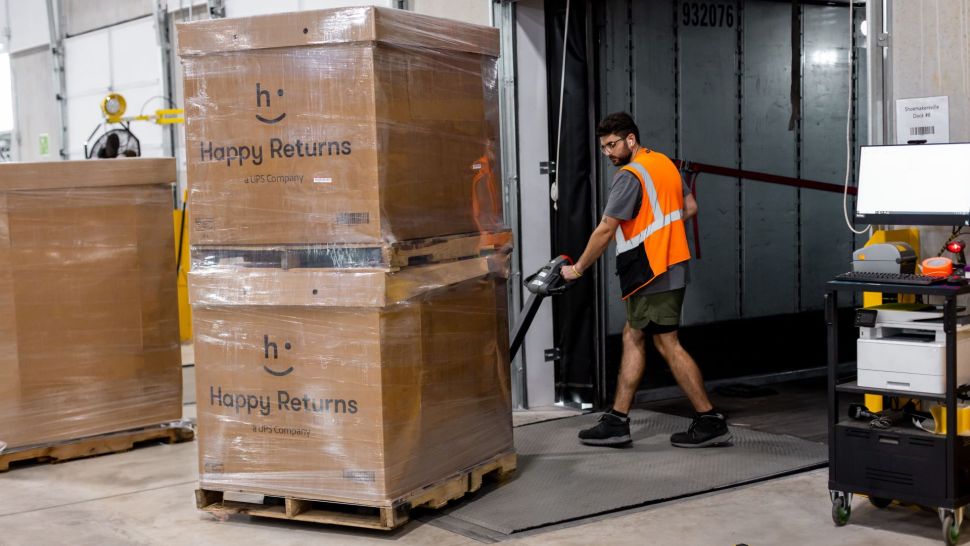
Happy Returns operates three automated returns facilities in Valencia, California, near Los Angeles; South Haven, Mississippi, near Memphis, Tennessee; and in Shoemakerville, Pennsylvania. Shipments are sorted and transported in bulk to the merchant’s warehouse by truckload or less-than-truckload carrier, depending on their volume. Customized software and automation allow Happy Returns to design shipping schedules based on a retailer’s needs, including same-day out for some large accounts.
Campos said that in order to be profitable and satisfy the retailer, a B2C reverse logistics business needs to have sufficient volume across its access points to get the necessary economies of scale.
“If you don’t have enough volume in your network, when somebody drops off a return at a place and you don’t get another return the next day and they slowly trickle in, by the time that consolidated shipment leaves the access point it could be several days or a week before it gets full” and is shipped to a consolidation warehouse, he said. From there, it takes several more days before items reach the retailer and can be put back in inventory.
Some e-commerce customers are small enough that they just use Happy Returns for intake and to ship by parcel directly from the Return Bars.
And more non-consolidated services are on the horizon. UPS envisions rationalizing its return offerings under one umbrella, with easy-to-use Happy Returns software managing the process, Campos said.
Consolidated returns works well for soft goods, like apparel and shoes, but fragile or high-value goods like electronics, are great candidates for consolidation because they break easily or have high-inventory turnover, requiring fast return.
“So part of what we’re trying to do is bring some of those software-enabled solutions to those customers that don’t have that today. It’s not for consolidation, but it’s just the ability to be able to create a return online, have easy-to-use drop-off points, and not needing to print a label,” Campos told FreightWaves.
Insulating retailers from fraud risk
Return fraud is a growing problem. Retailers surveyed by the NRF and Happy Returns said that 9% of all returns are fraudulent.
Companies that provide print-label solutions often see scammers alter the address on the label or the PDF document to make it look like the item got delivered to the retailer’s warehouse even though it got delivered to someplace like a neighbor’s house. That’s not a problem when QR codes are used instead of labels, but people still send empty boxes, deliberately swap items, overstate quantities and otherwise try to exploit the returns process.
The Happy Returns AI system, called Return Vision, begins anomaly detection as soon as someone initiates a return online, looking for returns requested soon after a delivery is made, entries from people with multiple linked email addresses or previous suspicious behavior. It also compares the image of the item received with the catalog image to make sure the return is legitimate. If someone, for example, returns 10 pairs of Nike shoes of different sizes it would identify that as an abnormal transaction.
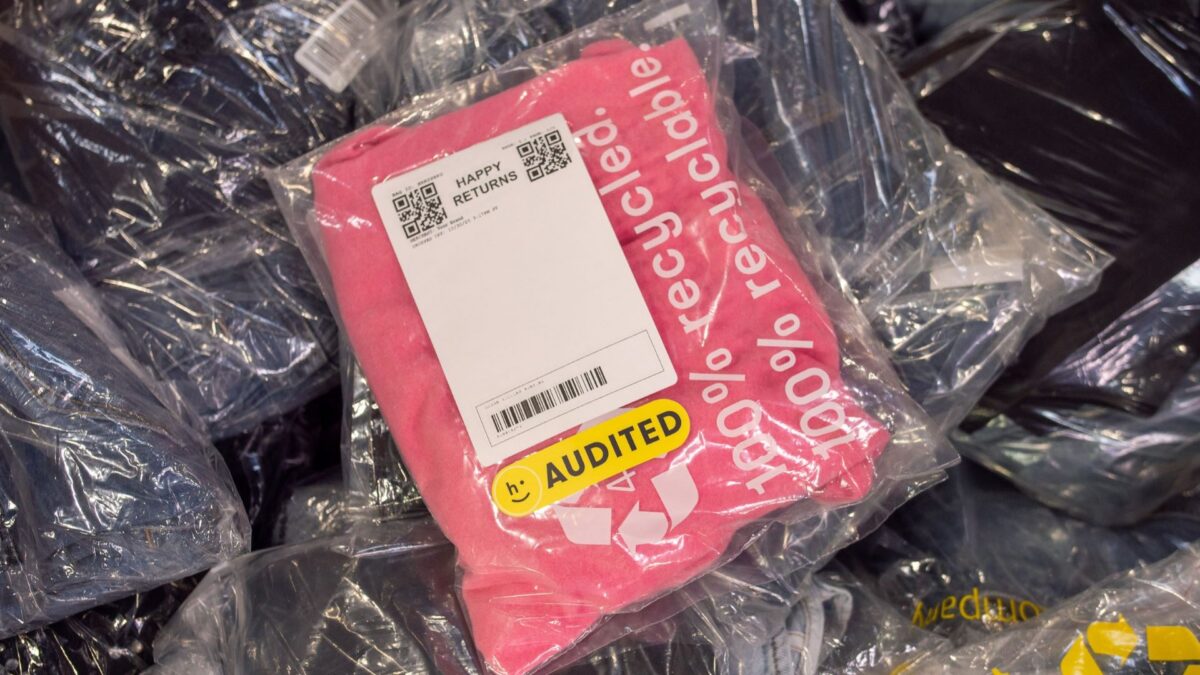
“The AI is able to catch subtle things that a human usually may gloss through, such as the type of fabric or the number of buttons on a piece of apparel,” the COO said. Humans at the return centers make the final call on whether to reject a refund.
Happy Returns views its anti-fraud tools as a differentiator from other parcel carriers. It launched a pilot program with four customers in November to validate the fraud detection technology and now most customers get a risk score on every single return. The reverse logistics company is flagging just under 1% of returns for review and finding fraudulent products in about 20% of those cases,
“Every other party is outsourcing that piece or they’re not doing that altogether. That’s a distinct capability that we can deliver and why we’ve been investing to ingest that information from a 3PL, from a customer, from ourselves, from anybody. Because it’s an important part of the returns process to reduce the cost and liability to the retailers,” Campos said.
“We’re already using our hubs to stop returns, prevent refunds from happening. Our vision is to continue enriching the breadth of the dataset. Over time we expect to have more customers and more partners on this (anti-fraud) platform, a more end-to-end solution that is insulated from bad actors. And if bad actors really want to do fraud, it’s not gonna be with Happy Returns because it’s going to be too difficult.”
Click here for more FreightWaves/American Shipper stories by Eric Kulisch.
Write to Eric Kulisch at ekulisch@freightwaves.com.
RELATED STORIES:
Uber Eats launches retail returns feature
Brokerage Compliance Symposium
The day before F3. Every compliance issue you face - fraud exposure, carrier liability, FMCSA rules, cargo theft, insurance gaps - navigated by attorneys and operators defining best practices in a changing industry.
F3 Awards Dinner
The night before F3. FreightTech100 companies honored. FreightTech 25 and Shipper of Choice winners revealed live. Cocktail reception into dinner and live music - 300 industry leaders in one purpose-built room.
F3: Future of Freight Festival
Industry-defining keynotes, rapid-fire technology demos, and industry leaders networking in experiences across Chattanooga - plus the inaugural F3 Awards Dinner featuring the FreightTech and Shipper of Choice reveals.
The day before F3. Every compliance issue you face - fraud exposure, carrier liability, FMCSA rules, cargo theft, insurance gaps - navigated by attorneys and operators defining best practices in a changing industry.
The Signal at Chattanooga Choo Choo • Chattanooga, TN Register NowThe night before F3. FreightTech100 companies honored. FreightTech 25 and Shipper of Choice winners revealed live. Cocktail reception into dinner and live music - 300 industry leaders in one purpose-built room.
The Signal at Chattanooga Choo Choo • Chattanooga, TN Register NowIndustry-defining keynotes, rapid-fire technology demos, and industry leaders networking in experiences across Chattanooga - plus the inaugural F3 Awards Dinner featuring the FreightTech and Shipper of Choice reveals.
The Signal at Chattanooga Choo Choo • Chattanooga, TN Register Now