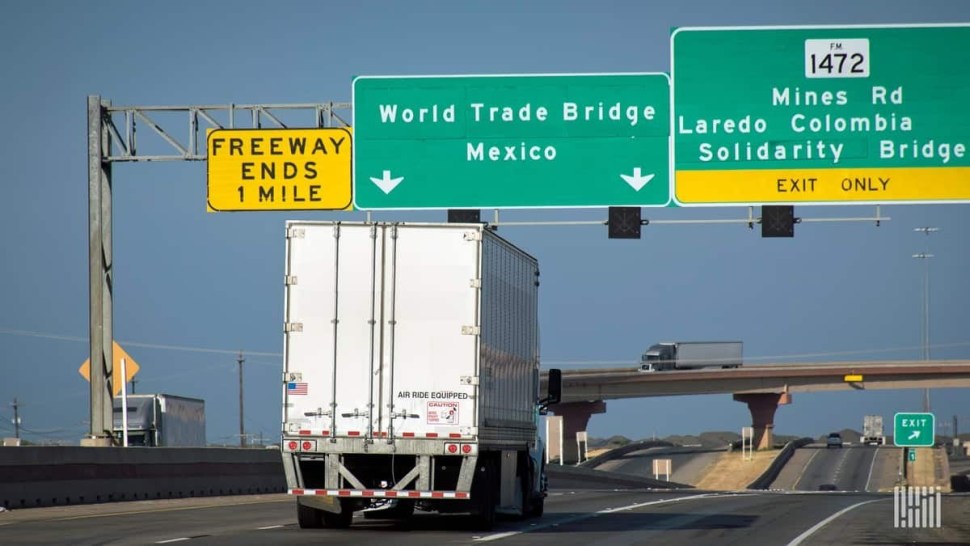
Trucking companies at the U.S.–Mexico border say that the Trump administration’s pause on new work visas for foreign commercial drivers is intensifying driver recruiting that is already squeezing freight capacity and raising costs for shippers.
In Laredo — the nation’s busiest inland port — several carrier executives said the policy is upending cross-border operations, forcing companies to rework driver models and pay structures as they struggle to retain qualified Class A drivers.
One fleet official described how the Department of Homeland Security has begun targeting companies as well as individual drivers that rely on cross-border visa holders, forcing some large carriers “to change their model quickly to keep business moving.”
The executive, who requested anonymity, said new English-proficiency interviews at U.S. consulates in Mexico are also creating bottlenecks for “transfer drivers” — those allowed to operate within a limited 20- to 30-mile radius in the U.S.
“These drivers depend on that visa, and this new requirement is going to affect the industry tremendously,” the executive told FreightWaves.
Join the leaders shaping freight’s future at
F3: Future of Freight Festival, Oct 21-22.
Network with the industry’s best and discover what’s next.
Jerry Maldonado, director of Laredo and Mexico operations for Warren Transport Inc., said some fleets have begun offering rates as high as $0.75 per mile to attract qualified drivers.
“I believe this is partly a side effect of the English proficiency regulation—particularly for carriers whose fleets were previously composed of a high percentage of drivers who may not have been fully compliant with that requirement,” Maldonado said in an email to FreightWaves.
“It’s also worth noting that not all CDL drivers are fully proficient in English, so hiring a CDL holder doesn’t necessarily guarantee complete compliance either.”
FreightWaves’ SONAR data shows a 3.8% tender rejection rate in Laredo, up 18% since Friday, indicating more carriers are declining to accept loads at the contract price.
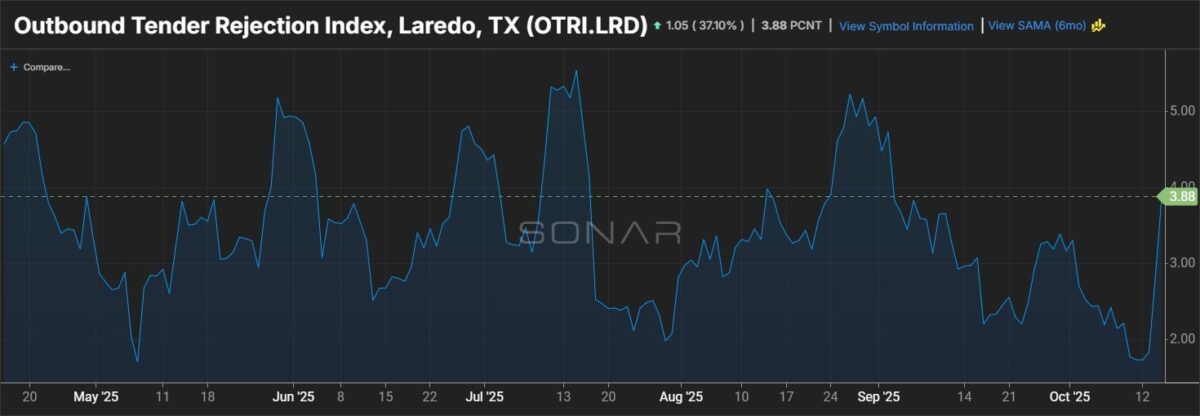
But with freight rates still weak, Maldonado added, “Additionally, the current low freight rates in the market make it challenging for carriers to increase driver pay. Hopefully, conditions improve soon, as the industry could greatly benefit from a rate adjustment in our favor.”
Beyond the border, industry leaders warn that immigration crackdowns are affecting domestic freight lanes too. Royce Neubauer, founder and CEO of Auto Hauler Exchange, said he’s seen drivers refuse to operate in certain states due to heightened U.S. Immigration and Customs Enforcement (ICE) enforcement.
“A lot of our truck drivers are immigrants, and they have been for a very long time,” Neubauer told FreightWaves. “Some drivers are afraid to go into certain states … It’s creating rate fluctuations we’ve never seen before.”
Neubauer said his company’s AI pricing systems have struggled to adapt to these rapid changes in lane rates and capacity availability.
“If we have drivers walking away from the industry, that means rates are going to go up,” Neubauer said. “At the end of the day, it’s all about supply and demand — and when that supply of trucks isn’t there to handle demand, the consumer will end up paying for it.”
The visa pause, announced Aug. 22 by Secretary of State Marco Rubio, follows a fatal crash involving an undocumented driver and remains open-ended.
Rubio said the action is necessary to protect American jobs and improve highway safety. But according to the American Trucking Associations (ATA), the decision could worsen the nation’s driver deficit, projected to exceed 1.2 million drivers over the next decade.
Legal analysts at Amundsen Davis urged fleets to audit their training programs and ensure compliance with the Federal Motor Carrier Safety Administration’s Entry-Level Driver Training (ELDT) rule, which mandates that new drivers train through FMCSA-approved providers. The firm also warned companies to prepare for labor disruptions and contract delays until the visa process stabilizes.
Neubauer said the challenges highlight a deeper truth about the U.S. freight economy.
“There’s a need for truck drivers in this country more than any other country in the world — and we’ve got to make sure there are enough good drivers in those seats,” he said.
Brokerage Compliance Symposium
The day before F3. Every compliance issue you face - fraud exposure, carrier liability, FMCSA rules, cargo theft, insurance gaps - navigated by attorneys and operators defining best practices in a changing industry.
F3 Awards Dinner
The night before F3. FreightTech100 companies honored. FreightTech 25 and Shipper of Choice winners revealed live. Cocktail reception into dinner and live music - 300 industry leaders in one purpose-built room.
F3: Future of Freight Festival
Industry-defining keynotes, rapid-fire technology demos, and industry leaders networking in experiences across Chattanooga - plus the inaugural F3 Awards Dinner featuring the FreightTech and Shipper of Choice reveals.
The day before F3. Every compliance issue you face - fraud exposure, carrier liability, FMCSA rules, cargo theft, insurance gaps - navigated by attorneys and operators defining best practices in a changing industry.
The Signal at Chattanooga Choo Choo • Chattanooga, TN Register NowThe night before F3. FreightTech100 companies honored. FreightTech 25 and Shipper of Choice winners revealed live. Cocktail reception into dinner and live music - 300 industry leaders in one purpose-built room.
The Signal at Chattanooga Choo Choo • Chattanooga, TN Register NowIndustry-defining keynotes, rapid-fire technology demos, and industry leaders networking in experiences across Chattanooga - plus the inaugural F3 Awards Dinner featuring the FreightTech and Shipper of Choice reveals.
The Signal at Chattanooga Choo Choo • Chattanooga, TN Register Now