




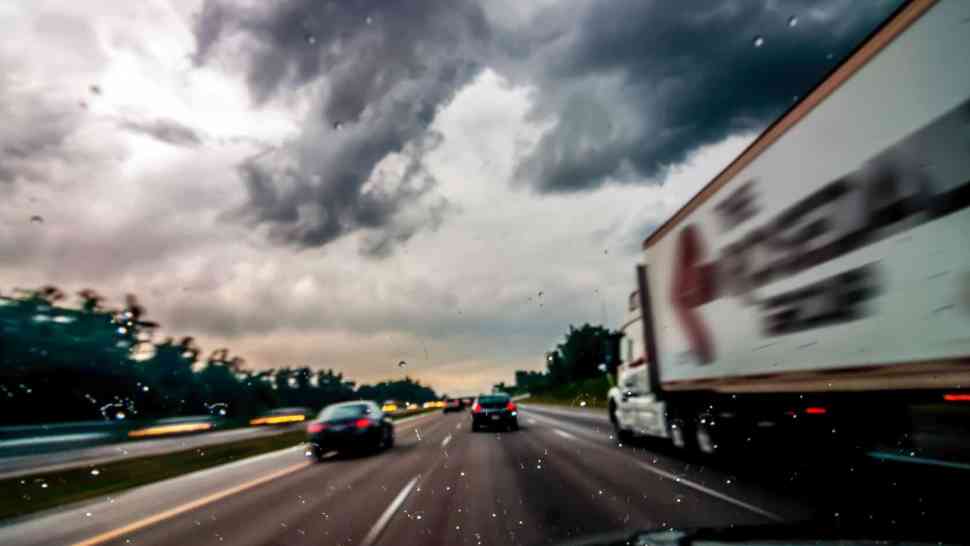
A wet May in the Northeast is an example of how weather is impacting rates and volumes
Spot market rates have continued their usual pattern of volatility in recent weeks, and one reason has been the current weather patterns, particularly in the Northeast. Weather, as it also turns out, can be a good predictor of future freight volumes.
The Northeast has seen an unusually cool and wet May, and that will likely continue, reports Jon Davis, meteorology team lead for Riskpulse.
“The middle to end of April was a warmer than normal period in the Northeast,” Davis says. “This changed dramatically during May as temperatures have been below normal virtually the entire month with the coolest conditions from May 7 to May 14. These departures over this large of an area are very significant and highly anomalous.”
Rainfall over the region was also significant in May, and when combined with a wet winter that has helped alleviate near-drought conditions in some parts of the region.

Related:
How weather impacts trucking
“For reference, normal rainfall during this 2-week period is around 2 to 2.25 inches in this area,” Davis notes. “So, anything above 3 inches is well above normal. Most of the areas within the I-95 corridor have had 3-plus inches during the past 2 weeks.”
That weather pattern has affected freight moving into and out of the Northeast.
“Part of the freight story last week appears to be lighter volumes due to lack of demand in the Northeast quadrant due to chilly, damp conditions,” Mark Montague, analyst with DAT Solutions, tells FreightWaves. “Further West, freight movements remain robust from California, Texas and other sunbelt states.”
In this week’s DAT Trendlines spot rate reports, as an example, a refrigerated lane from Elizabeth, NJ, to Boston was up 23 cents per mile to $3.58/mile. Nationally, refrigerated rates are at a 4-month high at $1.99 per mile for the week ending May 13. Part of that is due to a ramp up of produce season in California.
Outbound rates in Fresno, CA, and Los Angeles both shot up 12 cents to $2.14 per mile and $2.57 per mile.
“Nationally, the number of available refrigerated loads declined 1% while truck posts increased 5%,” DAT reports. “On the top 72 lanes for spot reefer freight, 51 lanes had higher rates last week—despite uneven production out of Florida, shipping gaps in California, and a drop in volumes in markets near the Mexican border.”
The same was true of van lanes in the Northeast. Philadelphia to Boston climbed 16 cents to $3.18 per mile while Atlanta to Charlotte jumped 23 centers to $2.40 per mile. Just a week ago, outbound van rates in the Northeast were trending downward, DAT’s Matt Sullivan wrote.
Brokerage Compliance Symposium
The day before F3. Every compliance issue you face - fraud exposure, carrier liability, FMCSA rules, cargo theft, insurance gaps - navigated by attorneys and operators defining best practices in a changing industry.
F3 Awards Dinner
The night before F3. FreightTech100 companies honored. FreightTech 25 and Shipper of Choice winners revealed live. Cocktail reception into dinner and live music - 300 industry leaders in one purpose-built room.
F3: Future of Freight Festival
Industry-defining keynotes, rapid-fire technology demos, and industry leaders networking in experiences across Chattanooga - plus the inaugural F3 Awards Dinner featuring the FreightTech and Shipper of Choice reveals.
The day before F3. Every compliance issue you face - fraud exposure, carrier liability, FMCSA rules, cargo theft, insurance gaps - navigated by attorneys and operators defining best practices in a changing industry.
The Signal at Chattanooga Choo Choo • Chattanooga, TN Register NowThe night before F3. FreightTech100 companies honored. FreightTech 25 and Shipper of Choice winners revealed live. Cocktail reception into dinner and live music - 300 industry leaders in one purpose-built room.
The Signal at Chattanooga Choo Choo • Chattanooga, TN Register NowIndustry-defining keynotes, rapid-fire technology demos, and industry leaders networking in experiences across Chattanooga - plus the inaugural F3 Awards Dinner featuring the FreightTech and Shipper of Choice reveals.
The Signal at Chattanooga Choo Choo • Chattanooga, TN Register Now