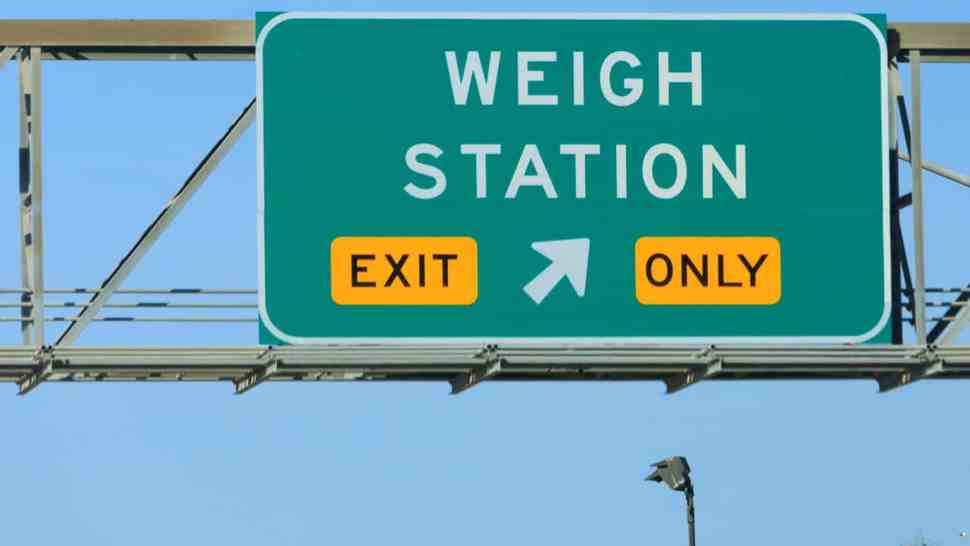
The next step toward making weigh in motion technology acceptable in the U.S. for speed enforcement lies with the National Council for Weights and Measures.
That was the view expressed by Jon Arnold, a market specialist with Intercomp, a manufacturer of a variety of weight measurement devices and technologies. Arnold reviewed the current states of WIM technology in a seminar at the Modex conference in Atlanta.
WIM is already very much a factor in enforcement, Arnold said. It is often used by law enforcement to “pre-screen” vehicles, and the information gathered from that pre-screening can lead to an enforcement officer deciding whether to go after a vehicle, pull it over and do a more precise stationary measurement. Virtually all states in the U.S. are using WIM technology for pre-screening, Arnold said.
It can also more efficiently measure the weight of vehicles about to take to the highway. “They’re looking for overload before it leaves the yards,” Arnold said.
Does that have an impact? Arnold showed data that in 1985, there were six weight-related citations for every 1,000 pullovers. That rose slightly to seven by 1995, but by 2008, as WIM technology was starting to be rolled out in various applications, it rose to 13. But by 2012, it had dropped to 10, which Arnold attributed to a greater amount of data available to carriers because of WIM technology that in turn was leading to greater compliance.
The use of WIM as a legal tool to enforce weight restrictions needs a task force set up by the NCWM to finish its work. In a Federal Register notice last year announcing the creation of the task force, it was stressed that the group would be looking to develop procedures “that can be used to verify the accuracy of a slow-speed WIM system.” But it would also stay away from speaking about its use in law enforcement. (A request for input on the group’s work from last September can be found here).
“All states want a certified system,” Arnold told Freightwaves after his seminar address. “You need to certify it for performance, and then we can write tickets off it. How do you certify it if you’re in a country that doesn’t have a standard?” The work that the NCWM is doing could provide that standard, Arnold said.
When will this work change the role of WIM in weight enforcement? Arnold would only say in the “next year or two.”
Arnold cited several European countries using WIM technology for weight enforcement. What is at the center of that is acceptance by those countries of the standards set by the International Organization of Legal Metrology. That doesn’t mean that all those countries–he cited the Czech Republic, France and Russia as examples–have identical rules. But the acceptance of the OILM standards allows for the enforcement using WIN data. The U.S. is a member of OILM.
“The OILM standards have been around since 2006,” he said. “They state the standard and say, this is how you certify this.” From that point, according to Arnold, countries are free to set their own rules on the application of WIM technology. But having accepted the OILM standard is the starting point for that process. (The acronym reflects the French spelling of the organization.)
With full ELD enforcement in effect, every moment of a driver’s day is precious. Spending time on line at what Arnold called a “static” weigh station–the traditional scale that necessitates a truck to pull off the highway–is yet one more interruption for a driver trying to maximize driving time before the Hours of Service limitations kick in.
Still, even with the fact that WIM can’t be used for enforcement in the U.S., one of Arnold’s slides during his presentation quoted a government official from Minnesota saying that because of WIM technology, the state would almost certainly never build another bricks-and-mortar weigh station.
Arnold reviewed a variety of WIM applications other than on the highway. WIM applicatoins can be used in depots so that companies are better aware of a truck’s weight while not requiring it to line up at its own stationary facilities. The whole idea is to keep moving whenever possible. Arnold gave the example of a truck partially loaded with freight pulling into a depot, and the WIM equipment that it crosses as it enters the facility gives a weight–usually within 5% accuracy–that can then be used to better calculate the amount of free space on that truck is available for more products to load. Knowing that earlier in the process leads to greater efficiency and less down time.
Brokerage Compliance Symposium
The day before F3. Every compliance issue you face - fraud exposure, carrier liability, FMCSA rules, cargo theft, insurance gaps - navigated by attorneys and operators defining best practices in a changing industry.
F3 Awards Dinner
The night before F3. FreightTech100 companies honored. FreightTech 25 and Shipper of Choice winners revealed live. Cocktail reception into dinner and live music - 300 industry leaders in one purpose-built room.
F3: Future of Freight Festival
Industry-defining keynotes, rapid-fire technology demos, and industry leaders networking in experiences across Chattanooga - plus the inaugural F3 Awards Dinner featuring the FreightTech and Shipper of Choice reveals.
The day before F3. Every compliance issue you face - fraud exposure, carrier liability, FMCSA rules, cargo theft, insurance gaps - navigated by attorneys and operators defining best practices in a changing industry.
The Signal at Chattanooga Choo Choo • Chattanooga, TN Register NowThe night before F3. FreightTech100 companies honored. FreightTech 25 and Shipper of Choice winners revealed live. Cocktail reception into dinner and live music - 300 industry leaders in one purpose-built room.
The Signal at Chattanooga Choo Choo • Chattanooga, TN Register NowIndustry-defining keynotes, rapid-fire technology demos, and industry leaders networking in experiences across Chattanooga - plus the inaugural F3 Awards Dinner featuring the FreightTech and Shipper of Choice reveals.
The Signal at Chattanooga Choo Choo • Chattanooga, TN Register Now