




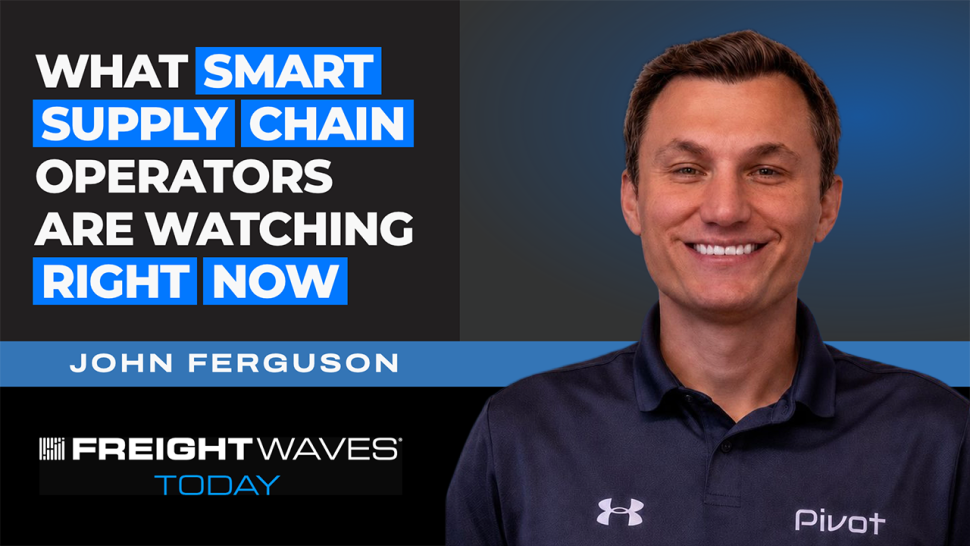
John Ferguson of Pivot Supply Chain Solutions joins FreightWaves Today for a straight conversation on supply chain strategy, market conditions and what operators should actually focus on. What’s the biggest issue your team is dealing with right now?
Freight brokers are fielding a new kind of sales call. John Ferguson, founder and CEO of Chattanooga-based Pivot Supply Chain Solutions, said a prospective enterprise shipper recently required him to walk through his firm’s entire carrier vetting process — system by system — before any rate discussion took place. The shipper told Ferguson that rates were secondary to liability exposure in the wake of the post-Montgomery ruling, a posture Ferguson described as unlike anything he had previously encountered in years of pitching that account.
The shift reflects broader anxiety rippling through the brokerage market following the C.H. Robinson vicarious liability verdict. Ferguson noted that C.H. Robinson faced a $604 million verdict in which it was found 23% responsible — a share that aligns almost exactly with its $135 million insurance policy. He said plaintiffs’ attorneys are increasingly targeting all parties in the chain, including shippers and warehouse operators, pointing to recent amendments to Delilah’s Law that now explicitly include both.
“I’m still close enough to the business where I understand how we’re vetting everything. I don’t need to have somebody explain it to me. I can sit down with the client and explain it directly to them, how we’re keeping their loads safe, how we’re qualifying carriers,” Ferguson said.
One legal nuance that emerged during the C.H. Robinson trial carries direct operational implications for brokers: an attorney present during proceedings told Ferguson that jurors determined shared-employee status partly because C.H. Robinson described itself as “tracking the driver” through its app. Ferguson said the practical takeaway for brokers is precise language — carriers and drivers should be described as tracked by load, not by person.
On the rate and capacity side, Ferguson described the market as “very uncertain,” with fuel costs elevated and capacity still exiting. He said the tender rejection rate dipped to around 13% before recovering to roughly 14%, and that the Northeast — historically a softer region — posted the highest load-to-truck ratios in the country for about 60 days before the West Coast, driven by Washington State produce, took over that position in the past two weeks.
Volume patterns are also shifting in ways that complicate carrier planning. Ferguson said shippers are concentrating pickups Monday through Wednesday, leaving Thursday and Friday with sharp volume drop-offs week over week. He attributed the front-loading partly to must-arrive-by date management — shippers want buffer days in case a load falls through — and partly to end-of-quarter pull-forwards, with several enterprise customers already moving October volume into September. Ferguson said he expects a meaningful slowdown in the first weeks of October as a result.
On contract structures, Ferguson said more shippers are abandoning annual RFPs in favor of quarterly or even monthly bids, seeking flexibility in a volatile rate environment while still pressing to recover rates from one to two years ago. He framed tighter compliance requirements around carrier vetting as a competitive advantage for smaller, operator-led brokerages whose leadership can speak directly to vetting processes — a harder proposition, he argued, for larger firms where that knowledge is several management layers removed from the client conversation.
- A C.H. Robinson verdict of $604 million — with Robinson held 23% liable, matching its $135 million policy — is pushing shippers to demand detailed carrier vetting disclosures from brokers before rate talks.
- Northeast load-to-truck ratios led the entire U.S. market for roughly 60 days before West Coast volumes, fueled by Washington State produce, took over in the past two weeks.
- Shippers are concentrating pickups Monday through Wednesday and pulling October volume into September end-of-quarter, setting up a potential sharp drop in freight activity in early October.
This Summary is generated thanks to a transcription of the interview, for the full interview please enjoy the video above.
Brokerage Compliance Symposium
The day before F3. Every compliance issue you face - fraud exposure, carrier liability, FMCSA rules, cargo theft, insurance gaps - navigated by attorneys and operators defining best practices in a changing industry.
F3 Awards Dinner
The night before F3. FreightTech100 companies honored. FreightTech 25 and Shipper of Choice winners revealed live. Cocktail reception into dinner and live music - 300 industry leaders in one purpose-built room.
F3: Future of Freight Festival
Industry-defining keynotes, rapid-fire technology demos, and industry leaders networking in experiences across Chattanooga - plus the inaugural F3 Awards Dinner featuring the FreightTech and Shipper of Choice reveals.
The day before F3. Every compliance issue you face - fraud exposure, carrier liability, FMCSA rules, cargo theft, insurance gaps - navigated by attorneys and operators defining best practices in a changing industry.
The Signal at Chattanooga Choo Choo • Chattanooga, TN Register NowThe night before F3. FreightTech100 companies honored. FreightTech 25 and Shipper of Choice winners revealed live. Cocktail reception into dinner and live music - 300 industry leaders in one purpose-built room.
The Signal at Chattanooga Choo Choo • Chattanooga, TN Register NowIndustry-defining keynotes, rapid-fire technology demos, and industry leaders networking in experiences across Chattanooga - plus the inaugural F3 Awards Dinner featuring the FreightTech and Shipper of Choice reveals.
The Signal at Chattanooga Choo Choo • Chattanooga, TN Register Now