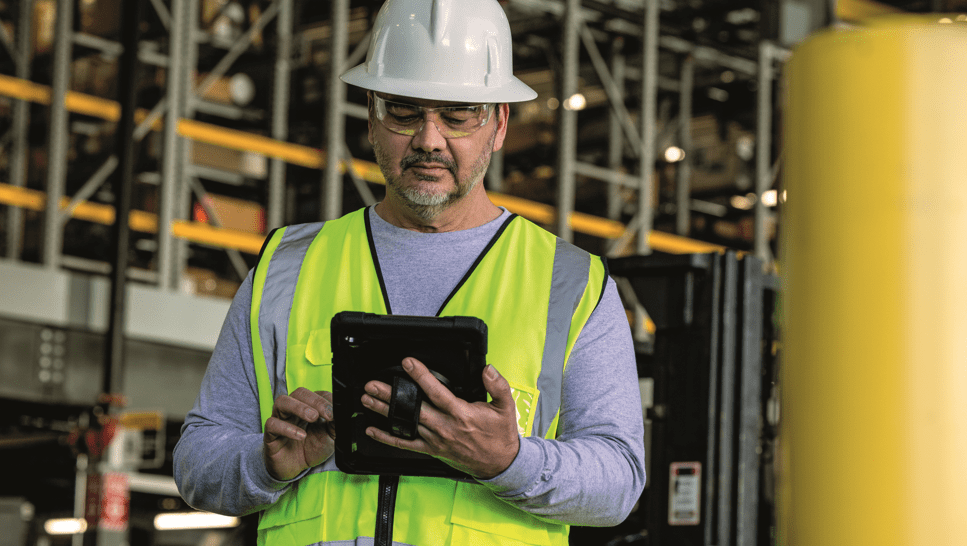

A parts supplier outside Detroit runs its production line around the clock. Orders feed in through a cloud-based ERP system, shipping commitments sync with carrier TMS platforms in real time, and quality data streams from sensors embedded in the assembly equipment. All of it depends on a network connection that many people take for granted.
When that network connection drops, though, the math gets ugly fast.
According to a 2024 Siemens report, unscheduled downtime now drains roughly 11% of annual revenues from the world’s 500 largest companies. That adds up to a collective hit of $1.4 trillion, up sharply from $864 billion just five years earlier. In the automotive sector alone, the per-hour cost of a production stoppage runs $2.3 million. That’s $600 every second a line sits idle.
For the contract producers, component fabricators, and the packagers and assemblers that make up the backbone of American freight, those numbers take a proportionally steep toll. The average cost of unplanned downtime for a manufacturing facility is roughly $260,000 per hour, and many plants log more than 800 hours of downtime annually across planned and unplanned events.
Swiss electrical equipment manufacturer ABB surveyed more than 3,200 plant maintenance leaders globally and found that two-thirds of companies dealt with unplanned downtime at least once a month, at a reported cost of $125,000 per hour.
Keep in mind, those are just the direct costs attributed to things like idle labor and raw materials sitting in queue. The downstream consequences are where network failures inflict the deepest damage.
The ripple effect moves quickly when a network outage takes down production. Modern manufacturing operates inside a web of contractual shipping commitments and just-in-time delivery windows. Decades of this kind of operation have left customer expectations with zero tolerance for delays.
If a cloud-based production scheduling system goes dark, work orders freeze and operators on the floor lose visibility into what to run next. Likewise, automated, API-connected TMS platforms can stall carrier dispatching. The resulting cascade impacts millions of people yearly, even those who aren’t aware of why.
In February 2022, Toyota suspended operations across all 28 production lines at 14 manufacturing plants in Japan for a full day after a system failure at a key supplier severed network communications with Toyota’s production monitoring systems. The ripple effect extended across numerous partner companies. At Toyota’s production volumes, those 14 plants accounted for roughly a third of its global output.
When AT&T’s mobile network went offline nationwide for more than 12 hours in February 2024, the disruption blocked an estimated 92 million calls, took down mobile payment systems at countless businesses, and knocked out real-time tracking for logistics providers who depended on cellular connectivity for fleet visibility.
Trucking technology platforms reliant on AT&T’s network were directly impacted, too. Because our supply chain is increasingly dependent on real-time data flows, many operations lost track of where freight was going during the network outage.
Network-driven production delays translate directly to financial penalties, especially for those manufacturers that ship under contract. Late delivery clauses are a standard feature in supply agreements, and they carry teeth. Typical contract language stipulates penalties of 0.5% to 1% of order value per week of delay, with caps often set at 5% to 10% of the total contract value. In some industries, buyers can charge back the cost of expedited freight when a supplier misses its window.
Retail programs routinely issue chargebacks for late or incomplete shipments. In grocery and consumer goods, a missed delivery window can mean lost shelf space, promotional markdowns funded by the shipper, or even termination of a supplier relationship.
According to ABB, 46% of companies that experienced unplanned downtime reported that they couldn’t deliver services to customers as a result of that downtime. 29% were left completely unable to service or support specific equipment. That quickly becomes a customer relationship problem with long-term commercial consequences.
When a manufacturer misses a shipping commitment because its systems went dark, the customer doesn’t file the incident under “network outage.” They file it under “unreliable supplier.” Because supply chain procurement teams often maintain approved vendor lists and regularly benchmark supplier performance scorecards, one missed delivery window can trigger a review that leads to reduced allocation, a shift to a backup supplier, or an outright loss of the account.
What Always-On Connectivity Makes Possible
The cost of network failure is one side of the ledger. The other is the opportunity that manufacturers leave on the table when connectivity is merely adequate rather than engineered for performance.
The same network infrastructure that prevents a catastrophic production stoppage can also enable real-time quality monitoring, where sensors on the line detect defects at the point of assembly rather than at end-of-line inspection. It can power dynamic production scheduling that adjusts work orders on the fly based on inbound material availability and outbound shipping windows. Likewise, it can support dense, low-latency automation, such as autonomous guided vehicles coordinating with robotic arms. In other words, reliable connectivity is the foundation for future investments in smart manufacturing, AI, and robotics.
Investing in Prevention
Given the scale of exposure, the investment case for network reliability is not particularly close. Industry analysts note that proactive monitoring and redundancy systems typically cost 10% to 20% of a manufacturer’s total annual downtime risk exposure. The break-even on that investment often occurs after preventing a single incident.
One automotive parts manufacturer with 75 employees and just-in-time delivery commitments invested in comprehensive network monitoring and redundancy after experiencing two to three system outages per month, each lasting two to four hours. Unplanned downtime fell by 89%, customer complaints related to delivery delays dropped to zero, and the company saved an estimated $180,000 annually in avoided downtime costs.
If the cost of a single hour of production downtime exceeds $50,000 (which is a threshold most mid-size manufacturers easily clear), the math heavily favors redundancy and proactive monitoring.
How T-Mobile Advanced Network Solutions Bring It Together
T-Mobile for Business believes that the network connecting your factory floor, your warehouse, your fleet, and your customer should be as engineered and as redundant as the production line itself. That’s the thinking behind the company’s Advanced Network Solutions (ANS) portfolio, a set of integrated capabilities designed to not only prevent downtime, but also to power connected, intelligent manufacturing.
The foundation is T-Mobile’s standalone 5G network, a fully independent architecture that doesn’t rely on legacy 4G infrastructure. T-Mobile operates America’s largest and fastest 5G network, named Best Mobile Network in the U.S. by Ookla Speedtest in 2025.1
Standalone 5G enables the capabilities that matter most to manufacturers: network slicing for guaranteed performance on mission-critical operations, ultra-reliable low-latency communications (URLLC) for time-sensitive automation, and support for the massive IoT device density that smart factory environments demand.
What makes the ANS approach different is how those capabilities come together on the plant floor and across the supply chain.
On-site, T-Mobile’s Edge Control service enables cellular traffic to exit locally and flow directly into an enterprise’s edge computing environment, rather than routing through centralized data centers or the public internet. For a manufacturer running IoT sensors, quality inspection cameras, and autonomous guided vehicles, that means fewer network hops, lower latency, and the kind of deterministic performance that real-time automation requires. Edge Control is hyperscaler-agnostic, supporting integration with AWS, Azure, and Google Cloud, and it can be paired with private or hybrid 5G deployments that deliver dedicated, interference-resistant connectivity on factory floors where heavy equipment, metal structures, and dense device environments challenge conventional Wi-Fi.
From there, T-Mobile’s network slicing allows manufacturers to carve out a prioritized slice of network capacity for the operations that absolutely cannot tolerate degradation (such as ERP systems, production scheduling, carrier dispatching, and first responder communications), ensuring guaranteed bandwidth and low latency even when the broader network is under load.
Tying it all together is T-Platform, T-Mobile’s unified management portal, which gives manufacturers a single interface to monitor and manage everything from 5G Business Internet to IoT device fleets to Edge Control deployments.
Beyond the factory walls, T-Mobile’s IoT platform and Control Center extend real-time asset tracking across the full supply chain, covering inbound raw materials and outbound finished goods with device lifecycle management, SIM management, and dynamic cost controls.
The cumulative effect is a connectivity layer that enables manufacturers to operate the way the industry is heading: continuous, data-driven, and increasingly autonomous.
Where Manufacturing Goes From Here
The factories leading the next wave of American manufacturing will be connected and intelligent. AI-driven predictive maintenance that flags equipment failures before they happen. Digital twins that model entire production lines in real time, letting managers test operational changes before committing resources. Fully autonomous material handling systems that coordinate across facilities without human intervention. These capabilities are already in deployment at the industry’s leading edge, and every one of them depends on a connectivity layer that is fast, reliable, and built for density.
The ROI conversation is less about whether to invest and more about how quickly the investment pays for itself. The manufacturers that have already done the painful post-mortem on network failures can tell you that the answer is usually “before the next one happens.” The right network protects today’s production and enables tomorrow’s.
The freight that moves through America’s supply chain starts at the production line. When that line goes down because the network did, every truck, every shipper, and every customer feels the impact. When the network is engineered to make the entire operation smarter, the upside can be even more impactful than the downside it prevents.
Click here to learn more about T-Mobile for Business.
- America’s Best Network: Best based on analysis by Ookla of Speedtest Intelligence® data 2H 2025. Ookla trademarks used under license and reprinted with permission. T-Mobile is America’s Largest and Fastest 5G Network: Based on analysis by Ookla® of Speedtest Intelligence® data of national Speed Score results incorporating 5G download and upload speeds for 2H 2025. See 5G device, coverage,& access details at T-Mobile.com ↩︎
Brokerage Compliance Symposium
The day before F3. Every compliance issue you face - fraud exposure, carrier liability, FMCSA rules, cargo theft, insurance gaps - navigated by attorneys and operators defining best practices in a changing industry.
F3 Awards Dinner
The night before F3. FreightTech100 companies honored. FreightTech 25 and Shipper of Choice winners revealed live. Cocktail reception into dinner and live music - 300 industry leaders in one purpose-built room.
F3: Future of Freight Festival
Industry-defining keynotes, rapid-fire technology demos, and industry leaders networking in experiences across Chattanooga - plus the inaugural F3 Awards Dinner featuring the FreightTech and Shipper of Choice reveals.
The day before F3. Every compliance issue you face - fraud exposure, carrier liability, FMCSA rules, cargo theft, insurance gaps - navigated by attorneys and operators defining best practices in a changing industry.
The Signal at Chattanooga Choo Choo • Chattanooga, TN Register NowThe night before F3. FreightTech100 companies honored. FreightTech 25 and Shipper of Choice winners revealed live. Cocktail reception into dinner and live music - 300 industry leaders in one purpose-built room.
The Signal at Chattanooga Choo Choo • Chattanooga, TN Register NowIndustry-defining keynotes, rapid-fire technology demos, and industry leaders networking in experiences across Chattanooga - plus the inaugural F3 Awards Dinner featuring the FreightTech and Shipper of Choice reveals.
The Signal at Chattanooga Choo Choo • Chattanooga, TN Register Now