




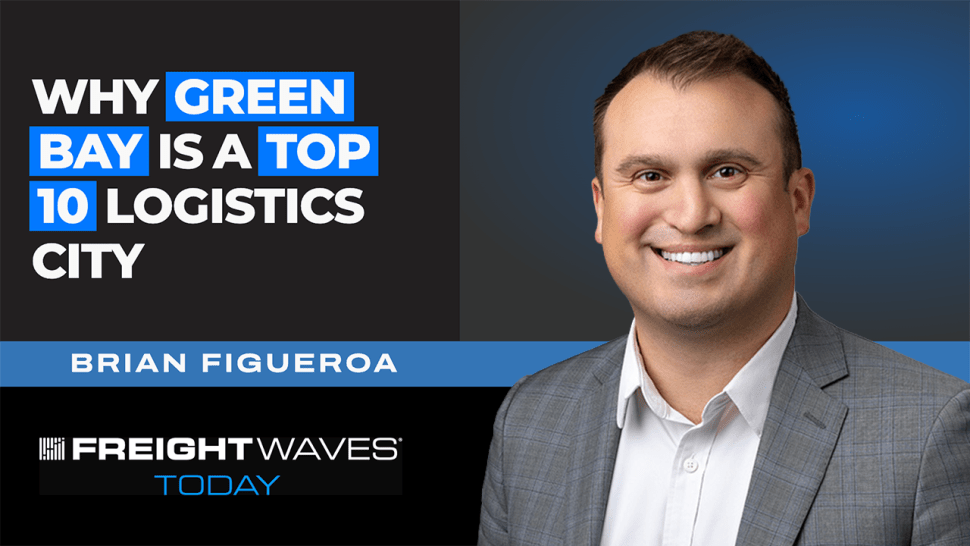
Green Bay, Wisconsin, isn’t just about football. Brian Figueroa of KBX Logistics reveals why this city, with 1/10th of 1% of the US population, accounts for over 1% of all national transportation roles. Discover how Green Bay leverages deep industry collaboration and talent development to cement its status as a critical supply chain hub. Plus, gain insights into the current, supply-driven freight market and how businesses are navigating shifting dynamics toward a new equilibrium.
Green Bay, Wisconsin, punches far above its weight in transportation and logistics, with over 640 transportation, logistics, and shipping companies operating in the metro area — a concentration that KBX Logistics Managing Director of Transportation Brian Figueroa says rivals better-known freight hubs. The city accounts for more than 1% of all U.S. transportation roles while representing just 1/10 of 1% of the national population, a ratio Fuguera argues makes the case for Green Bay alongside cities like Chattanooga and Chicago.
“There’s not a product that’s close to you that we don’t touch or ship,” Figueroa said, describing the region’s reach into national and global supply chains. He chairs the Greater Green Bay Chamber’s Transportation and Logistics Task Force, which formed shortly after a 2019 industry event and has since focused on two priorities: marketing the region’s freight identity and building a talent pipeline through local universities.
“I don’t think it’s about deserving. I think they are. We’re just maybe a little bit too Midwest nice about stuff.” — Brian Figueroa, Managing Director of Transportation, KBX Logistics
On the freight market, Figueroa said KBX began seeing meaningful shifts in early Q1, driven not by a demand surge but by supply-side forces — including regulatory enforcement of non-domicile CDL rules, cabotage, and English proficiency requirements, combined with the impact of the conflict involving Iran on fuel costs. He noted the cycle had been largely unchanged for 3.5 to 4 years, making the transition jarring for shippers whose procurement teams had never navigated a carrier-favorable market.
A key signal for KBX came from its carrier partners. Small carriers — many running five trucks or fewer — became less willing to drive empty miles to reach their next load as fuel costs rose and margins tightened. “The biggest thing I’ve heard is more so their tolerance to being able to drive empty further to get to that next load has diminished,” Figueroa said. KBX responded by leaning on its dense facility network to improve carrier utilization, offering head- and backhaul solutions tied to Georgia-Pacific and other Koch businesses.
Figueroa described the current market as trending toward equilibrium rather than a clean directional flip. Post-Fourth of July softness is normal seasonality, he said, but the broader picture is a supply-driven adjustment without the demand catalyst that typically triggers a cycle turn. He used the term “Goldilocks” to characterize conditions — stable but fragile, where a demand spike or a disruptive weather event could shift the balance quickly.
KBX is seeing strong growth in data centers, with Koch subsidiaries Molex and Georgia-Pacific Building Products supplying materials for those capital infrastructure projects. Paper and consumer products — which Figueroa described as recession-resilient and tied to population and GDP growth — continue to generate steady truckload volume annually. The housing-related building products segment faces the most pressure given weakness in that sector, though data center demand is partly offsetting it with overlapping product and capacity needs.
On payments, Figueroa said digital accuracy is a competitive tool: when physical shipment events are reflected in real time through EDI, it enables faster carrier payments — a priority for small carriers managing tight cash flow on two-week payroll cycles.
- Green Bay has more than 1% of all U.S. transportation roles despite being just 1/10 of 1% of the national population, with over 640 logistics companies in the metro area.
- KBX began seeing freight market shifts in early Q1, driven by supply-side factors including CDL regulatory enforcement and fuel cost pressure rather than a demand uptick.
- Data centers are a top growth driver for KBX, with Koch units Molex and Georgia-Pacific Building Products supplying materials for those infrastructure projects.
This Summary is generated thanks to a transcription of the interview, for the full interview please enjoy the video above.
Brokerage Compliance Symposium
The day before F3. Every compliance issue you face - fraud exposure, carrier liability, FMCSA rules, cargo theft, insurance gaps - navigated by attorneys and operators defining best practices in a changing industry.
F3 Awards Dinner
The night before F3. FreightTech100 companies honored. FreightTech 25 and Shipper of Choice winners revealed live. Cocktail reception into dinner and live music - 300 industry leaders in one purpose-built room.
F3: Future of Freight Festival
Industry-defining keynotes, rapid-fire technology demos, and industry leaders networking in experiences across Chattanooga - plus the inaugural F3 Awards Dinner featuring the FreightTech and Shipper of Choice reveals.
The day before F3. Every compliance issue you face - fraud exposure, carrier liability, FMCSA rules, cargo theft, insurance gaps - navigated by attorneys and operators defining best practices in a changing industry.
The Signal at Chattanooga Choo Choo • Chattanooga, TN Register NowThe night before F3. FreightTech100 companies honored. FreightTech 25 and Shipper of Choice winners revealed live. Cocktail reception into dinner and live music - 300 industry leaders in one purpose-built room.
The Signal at Chattanooga Choo Choo • Chattanooga, TN Register NowIndustry-defining keynotes, rapid-fire technology demos, and industry leaders networking in experiences across Chattanooga - plus the inaugural F3 Awards Dinner featuring the FreightTech and Shipper of Choice reveals.
The Signal at Chattanooga Choo Choo • Chattanooga, TN Register Now