This is part of a FreightWaves series on the electronic logging device mandate. Federal regulators began enforcing the mandate on April 1, 2018. Read more from this series here.
Driverless trucks, which may or may not be the future state of long-haul heavy-duty trucking, likely won’t need electronic logging devices. Nor will hours-of-service regulations apply to them. But the reality is more nuanced.
“Anytime a human is involved, ELDs will matter,” said Wiley Deck, vice president of government affairs and public policy at autonomous software developer Plus and a former acting administrator of the Federal Motor Carrier Safety Administration.
“The challenging part, for not only motor carriers but the [FMCSA], is that you’ve got the vehicle operating, and the ELD knows when you turn on the system. The ELD knows whether it’s logged in or not with a human driver. It knows the vehicle is moving.”
But if no one is in the cab, does that matter?
“We’re integrating advanced monitoring tools into our autonomous trucks that will track the health of each vehicle’s sensors, brakes, and other systems,” Gerardo Interiano, Aurora Innovation vice president of government relations and public affairs. “This will be critical as we work toward deploying driverless trucks that operate nearly 24/7 – expanding customers’ freight capacity and stopping only for loading, fueling, and maintenance.”
Early guidance suggests robot driving ELD exemption
According to AV 3.0 guidance from the Department of Transportation in 2019, federal regulations covering autonomous vehicles “will no longer assume that the CMV driver is always human or that a human is necessarily present onboard a commercial vehicle during its operation.”
So, human-specific rules such as drug testing, hours of service, commercial driver’s licenses or physical qualification requirements would not apply.
The developers of autonomous software want to see this guidance become federal law. They’ve spent billions in research and development to prepare for robot-driven trucks.
Watch now: What has been the impact of the ELD in trucking?
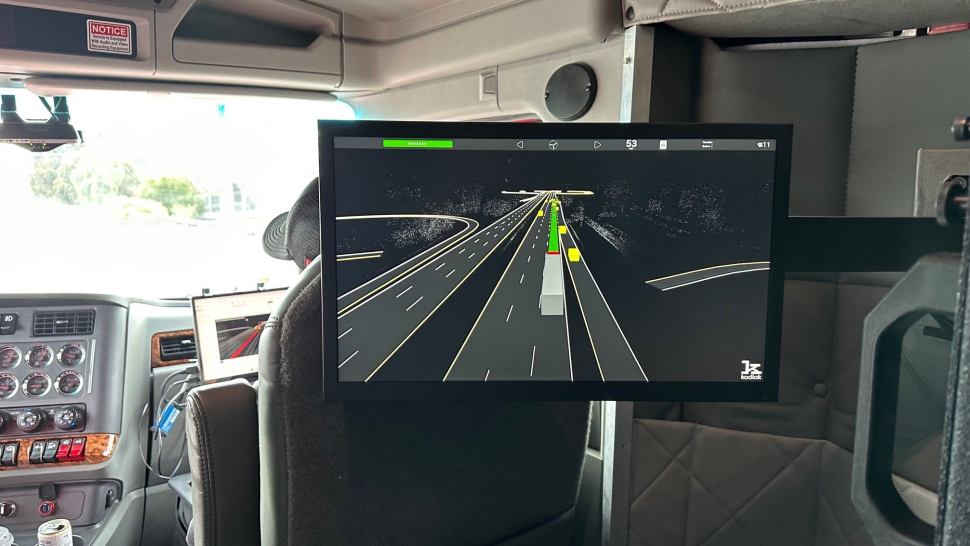
“FMCSA should codify this interpretation and reduce the potential for future misinterpretation,” Kodiak Robotics wrote in March 21 comments on the agency’s supplemental notice of proposed rulemaking focused on trucks with level 4 (high autonomy) or level 5 (full autonomy).
The Mountain View, California-based startup focused on two amendments.
The first seeks to clarify that HOS regulations do not apply to level 4 or level 5 trucks. Since they don’t get tired or distracted, they don’t need a limit on operating hours.
The second amendment would exempt autonomous trucks from minimum qualifications and duties for drivers.
“FMCSA’s most foundational frameworks can be retooled to ensure the operational safety of AV fleets,” Kodiak wrote. “FMCSA’s existing rules create operational frameworks for certain load types and business models. It can encourage industry standardization around AV fleet operational safety.”
The FMCSA received 182 submissions to questions it posed by the expiration of the comment period on March 21.
“Fundamentally there’s pretty broad agreement about the key issues,” Dan Goff, Kodiak head of external affairs, told FreightWaves.
Hub to hub and then what for ELDs?
Driverless trucks expect to operate in a hub-to-hub model. Human drivers would drive a load to the originating hub. They would be met at the destination hub by other human drivers.
“They’d still have their 14-hour window to operate within and both driving and on duty not driving,” Deck told FreightWaves. “The challenge will be tracking those drivers. If they’re driving that one truck, and then they’re switching to a different truck, tracking that driver and their hours of service is very challenging.”
The FMCSA granted just one exemption to the ELD rule when it went into effect in December 2017. That was to the Motion Picture Association of America (MPAA). It could not figure out how to make ELDs work for drivers operating multiple trucks in a single day.
The solution: daily independent auditing of paper logs.
“There was no way to track hours of service,” Deck recalled. “The agency felt very comfortable that [MPAA was] going above and beyond what even an ELD would do. An ELD’s not going to tell a driver, ‘Hey, you can’t drive tomorrow.’”
The FMCSA recently renewed the MPAA’s exemption.
Could a similar scenario apply for short-haul drivers moving loads from an autonomous hub to a distribution center multiple times?
“[If] you’re moving the goods more efficiently back and forth between the distribution centers hub to hub, you’re going to increase the goods in either location needing to get to the initial stage for the autonomous truck to pick up, and then for it to drive however many hours you can operate that thing in a day,” Deck said.
“Because the ELD is tuned to the particular truck to measure the miles and everything on that particular truck, it’s not something you can move from truck to truck to follow the driver.”
Hey drivers, ELDs are probably here to stay. But what if the truck-based functions of an ELD could be transferred to a wearable device for drivers moving from truck to truck? Would you favor such a device? Would you wear one yourself? Let me know what you think at aadler@www.freightwaves.com. Please put ELD in the subject line and give me a way to contract you.
Related articles:
Federal law designed to make trucking safer may have aggravated worst issues
The quest to get truck drivers to stop worrying and love the ELD
ELDs coming to California intrastate truck in 2024, trailing rest of US
Brokerage Compliance Symposium
The day before F3. Every compliance issue you face - fraud exposure, carrier liability, FMCSA rules, cargo theft, insurance gaps - navigated by attorneys and operators defining best practices in a changing industry.
F3 Awards Dinner
The night before F3. FreightTech100 companies honored. FreightTech 25 and Shipper of Choice winners revealed live. Cocktail reception into dinner and live music - 300 industry leaders in one purpose-built room.
F3: Future of Freight Festival
Industry-defining keynotes, rapid-fire technology demos, and industry leaders networking in experiences across Chattanooga - plus the inaugural F3 Awards Dinner featuring the FreightTech and Shipper of Choice reveals.
The day before F3. Every compliance issue you face - fraud exposure, carrier liability, FMCSA rules, cargo theft, insurance gaps - navigated by attorneys and operators defining best practices in a changing industry.
The Signal at Chattanooga Choo Choo • Chattanooga, TN Register NowThe night before F3. FreightTech100 companies honored. FreightTech 25 and Shipper of Choice winners revealed live. Cocktail reception into dinner and live music - 300 industry leaders in one purpose-built room.
The Signal at Chattanooga Choo Choo • Chattanooga, TN Register NowIndustry-defining keynotes, rapid-fire technology demos, and industry leaders networking in experiences across Chattanooga - plus the inaugural F3 Awards Dinner featuring the FreightTech and Shipper of Choice reveals.
The Signal at Chattanooga Choo Choo • Chattanooga, TN Register Now