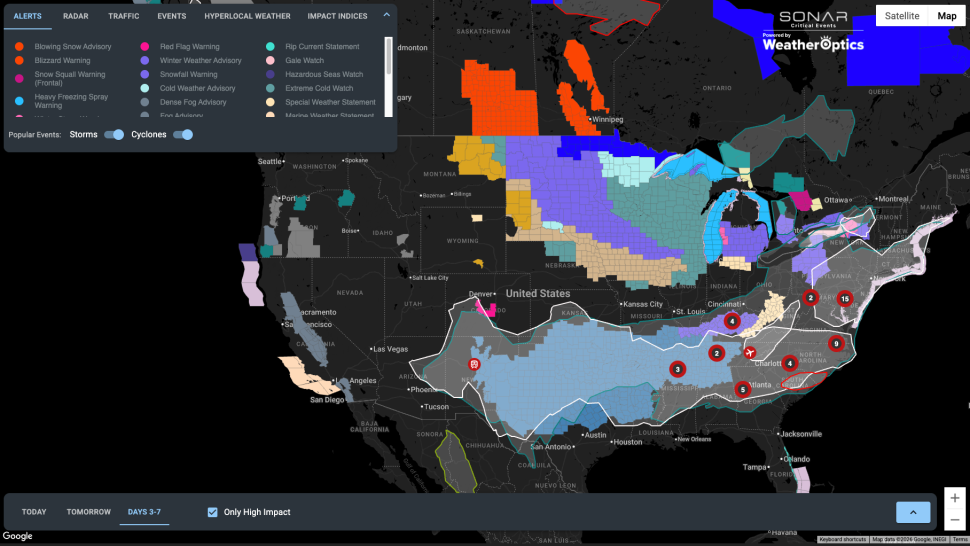
A powerful winter storm is setting its sights on a wide swath of the Southeast and the lower Midwest this weekend, bringing a dangerous mix of snow, freezing rain, and ice that could significantly disrupt road travel and regional freight movement. Meteorologists say the setup is particularly concerning for southern states that are less equipped to manage prolonged winter weather, especially ice.
In the Midwest and Great Lakes, colder air already in place will support additional snow showers, creating slick road conditions and reduced visibility. Farther south, however, the greater threat is ice.
As Arctic air funnels southward at the surface, a layer of much warmer air just a few thousand feet above ground will cause falling snow to melt into rain before refreezing on contact with frozen roads, bridges, and overpasses. This classic freezing-rain setup is expected to put Georgia, Alabama, the Carolinas, and parts of Tennessee in the bull’s-eye as the storm evolves Saturday into Sunday.
Forecasts indicate widespread ice accumulations across parts of the Southeast, with isolated areas potentially seeing more. Exact totals cannot be predicted, as the forecast is subject to change between now and Saturday; however, some areas may see up to half an inch of ice.
That may not sound extreme, but even a thin glaze of ice can make roads impassable, dramatically increase crash risk, and force closures, particularly along major freight corridors such as I-10, I-20, I-40, and connecting north–south routes with the most impacts happening around I-40. Power outages from ice-laden lines and trees could further complicate recovery efforts and delay road treatment.
Timing will be critical. Rain is expected early Saturday from Mississippi through central Georgia, but colder air will steadily push south and east. By Saturday night into early Sunday, cities including Charlotte, Raleigh, and Atlanta could see a transition from rain to freezing rain or a wintry mix, while Nashville, Knoxville, and parts of the Ohio and Tennessee valleys trend more toward snow.
Sunday morning into the afternoon appears to be the most hazardous period, when freezing rain and snow are most likely to overlap with peak travel impacts.
Transportation officials are urging commercial and passenger drivers to stay off the roads if possible, particularly on Sunday, as conditions may deteriorate rapidly and remain dangerous until the system clears out by Monday.
Brokerage Compliance Symposium
The day before F3. Every compliance issue you face - fraud exposure, carrier liability, FMCSA rules, cargo theft, insurance gaps - navigated by attorneys and operators defining best practices in a changing industry.
F3 Awards Dinner
The night before F3. FreightTech100 companies honored. FreightTech 25 and Shipper of Choice winners revealed live. Cocktail reception into dinner and live music - 300 industry leaders in one purpose-built room.
F3: Future of Freight Festival
Industry-defining keynotes, rapid-fire technology demos, and industry leaders networking in experiences across Chattanooga - plus the inaugural F3 Awards Dinner featuring the FreightTech and Shipper of Choice reveals.
The day before F3. Every compliance issue you face - fraud exposure, carrier liability, FMCSA rules, cargo theft, insurance gaps - navigated by attorneys and operators defining best practices in a changing industry.
The Signal at Chattanooga Choo Choo • Chattanooga, TN Register NowThe night before F3. FreightTech100 companies honored. FreightTech 25 and Shipper of Choice winners revealed live. Cocktail reception into dinner and live music - 300 industry leaders in one purpose-built room.
The Signal at Chattanooga Choo Choo • Chattanooga, TN Register NowIndustry-defining keynotes, rapid-fire technology demos, and industry leaders networking in experiences across Chattanooga - plus the inaugural F3 Awards Dinner featuring the FreightTech and Shipper of Choice reveals.
The Signal at Chattanooga Choo Choo • Chattanooga, TN Register Now