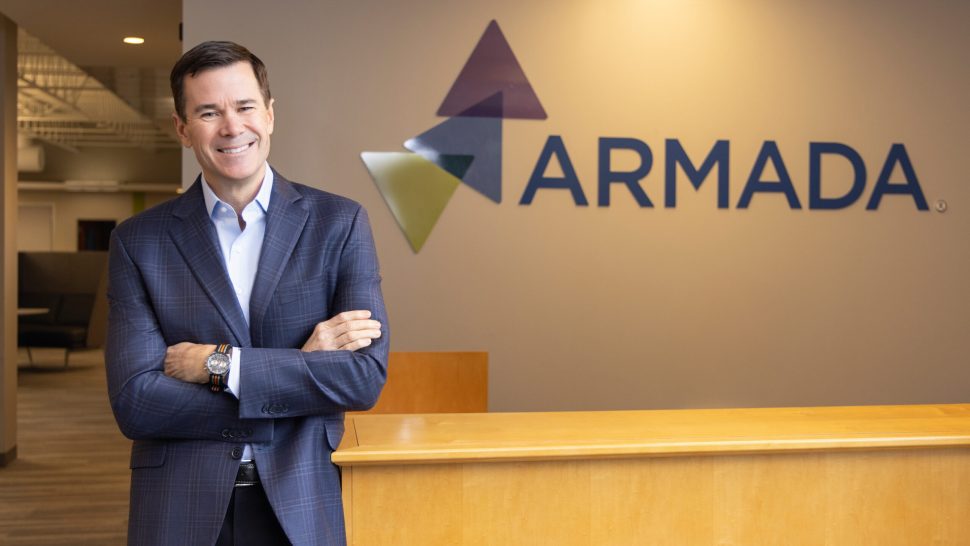
(Editor’s note: several alterations have been made in the article since its first publication to better reflect Armada’s business activities.)
When Chris O’Brien was hired by Armada Supply Chain Solutions as its president at the start of 2025, after having departed C.H. Robinson at the close of 2023, putting together Armada with its sister logistics companies under one brand was not on the agenda.
When O’Brien joined Armada as president, it had three logistics holdings: Armada Supply Chain Solutions, which specialized in servicing restaurants; Sunset Transportation, more of a general all-purpose 3PL but with strong ties to the automotive industry; and ATEC Logistics, which O’Brien described as an ocean and air forwarder with a specialty of operating in Latin America.
When O’Brien joined Armada in January 2025, he said in an interview with FreightWaves to announce the overhaul of the company’s structure, he did not do so with a plan in place or envisioned to combine the three companies into one.
Rather, he added, the decision to combine the three companies was part of a “thoughtful transition” that occurred after O’Brien had extensive discussions with the two primary owners of Armada, Joe Dominijanni, currently the CEO of Armada Supply Chain, and John Burke, the company’s chairman.
In the reorganization, Burke will remain as chairman and Dominijanni will become vice chair.
Customer base at Armada had overlap with CHRW
O’Brien said when he joined Armada, he knew many of Armada’s customers, having worked with them during his time at C.H. Robinson (NASDAQ: CHRW). (The prepared statement announcing the consolidation at Armada said at C.H. Robinson, O’Brien “led commercial strategy and scaled high-performing teams.”)
Eventually, working in the business and the discussions with the company’s two principals led to the decision to pull together the company’s three units under one banner. “But that wasn’t the plan that was a part of hiring me” O’Brien added.
The three companies will operate under a unified Armada brand. “From a leadership and management team standpoint, we’ll go to one integrated company,” O’Brien said. “We’re going to invest in this brand. I didn’t want to do it across three brands.”
The combined company has revenue of about $5.7 billion, O’Brien said. Its goal is to double that in five years.
“We’ve got a great story to tell,” O’Brien said. “I just didn’t want to do it across three different brands.”
O’Brien will assume the CEO role at the start of 2026.
Restaurants are the focus
The legacy Armada Supply Chain Solutions has essentially its entire customer base in one business: restaurants.
Measuring market share at Armada, O’Brien said the company’s clients include 30% of all restaurants that are in the top 200 as measured by revenue, “so for most of those clients we partner with and help manage their inventory and freight.”
Where Armada is unique among 3PLs in that it owns four warehouses: in Pennsylvania near Harrisburg on the I-81 corridor, and locations near Chicago, Dallas and Atlanta. It also has a third party relationship that gives it access to warehouse capacity in southern California.
But another service it provides that is very un 3PL-like, and can only be accomplished because of its warehouses, is that it takes “all those slower moving goods” that O’Brien said can not be received in full truckloads at customer distribution centers and plans their distribution to the customer outlets. “So we’re saving a lot of money [for customers], managing that inventory,” O’Brien said.
“When we go out and bring in this inventory, we’re typically buying that inventory and managing on behalf of our customers,” O’Brien said.
And it’s done by Armada because “you’ve got a lot of supply chain professionals in there.”
Armada also manages a restaurant company’s carriers that are servicing its outlets, O’Brien said. He added that Armada keeps a small number of carriers that it uses to service its clients, putting the number at about 100 medium to large carriers.
Armada works closely with its clients on supply chain planning and “we get very involved in the order flow. There’s a part of our business that is really like a supply chain financial service.”
Even though Sunset is not a restaurant specialist like Armada, O’Brien said the company was providing it with trucking capacity. “Over the last three years, they’ve learned a lot about the restaurant space,” O’Brien said.
But he added there is no plan to have Sunset specialize only in the restaurant business.
Growing Sunset through warehouses
With Sunset’s diversification, O’Brien said he believes Sunset can grow under the Armada banner by utilizing the warehouse space and the capabilities of managing inventory in those facilities.
“I’ve never had that combination of a 3PL with warehousing services in the past,” O’Brien said. “It’s when we bring those two things together that is why we are so dominant in the restaurant space.”
The expertise that Armada has in the blended model of 3PL plus warehouses can be combined with the various industries that Sunset is involved in–O’Brien mentioned automotive several times–”and by integrating, we can bring in customers and expertise that takes us into these other industries.”
While Sunset was diversified, O’Brien said ATEC also has been focused on servicing restaurants. “There were many shared ATEC customers across Armada,” O’Brien said. That overlap will allow expansion in the international restaurant business, he added.
Asked about any drawbacks in bringing the three companies under one banner, O’Brien said the potential loss of “three unique individual cultures” was a key consideration.
The goal in the integration will be to create a new culture across Armada, rather than have Sunset and ATEC being driven into the culture of the larger sister company swallowing them up.
“Instead of going down that path, of losing those cultures, we decided we would create something new,” O’Brien said. “So this just wasn’t just going to be those two things being swallowed up into Armada. It was creating something new, a bigger, stronger Armada.”
More articles by John Kingston
Louisiana scheme to obtain class A CDLs without passing tests snags six in sweeping indictment
Trimble’s Freight Marketplace snags its first shipper: Procter & Gamble
California vs. US showdown: two cases might head to same stage, and Federal Register notice posted
Brokerage Compliance Symposium
The day before F3. Every compliance issue you face - fraud exposure, carrier liability, FMCSA rules, cargo theft, insurance gaps - navigated by attorneys and operators defining best practices in a changing industry.
F3 Awards Dinner
The night before F3. FreightTech100 companies honored. FreightTech 25 and Shipper of Choice winners revealed live. Cocktail reception into dinner and live music - 300 industry leaders in one purpose-built room.
F3: Future of Freight Festival
Industry-defining keynotes, rapid-fire technology demos, and industry leaders networking in experiences across Chattanooga - plus the inaugural F3 Awards Dinner featuring the FreightTech and Shipper of Choice reveals.
The day before F3. Every compliance issue you face - fraud exposure, carrier liability, FMCSA rules, cargo theft, insurance gaps - navigated by attorneys and operators defining best practices in a changing industry.
The Signal at Chattanooga Choo Choo • Chattanooga, TN Register NowThe night before F3. FreightTech100 companies honored. FreightTech 25 and Shipper of Choice winners revealed live. Cocktail reception into dinner and live music - 300 industry leaders in one purpose-built room.
The Signal at Chattanooga Choo Choo • Chattanooga, TN Register NowIndustry-defining keynotes, rapid-fire technology demos, and industry leaders networking in experiences across Chattanooga - plus the inaugural F3 Awards Dinner featuring the FreightTech and Shipper of Choice reveals.
The Signal at Chattanooga Choo Choo • Chattanooga, TN Register Now