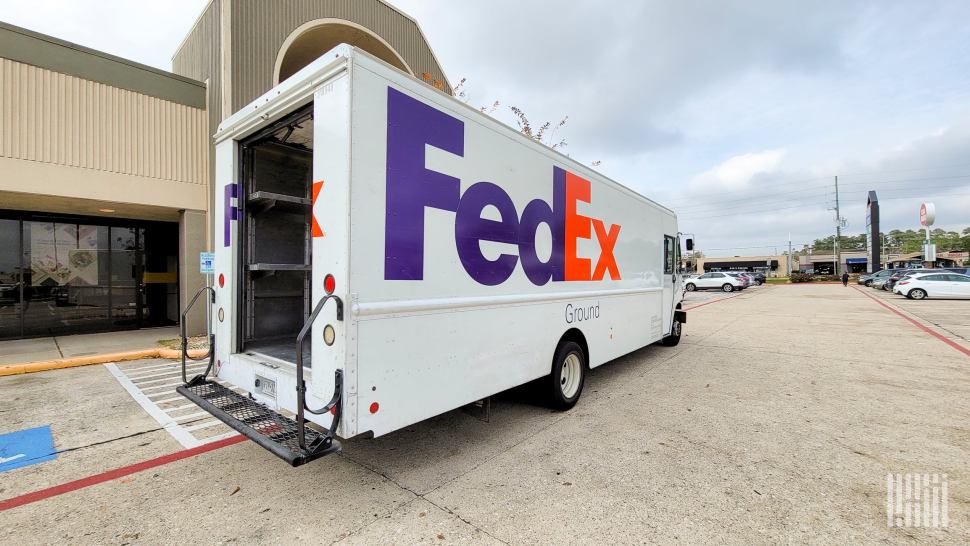
Not every analyst is head over heels over FedEx Corp.’s announcement Wednesday that it will integrate its two largest operating units June 1, 2024, in an effort to kick-start its way to as much as $6 billion in savings through 2027.
Ravi Shanker, of Morgan Stanley & Co., who has been mostly bearish on FedEx (NYSE: FDX) shares, warned investors not to ignore top-line risk while focusing exclusively on the cost-cutting actions. Mean reversion of pandemic demand and an increasingly competitive market all pose real challenges that cost cutting won’t solve, he said.
Another factor is the downgrading of service modes that could come from the company’s Drive plan, through which it expects to save $4 billion by the end of its fiscal year 2025, which ends in May 2025. In the air business, trucks could be substituted for planes. On the ground delivery side, trucks would be replaced by rail and intermodal. “This should deliver cost savings on paper but we think could bring operational challenges,” Shanker wrote.
Rerouting to slower transport modes, and shifting to non-central air hubs, “could end up slowing the entire parcel move and reduce service.” That is especially the case on the ground because rail service is not up to truck’s levels, he wrote.
In addition, more stops and touches, which could be likely under these steps, is far more costly and disruptive than it is today, Shanker wrote. “We need more data/evidence to see if this new approach can indeed result in net cost savings.”
The real benefit of the integration, which combines FedEx Ground, FedEx Express and its FedEx Services unit, will not occur until fiscal year 2027 or even beyond, when the $2 billion in total savings for the consolidation, known as “Network 2.0,” are expected to be realized.
Outsourcing the delivery of non-high-value parcels and keeping high-margin assets on company equipment is another key element of gains in Drive. However, those steps also raise questions about control and service quality, especially during peak season and other tight upcycles, Shanker said.
FedEx Freight, the company’s LTL operation, will remain a stand-alone entity and sell services as usual. Shanker called the announcement “meaningful” in that it may be a setup to sell or spin off the business. However, he thought that to be doubtful because it is too heavily embedded in the rest of the company.
The One FedEx announcement made Wednesday puts the company on the path to the “holy grail” of integration gains but will likely take smaller steps and a longer path than the headlines suggest, Shanker said. For example, the company did not make any other structural decisions like exiting or significantly restructuring its long-troubled European business. There was also some speculation it would upsize the Drive savings target, which did not happen.
Shanker raised his price target $35 a share to $180, still well below his peers. The big leap reflects the fact that earnings have stopped falling and the market is willing to give FedEx credit for cost-cutting potential and for restoring the stock’s multiple to historic levels, he said.
Tom Wadewitz of UBS Securities has been far more bullish, and it showed again in a note late Wednesday. He said elimination of operating redundancies under the integration provides a significant lever for cost reduction and greater clarity on the cost-out structure “points to a long runway” for the stock.
Wadewitz said the plans highlighted on Wednesday are solid, but management would need to show it can execute on the cost takeout initiatives to bring it to fruition.
Wadewitz has a $260 per share, 12-month buy target. Shares rose nearly $3 Thursday to near $233 a share.
Brokerage Compliance Symposium
The day before F3. Every compliance issue you face - fraud exposure, carrier liability, FMCSA rules, cargo theft, insurance gaps - navigated by attorneys and operators defining best practices in a changing industry.
F3 Awards Dinner
The night before F3. FreightTech100 companies honored. FreightTech 25 and Shipper of Choice winners revealed live. Cocktail reception into dinner and live music - 300 industry leaders in one purpose-built room.
F3: Future of Freight Festival
Industry-defining keynotes, rapid-fire technology demos, and industry leaders networking in experiences across Chattanooga - plus the inaugural F3 Awards Dinner featuring the FreightTech and Shipper of Choice reveals.
The day before F3. Every compliance issue you face - fraud exposure, carrier liability, FMCSA rules, cargo theft, insurance gaps - navigated by attorneys and operators defining best practices in a changing industry.
The Signal at Chattanooga Choo Choo • Chattanooga, TN Register NowThe night before F3. FreightTech100 companies honored. FreightTech 25 and Shipper of Choice winners revealed live. Cocktail reception into dinner and live music - 300 industry leaders in one purpose-built room.
The Signal at Chattanooga Choo Choo • Chattanooga, TN Register NowIndustry-defining keynotes, rapid-fire technology demos, and industry leaders networking in experiences across Chattanooga - plus the inaugural F3 Awards Dinner featuring the FreightTech and Shipper of Choice reveals.
The Signal at Chattanooga Choo Choo • Chattanooga, TN Register Now