




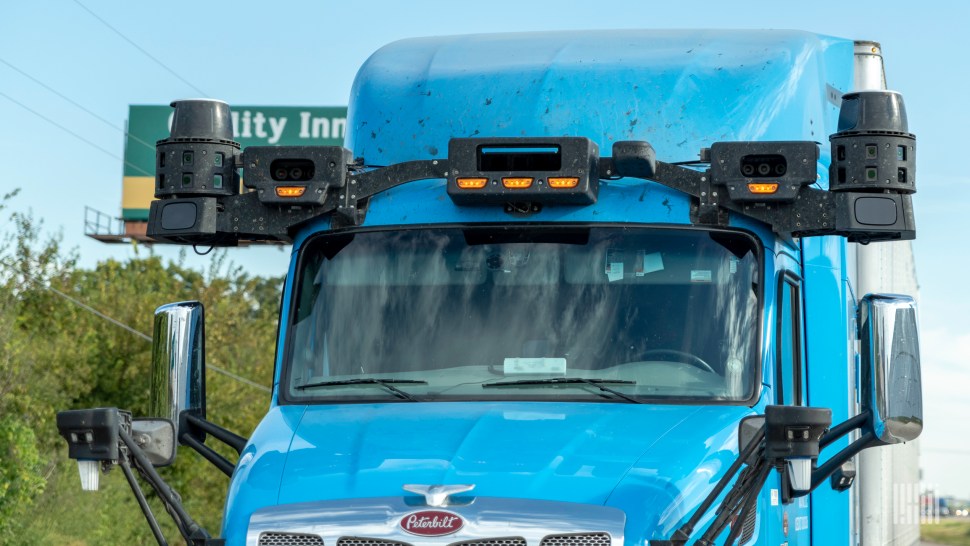
WASHINGTON — The long-haul trucking industry may have just received a legislative roadmap for the future of autonomous vehicle operations.
U.S. Reps. Bob Latta, R-Ohio, and Debbie Dingell, D-Mich., released this week a discussion draft of a new bill, “Safely Ensuring Lives Future Deployment and Research in Vehicle Evolution (SELF DRIVE) Act” of 2026, the first federal statute – if enacted – advancing AV regulations for trucking.
The bipartisan bill moves to dismantle regulatory roadblocks that have kept autonomous freight in a perpetual “testing” phase by allowing limited commercial operations while trucks are evaluated during their pilot stage.
By preempting state-level restrictions on autonomous vehicles, it provides the legal certainty required to move autonomous heavy trucks from closed tracks to interstate commerce.
“It would have major implications for not only federal, but also state and local regulation,” wrote Adam Raviv, co-leader of the automotive and mobility practice at the law firm Sidley Austin LLP, in a blog posted on Thursday. “It would also raise some key legal questions and require federal regulators to promulgate a new federal motor vehicle safety standard very different from any of its predecessors.”
Raviv pointed out that some states have imposed testing mandates and permitting requirements for AV deployment, while others prohibit vehicles from operating without a driver. “The various state and local regulations have been frequently derided as a ‘patchwork’ and the SELF DRIVE Act would slice that patchwork to tatters,” he said.
The draft specifies that vehicles with automated driving systems configured “solely to carry property” – such as driverless trucks – cannot be required to include manually operated controls or equipment intended to support a human driver. This allows for the design of “cab-less” trucks, optimized for aerodynamics rather than human comfort, and potentially reducing weight and increasing cargo space.
In addition, the bill establishes a National Automated Vehicle Safety Data Repository, which would replace the National Highway Traffic Safety Administration’s “Standing General Order” issued in 2021, which has required manufacturers to report crashes involving ADS-equipped vehicles.
“The repository would be accessible by state and local transportation agencies, but would also prohibit those agencies from requiring crash reporting that is already encompassed by the repository’s requirements,” according to Raviv.
For the freight sector, certain “covered crashes” as delineated in the legislation would be required to be reported in the repository, as well as quarterly reports on “total miles traveled in revenue service during commercial operations”. The repository data would be used to establish the safety record of autonomous trucks compared to human-driven fleets.
Latta introduced earlier iterations of “SELF DRIVE” legislation in 2017 and 2021 but those bills, which did not get enacted, intentionally excluded autonomous trucks, likely to avoid labor-related friction.
“Whether this legislation gets further than the previous two remains to be seen,” Raviv said, noting it could end up folded into the highway bill reauthorization that Congress is taking up this year.
Related articles:
F3: Future of Freight Festival
Industry-defining keynotes, rapid-fire technology demos, and industry leaders networking in experiences across Chattanooga - plus the inaugural F3 Awards Dinner featuring the FreightTech and Shipper of Choice reveals.
Industry-defining keynotes, rapid-fire technology demos, and industry leaders networking in experiences across Chattanooga - plus the inaugural F3 Awards Dinner featuring the FreightTech and Shipper of Choice reveals.
The Signal at Chattanooga Choo Choo • Chattanooga, TN Register Now