




Alaska Airlines wants to renegotiate the cargo flying contract with Amazon it inherited after acquiring Hawaiian Airlines 16 months ago because the venture isn’t very economical, a top executive strongly suggested last month.
Industry experts familiar with both companies say Alaska Airlines’ dissatisfaction with the Amazon (NASDAQ: AMZN) business likely stems from difficulties aligning passenger and cargo pilot schedules for better efficiency, and contract terms with razor-thin profit margins.
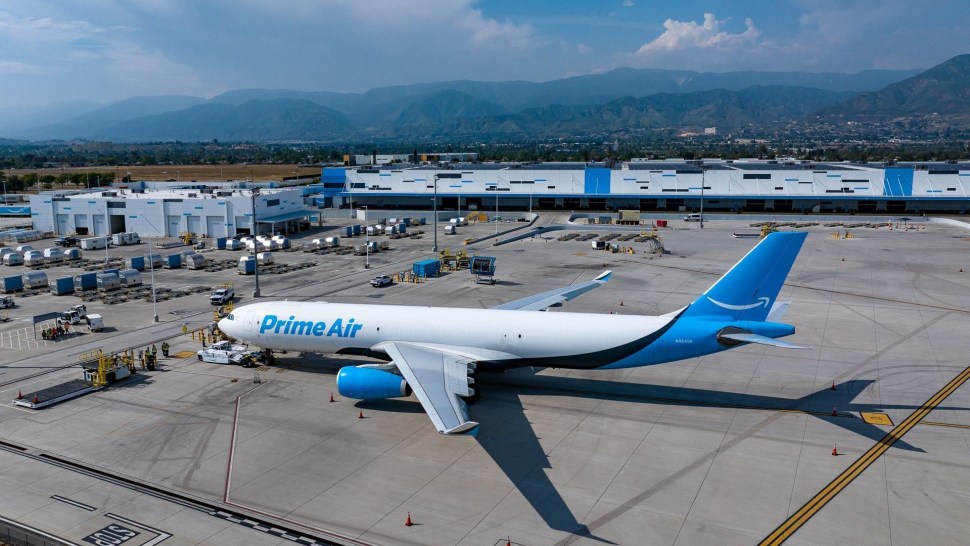
Hawaiian Airlines began supporting Amazon’s air logistics network in October 2023 and currently operates 10 Airbus A330-300 converted freighter aircraft on behalf of the retail giant. Under the contract, Amazon supplies the leased widebody aircraft and Hawaiian provides crews and maintenance. Alaska Air Group acquired Hawaiian in September 2024.
“We’re excited about the cargo side of the business, but there is optimization that has to happen. [The dedicated charter arrangement] with Amazon is a tough business. It’s only 10 aircraft. It’s a whole different operation than the passenger side of the business. And we’ve got to make that work long-term,” Alaska Air Group’s Chief Financial Officer Shane Tackett said during a session at the Goldman Sachs Industrial and Materials Conference on Dec. 4.
“So there are parts of the business that are going to require focus to optimize. It’s now clear where we have to go and sort of fix pieces that were a little bit broken when we closed the transaction,” he added, without providing specifics.
Alaska Air declined to provide an additional comment. Media representatives from Amazon did not respond to queries. Amazon and Alaska Air are both based in Seattle.
As the integration of Alaska Airlines and Hawaiian continues, management probably realized the Amazon contract wasn’t favorably structured and limited its ability to use passenger and cargo pilots interchangeably, said an aviation industry source with intimate knowledge of the situation who spoke on condition of anonymity to preserve existing relationships.
“It wouldn’t necessarily surprise me that there is some expectation of renegotiating the deal on Alaska’s part,” the industry insider told FreightWaves.
Hawaiian signed the deal with Amazon in 2022, when it was on its way to losing nearly $900 million over three years because the Covid crisis decimated certain markets and was eager for some form of stable revenue. Amazon was interested because Hawaiian was one of only two A330 operators in the United States.
The aviation professional said Amazon, as it normally does with vendors, drove a hard bargain, leaving Hawaiian with an uneconomical fixed-fee deal with little room to decrease costs and enhance margins.
Alaska now covets the added operational flexibility of utilizing the A330 cargo pilots for more valuable international long-haul flights after acquiring two dozen A330-200s from Hawaiian as well as Hawaiian’s orderbook for 787 Dreamliners from Boeing, according to the source. Alaska, which has four 787s in its fleet, last year began flying from Seattle to Tokyo and Seoul, South Korea, as it transitions from a predominantly domestic carrier to a global one. The airline is scheduled to open service to Rome and London in the spring.
Hawaiian hired at least 160 additional pilots and opened a pilot base at Cincinnati/Northern Kentucky International Airport (CVG), where Amazon’s super hub for transferring parcels across the country is located, to service the Amazon account.
Pilots deployed for Amazon don’t offer improved operations efficiency because they can’t easily be reassigned to the passenger operation, especially since Alaska doesn’t operate widebody aircraft at CVG. And most of Amazon’s A330 routes don’t go to cities where Hawaiian operates A330 passenger service.
Earlier this month, Allegiant announced plans to acquire rival low-cost leisure carrier Sun Country Airlines, which operated 20 Boeing 737-800 cargo jets for Amazon. Sun Country CEO Jude Bricker said one of the benefits of the merger is that Sun Country gains access to 22 pilot bases, which make it easier to reposition crews for cargo flying and free up pilot capacity for other growth.
One of the challenges from the outset for Hawaiian Airlines has been the lack of synergy between the passenger and cargo crew bases, another logistics expert with ties to Amazon said.
All-cargo airlines that also provided outsourced capacity for Amazon’s network typically pay for pilots to commute from their hometown to the airport where their flight originates because their non-Amazon routes are constantly shifting with market demand. Scheduled airlines, including FedEx and UPS, will base pilots at certain locations where flight operations are dense enough to save on commuting costs.
“If you can pool a resource, it’s always gonna be cheaper. It’s easier to maintain a pilot base for passenger airlines because they usually have more connecting flights and schedules than a cargo airline that doesn’t have a super regular schedule,” the logistics professional said.
Periodic changes to Amazon’s route structure, or the number of flight hours required each month, could conflict with Hawaiian’s original pricing assumptions on pilot staffing levels and expenditures, or make it more difficult to rotate crews to passenger flying, the expert added.
Alaska Airlines cargo revenue increased 11% year over year to $146 million during the fourth quarter, according to results issues on Thursday. The company doesn’t break out the Amazon business from freight sales in its own network.
Click here for more FreightWaves/American Shipper stories by Eric Kulisch.
Write to Eric Kulisch at ekulisch@freightwaves.com.
RELATED STORIES:
Alaska Air completes Hawaiian cargo integration ahead of other units
Brokerage Compliance Symposium
The day before F3. Every compliance issue you face - fraud exposure, carrier liability, FMCSA rules, cargo theft, insurance gaps - navigated by attorneys and operators defining best practices in a changing industry.
F3 Awards Dinner
The night before F3. FreightTech100 companies honored. FreightTech 25 and Shipper of Choice winners revealed live. Cocktail reception into dinner and live music - 300 industry leaders in one purpose-built room.
F3: Future of Freight Festival
Industry-defining keynotes, rapid-fire technology demos, and industry leaders networking in experiences across Chattanooga - plus the inaugural F3 Awards Dinner featuring the FreightTech and Shipper of Choice reveals.
The day before F3. Every compliance issue you face - fraud exposure, carrier liability, FMCSA rules, cargo theft, insurance gaps - navigated by attorneys and operators defining best practices in a changing industry.
The Signal at Chattanooga Choo Choo • Chattanooga, TN Register NowThe night before F3. FreightTech100 companies honored. FreightTech 25 and Shipper of Choice winners revealed live. Cocktail reception into dinner and live music - 300 industry leaders in one purpose-built room.
The Signal at Chattanooga Choo Choo • Chattanooga, TN Register NowIndustry-defining keynotes, rapid-fire technology demos, and industry leaders networking in experiences across Chattanooga - plus the inaugural F3 Awards Dinner featuring the FreightTech and Shipper of Choice reveals.
The Signal at Chattanooga Choo Choo • Chattanooga, TN Register Now