




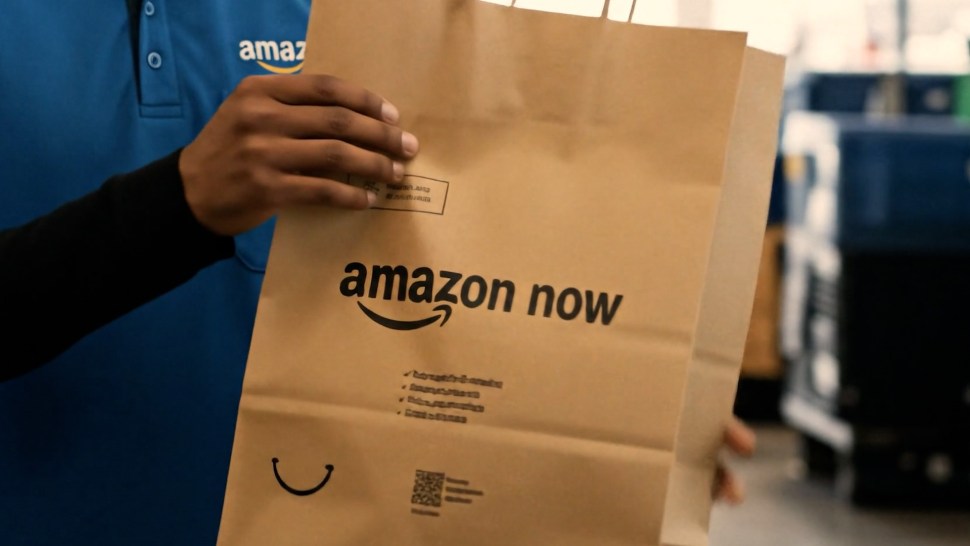
Amazon has launched a pilot program for ultra-fast delivery designed to drop off groceries and other household items in as little as 30 minutes, the company announced Monday afternoon.
The Amazon Now (NASDAQ: AMZN) service is available in parts of Seattle and Philadelphia, at a cost of $3.99 for Prime members and $13.99 for non-Prime members. Orders below $15 will be charged an extra $1.99.
The announcement follows last month’s expansion of Amazon Now in the United Arab Emirates, where customers can receive everyday essentials in 15 minutes.
Amazon Now will operate out of strategically located, urban micro-fulfillment centers, where Amazon Flex on-demand workers will pick up packaged orders of food, snacks, personal care products, electronics, medicines and other merchandise. The centers position essential products close to neighborhoods and work districts, utilizing advanced inventory systems that optimize product selection based on hyperlocal demand to maximize efficiency and speed.
Amazon has similarly created small, specialized facilities in the UAE designed exclusively for rapid delivery. It also recently launched a two-hour delivery service there on products from 30 categories.
Shoppers in Seattle and Philadelphia can check the Amazon shopping app and website for the “30-Minute Delivery” option in the navigation bar to learn if they have the service in their area. They can choose from thousands of food, health, paper, electronics, snacks, medicines and seasonal items, Amazon said.
The Information, which published a story shortly before Amazon’s announcement, noted that convenience-store items can be low margin and sometimes even unprofitable, but they encourage repeat buyers and bring shoppers to its website, which is beneficial to the overall business.
Amazon has made grocery a strategic focus this year. It reorganized Whole Foods, is expanding same-day grocery delivery to more than 2,300 U.S. cities, and has partnered with more local grocers to broaden its grocery selection. On Amazon’s third-quarter earnings call, CFO Brian Olsavsky mentioned that grocery shoppers tend to return to the marketplace twice as often as non-grocery shoppers.
“We think Amazon Now is potentially an important step toward Amazon matching or even surpassing the immediacy benefit of in-store purchasing. We expect Amazon Now to have low or even negative overall margins (about~$6 in fees plus product gross margins probably do not cover small basket delivery cost unless over a very short distance), but we think its impact on 2026 profitability will be limited given its small scale,” Bank of America analyst Justin Post, said in a research note. “Additionally, if the offering scales, Amazon Now could have an important lock-in benefit for Prime users” and drive higher margin third-party marketplace revenues.
Walmart is delivering about 7% of its store fulfilled orders in less than 30 minutes, according to calculations by parcel consultant Nate Skiver on LinkedIn based on figures in the company’s second quarter earnings call.
Click here for more FreightWaves stories by Eric Kulisch.
Sign up for the biweekly PostalMag newsletter The Delivery here.
RECOMMENDED READING:
Amazon closes Arkansas warehouse over earthquake-related design flaw
Brokerage Compliance Symposium
The day before F3. Every compliance issue you face - fraud exposure, carrier liability, FMCSA rules, cargo theft, insurance gaps - navigated by attorneys and operators defining best practices in a changing industry.
F3 Awards Dinner
The night before F3. FreightTech100 companies honored. FreightTech 25 and Shipper of Choice winners revealed live. Cocktail reception into dinner and live music - 300 industry leaders in one purpose-built room.
F3: Future of Freight Festival
Industry-defining keynotes, rapid-fire technology demos, and industry leaders networking in experiences across Chattanooga - plus the inaugural F3 Awards Dinner featuring the FreightTech and Shipper of Choice reveals.
The day before F3. Every compliance issue you face - fraud exposure, carrier liability, FMCSA rules, cargo theft, insurance gaps - navigated by attorneys and operators defining best practices in a changing industry.
The Signal at Chattanooga Choo Choo • Chattanooga, TN Register NowThe night before F3. FreightTech100 companies honored. FreightTech 25 and Shipper of Choice winners revealed live. Cocktail reception into dinner and live music - 300 industry leaders in one purpose-built room.
The Signal at Chattanooga Choo Choo • Chattanooga, TN Register NowIndustry-defining keynotes, rapid-fire technology demos, and industry leaders networking in experiences across Chattanooga - plus the inaugural F3 Awards Dinner featuring the FreightTech and Shipper of Choice reveals.
The Signal at Chattanooga Choo Choo • Chattanooga, TN Register Now