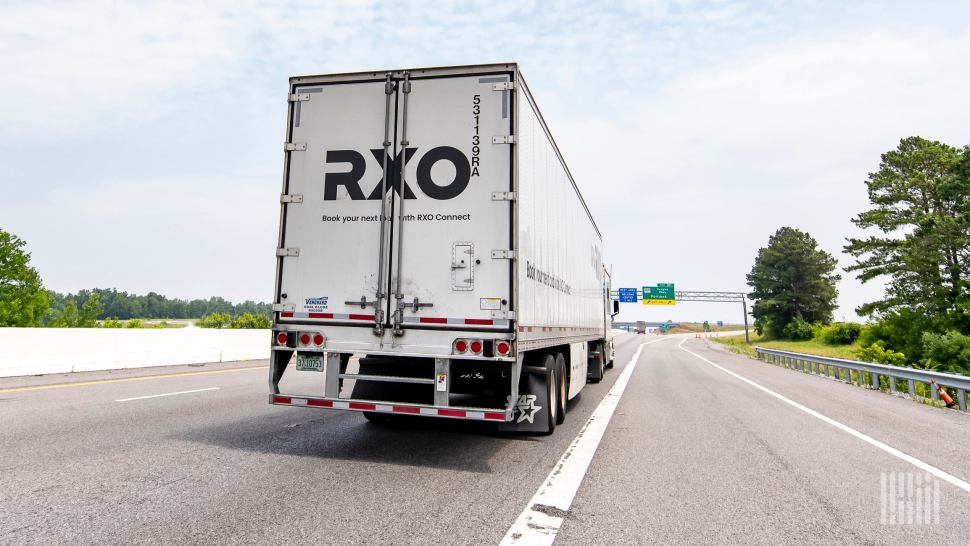
With a fourth quarter earnings report and subsequent call with analysts that was as negative as anticipated, RXO took the approach in its public-facing actions that it would seek to highlight what is getting better.
In its prepared released disclosed late Thursday, in an interview with FreightWaves and on its quarterly conference call, RXO (NYSE: RXO) management tried to shift the focus away from another quarter with lower EBITDA and another net loss and instead look at changes in its own structure to say it is well positioned to benefit from a turnaround in the freight market.
That broader freight market strengthening is well underway. But for a broker, the early stages of that are not good news. Spot rates rise, contract rates are stuck where they were negotiated, and the squeeze is on.
Drew Wilkerson, RXO CEO, summed up the market situation for brokers in his opening remarks on the conference call. “In December, rates increased by about 15% month over month, much faster than our contractual sale rates,” he said. “At the same time, demand remains off with not enough spot loads to offset the rise of purchased transportation costs.”
Wilkerson said the strength of the market was visible in the “waterfall” of freight going through routing guides, “where it’s making past the second, third and fourth carrier.”
The strength of the spot market is most visible in the SONAR Outbound Tender Rejection Index, which has soared in recent weeks.

Jared Weisfeld, the company’s chief strategy officer, told FreightWaves in a pre-earnings call interview that RXO “did see spot loads increase sequentially slightly from the third quarter to the fourth quarter and then increase again in January.”
“If this persists in a better demand environment, you are going to see spot start to increase pretty significantly as a percentage of the mix,” he added.
But in setting its outlook for the first quarter, with a projected EBITDA less than in the fourth quarter, CFO Jamie Harris suggested the growth wasn’t enough to move the needle on the bottom line. “Within our brokerage business, we’re not assuming a meaningful increase in either spot opportunities or sale rates in the first quarter,” he said on the earnings call.
Pushing the AI story
A major challenge for RXO has been convincing investors who have pushed down the company’s stock by about 25% in the last year that like C.H. Robinson, RXO is using AI to vastly improve profitability. The message relentlessly pushed by C.H. Robinson (NASDAQ: CHRW) has been consistent enough that the company’s stock, up more than 100% in the last year, has been described as much of an AI stock play as it is a logistics exposure.
Weisfeld took on the challenge in the company’s earnings call, saying the RXO AI results in the quarter were “transformational” that “(drive) improvements across four key pillars: volume, margin, productivity and service.”
He rattled off several of the areas where he said RXO has been using AI to improve performance. A new “proprietary AI spot agent will unlock an incremental market opportunity,” he said. There are “improvements in our pricing engine and in the quarter we extended pricing tools for the RXO platform.” RXO automated “thousands of training updates” through an AI tool and “delivered generative AI tickets to support customer sales and operations.” Theft prevention was aided by an “identity AI solution,” Weisfeld said.
Cutback in employees
Part of the C.H. Robinson success story with analysts is that it has continued to grow its business while using AI to see a reduction in its workforce. C.H. Robinson’s quarterly earnings disclose the number of total employees at the company as well as a breakout of its brokerage operation, North American Surface Transportation.
While RXO does not match that level of transparency, Wilkerson said on the call that brokerage headcount at the company had declined by a mid-teens percentage in the last 12 months while achieving a 19% increase in productivity. Productivity at brokerages is generally measured by volume or transactions per employee.
“Our streamlined operations will provide us with substantial operating leverage,” Wilkerson said.
Another key point RXO management noted in its prepared statements and on the earnings call is that what it said was its “late stage” brokerage sales pipeline was up more than 50% year over year, “strong momentum as we start 2026,” Wilkerson said.
“While bid season is not yet complete, we’ve seen some early wins,” Wilkerson said on the call. “The strength and makeup of our pipeline gives us confidence that we will resume truckload volume outperformance as early as the middle of this year.”
Truckload was a weak point for RXO in the quarter, particularly in comparison to growth in LTL. Truckload volume was down 12% year over year, and Weisfeld said it represented 74% of brokerage volume. But he said truckload volume had increased 500 basis points sequentially from the third quarter.
Weisfeld, in his interview with FreightWaves, said the growth of the LTL business at RXO–up 31% year-on-year–in contrast to the weakness in truckload because “a lot truckload customers come to use because LTL is such a pain point for them in terms of that freight, when you think about claims and damages, so let RXO be your easy button.”
Wall Street reaction
While RXO stock Friday morning declined at first in reaction to the report, it shifted higher later. RXO’s stock was up more than 1% at approximately 11:20 a.m., to $16.75. It is down about 19.7% in the last year. It traded as high Friday as $17.40.
A report from Deutsche Bank’s transportation team noted that the 130 basis point decline in RXO’s gross margins was better than the brokerage segments at J.B Hunt (NASDAQ: JBHT) and Knight Swift, (NYSE: KNX), which reported declines in their brokerage gross margins of about 500 and 200 points, respectively.
Deutsche also noted that the net loss of 7 cents per share was worse than the consensus forecast of 4 cents per share.
More articles by John Kingston
Werner settlement ready to go in drivers’ lawsuit that dates to 2014
Amazon’s LTL offering reaching out to shippers as possible customers: report
NFI’s Brown, others win another round in dismissed New Jersey indictment
Brokerage Compliance Symposium
The day before F3. Every compliance issue you face - fraud exposure, carrier liability, FMCSA rules, cargo theft, insurance gaps - navigated by attorneys and operators defining best practices in a changing industry.
F3 Awards Dinner
The night before F3. FreightTech100 companies honored. FreightTech 25 and Shipper of Choice winners revealed live. Cocktail reception into dinner and live music - 300 industry leaders in one purpose-built room.
F3: Future of Freight Festival
Industry-defining keynotes, rapid-fire technology demos, and industry leaders networking in experiences across Chattanooga - plus the inaugural F3 Awards Dinner featuring the FreightTech and Shipper of Choice reveals.
The day before F3. Every compliance issue you face - fraud exposure, carrier liability, FMCSA rules, cargo theft, insurance gaps - navigated by attorneys and operators defining best practices in a changing industry.
The Signal at Chattanooga Choo Choo • Chattanooga, TN Register NowThe night before F3. FreightTech100 companies honored. FreightTech 25 and Shipper of Choice winners revealed live. Cocktail reception into dinner and live music - 300 industry leaders in one purpose-built room.
The Signal at Chattanooga Choo Choo • Chattanooga, TN Register NowIndustry-defining keynotes, rapid-fire technology demos, and industry leaders networking in experiences across Chattanooga - plus the inaugural F3 Awards Dinner featuring the FreightTech and Shipper of Choice reveals.
The Signal at Chattanooga Choo Choo • Chattanooga, TN Register Now