The monthly report of the International Energy Agency, released Wednesday, has something to support both bullish and bearish predictions of where oil prices are headed following the signing of a peace agreement between the U.S. and Iran.
It comes as oil prices have plunged in recent days, visible in the weekly Department of Energy/Energy Information Administration average weekly retail diesel price released Tuesday, effective Monday.
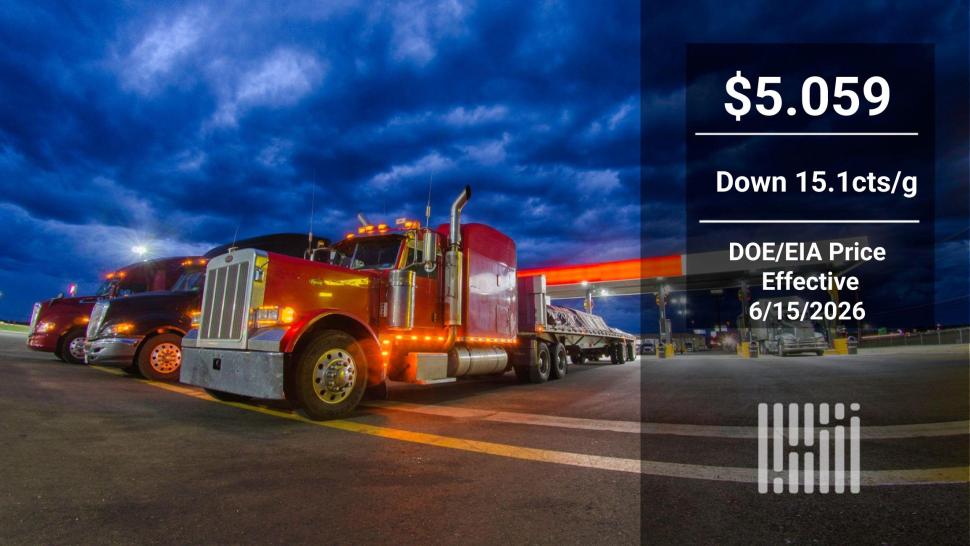
That price, used as the basis for most fuel surcharges, declined 15.1 cents/gallon to $5.059/g. It’s the lowest DOE/EIA price since $5.071/g posted on March 16, just two weeks after the first military action between the U.S. and Israel on one side and Iran on the other. The last price published by the DOE/EIA before the market began reacting to the war was $3.897/g on March 2.
The role of buffers
With a peace deal now signed, details to be revealed in the coming days, oil markets turn to the question of whether the decline in market prices will continue or whether it is a head fake as the “buffers,” as the IEA called them, that have limited oil price increase since the war began will be exhausted and the reality of lost production produces a post-peace surge.
The scorecard on the price of ultra low sulfur diesel (ULSD) on the CME commodity exchange is that the settlement Tuesday of $3.1702/g was down 44.24 cts/g in four trading days. It was down $1.5138/g from the settlement of $4.6084/g set March 20, the highest since the conflict began.
ULSD on the final trading day before the war began settled at $2.596/g.
While the IEA does not predict prices, it is often fairly easy to walk away from reading one of the agency’s monthly reports and declare it either bullish or bearish. But this month’s report could be read either way.
On the most important numbers regarding supply and demand, the IEA said that global supply this year will average a decline of 3.9 million barrels/day to 102.4 million b/d compared to 2025. But that average figure masks the short-term disruption, such as the IEA’s estimate that global production in May fell to 94.5 million b/d, down 13.6 million b/d from where it stood before the war began at the start of March.
There has been some relief for consumers from demand declining as well. But the numbers are nowhere near the decline in supply.
The IEA’s estimate is that second quarter demand will be down about 5 million b/d from where it was a year ago, a decline of 4.8%, “in the face of higher fuel prices and disruptions to product availability,” the agency said in its report.
For the full year, demand is set to decline an average of 1.1 million b/d. But that estimate is far greater than just a month ago, with the forecast of a drop in demand higher by about 700,000 b/d.
“Deep cuts to consumption have spread beyond the sectors and regions that were initially the most heavily impacted,” the IEA wrote. “Reported data and preliminary indications for both April (-4.6 mb/d y-o-y) and May (-5.4 mb/d) point to plunging demand across almost all product categories and regions. Asia and the Middle East have been by far the most affected, with Chinese, Korean and Japanese deliveries especially hard-hit.”
But the end result of that math is that demand is not going to fall on average this year as much as supply will.
It is the IEA’s shorter term outlook that should be most concerning to consumers.
The term “buffers” has been used in recent weeks to describe how oil prices, even after facing a loss of almost 20% of world supply at times due to the shutdown of the Strait of Hormuz and production shut-ins triggered by the strait’s closure, managed to stay reasonably in check. The high settlement for global crude benchmark Brent after military action began was $118.35/b on March 31. Brent settled Tuesday at $78.96/b on Tuesday. Its settlement on February 27, just before the war began, was $72.48/b.
How it happened so far
The IEA recapped some of the ways that supply managed to be either increased or rerouted to keep from even higher prices: sharp declines in Japanese and Chinese imports, reduced refinery runs (which in turn created supply shocks in products in Asia); “robust growth from the Americas along with steep U.S. Strategic Petroleum Reserve releases.”
Most of all, however, has been the drawdown in global inventories. According to the IEA, “global observed oil stocks” have declined on average 3.8 million b/d since the start of March, but that accelerated to 4.6 million b/d in May. “Further declines in the coming months could still take global stocks to historic lows,” the IEA wrote.
The various supply “buffers” can not mask some of the hard math, according to the IEA. “The global oil balance is still expected to remain in a sizeable deficit this year,” the agency said. “Our current supply/demand balance for June to August implies a deficit averaging 2.1 mb/d. If realised, global observable stocks would slip to their lowest seasonal levels since 2022.”
Output increases after the peace deal is signed are expected to result in exports that will “slowly ramp up.” A full return to normal exports through the Strait of Hormuz will take “at least several months or more.”
“The slower ramp up partly reflects expectations that tanker owners will avoid the pre-war shipping lanes until mines are removed, control of the waterway is more clearly defined, and the contentious issues over fee rates are resolved,” the IEA said.
But the IEA report also forecasts a 2027 where supply overwhelms demand. In its first forecast of next year, the IEA said it sees global oil supplies surging next year to about 110 million b/d. That would be around 8 million b/d more than this year, and about 2 million b/d where supply was trending in 2026 before the war began.
More articles by John Kingston
TIA asking FMCSA for guidance on approved carriers post-Montgomery
Carrier Nussbaum sets driver pay increase; others popping up more quietly
Commerce finding on van imports may give relief to beleaguered Wabash
Brokerage Compliance Symposium
The day before F3. Every compliance issue you face - fraud exposure, carrier liability, FMCSA rules, cargo theft, insurance gaps - navigated by attorneys and operators defining best practices in a changing industry.
F3 Awards Dinner
The night before F3. FreightTech100 companies honored. FreightTech 25 and Shipper of Choice winners revealed live. Cocktail reception into dinner and live music - 300 industry leaders in one purpose-built room.
F3: Future of Freight Festival
Industry-defining keynotes, rapid-fire technology demos, and industry leaders networking in experiences across Chattanooga - plus the inaugural F3 Awards Dinner featuring the FreightTech and Shipper of Choice reveals.
The day before F3. Every compliance issue you face - fraud exposure, carrier liability, FMCSA rules, cargo theft, insurance gaps - navigated by attorneys and operators defining best practices in a changing industry.
The Signal at Chattanooga Choo Choo • Chattanooga, TN Register NowThe night before F3. FreightTech100 companies honored. FreightTech 25 and Shipper of Choice winners revealed live. Cocktail reception into dinner and live music - 300 industry leaders in one purpose-built room.
The Signal at Chattanooga Choo Choo • Chattanooga, TN Register NowIndustry-defining keynotes, rapid-fire technology demos, and industry leaders networking in experiences across Chattanooga - plus the inaugural F3 Awards Dinner featuring the FreightTech and Shipper of Choice reveals.
The Signal at Chattanooga Choo Choo • Chattanooga, TN Register Now