Although a first glance at some of the numbers on the Variant segment of U.S. Xpress seems to reveal little improvement in its performance, CEO Eric Fuller told analysts that the best is yet to come.
“Variant is the growth engine for our company, and improving its financial results is critical for our long-term success,” Fuller said Thursday.
The numbers at Variant that looked better were figures that looked good at all truckload carriers in the first quarter. For example, Variant’s average revenue per tractor per week rose to $4,065 from $3,740 sequentially compared to the fourth quarter of 2021, an 8.7% increase that would have been easily matched or surpassed at numerous truckload carriers.
Driver turnover, which was always cited as one of the advantages that Variant was going to provide, was a staggering 148% in the first quarter, compared to 107% in the fourth quarter. That 107% figure had already marked a slide during the second half of the year that started with solid turnover figures of 58% in the first quarter of 2021 and deteriorated consistently through the end of the year.
Safety also was touted as a Variant strength. But preventable accidents per million miles traveled rose to 8.12 from 6.82 in the fourth quarter.
The truck count at Variant was 1,691 at the end of the quarter, up from 1,555. That is an 8.7% increase and now is about half the company’s over-the-road fleet (as opposed to its Dedicated division). Fuller said on the call that the increase was disappointing and below expectations. (In contrast, the truck count at Variant between the third and fourth quarter of 2021 rose 21.2%.)

Variant had operating revenue of $84 million in the quarter net of fuel, Fuller said on the earnings call. That is an increase of 17% sequentially. Total operating revenue at U.S. Xpress was $464.3 million for the quarter, net of fuel.
On the call, Fuller and CFO Eric Peterson were unbowed, vowing that changes made in Variant’s operating model would eventually succeed.
If there is an elevator speech for Variant, it would be a technology-driven truckload carrier within a truckload carrier, looking to the maximum use of processes for efficient routing, a team-based approach designed to retain drivers far better than in the legacy U.S. Xpress (NYSE: USX) business, and with a management team drawn heavily from the technology world, doing its work in Atlanta and away from the company’s Chattanooga, Tennessee, headquarters.
It also shocked the world in early December when the company’s president, Cameron Ramsdell, was dismissed.
Fuller said U.S. Xpress and Variant management had spent much of the first quarter, including some time at an offsite location, reviewing Variant’s operations “as we transition from a nimble startup to a scalable business” with “a more disciplined management approach on key metrics and earnings growth.”
Responding to a question from J.P. Morgan analyst Brian Ossenback, Fuller said — without mentioning Ramsdell by name — that after his departure, U.S. Xpress hired an “internal process engineering team” to review how Variant was operating.
“We had the team go in and do an analysis on the workload and the processes,” Fuller said. Many of those processes were reengineered, and management structures were changed.
Specifically, Fuller said the “communities” that were created to manage a specific group of trucks underwent structural changes.
The problem, he said, is that during this time while much of the staff was going through training on the new processes, some support activities faltered. Fuller specifically referred to an inability of drivers to get their calls answered in a timely manner, resulting in some of the push toward the high turnover rate at Variant.
All the revamped communities are now operating, Fuller said, “and we had significant improvement in turnover in April compared to March.” The revamped communities that began operating in February — the first ones out of the box — have had the most significant gains in productivity, Fuller said.
U.S. Xpress’ tractor fleet grew by 144, with 136 of those coming out of Variant. But U.S. Xpress’ overall tractor count declined for several years, and in a slide presentation distributed with the company’s earnings, U.S. Xpress said the company’s “fixed costs have grown while tractor count has declined, pressuring our near-term financial results.”
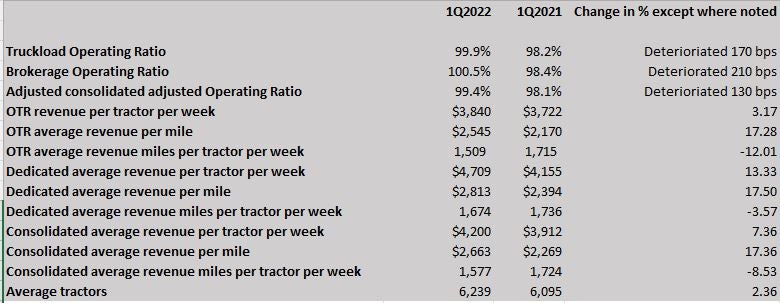
Total average tractors during the quarter at U.S. Xpress was 6,239, up from 6,095. Fuller said he believes the company has the infrastructure for an additional 2,000 seated tractors, “which equates to another $425 million in revenue.”
Other highlights of the U.S. Xpress earnings report:
— Fuller highlighted the performance of the company’s Dedicated division, which saw a 13.33% increase in average revenue per tractor per week and a 17.5% increase in average revenue per mile. He said utilization at the Dedicated segment was hit hard in January by drivers recovering from the December-January surge in the omicron variant of COVID-19.
— The adjusted operating ratio at U.S. Xpress was 99.4% for the quarter. By contrast, truckload carrier competitors Heartland (NASDAQ: HTLD), Marten (NASDAQ: MRTN) and P.A.M. Transportation (NASDAQ; PTSI) all had ORs in the 80s for the quarter.
— The bottom line at U.S. Xpress: It posted an operating loss of $200,000, compared to operating income of $8 million in the first quarter of 2021. It had adjusted operating income of $2.8 million and an adjusted loss per diluted share of 2 cents. That 2-cent loss was actually just 1 cent worse than consensus estimates, according to SeekingAlpha.
Disclosure: FreightWaves founder and CEO Craig Fuller retains ownership of U.S. Xpress shares through his family trust.
More articles by John Kingston
Variant’s metrics at U.S. Xpress show a second-half deterioration
CEO predicts Variant will drive USX sequential financial growth by Q1
U.S. Xpress bottom line takes hit from big labor cost increases
Brokerage Compliance Symposium
The day before F3. Every compliance issue you face - fraud exposure, carrier liability, FMCSA rules, cargo theft, insurance gaps - navigated by attorneys and operators defining best practices in a changing industry.
F3 Awards Dinner
The night before F3. FreightTech100 companies honored. FreightTech 25 and Shipper of Choice winners revealed live. Cocktail reception into dinner and live music - 300 industry leaders in one purpose-built room.
F3: Future of Freight Festival
Industry-defining keynotes, rapid-fire technology demos, and industry leaders networking in experiences across Chattanooga - plus the inaugural F3 Awards Dinner featuring the FreightTech and Shipper of Choice reveals.
The day before F3. Every compliance issue you face - fraud exposure, carrier liability, FMCSA rules, cargo theft, insurance gaps - navigated by attorneys and operators defining best practices in a changing industry.
The Signal at Chattanooga Choo Choo • Chattanooga, TN Register NowThe night before F3. FreightTech100 companies honored. FreightTech 25 and Shipper of Choice winners revealed live. Cocktail reception into dinner and live music - 300 industry leaders in one purpose-built room.
The Signal at Chattanooga Choo Choo • Chattanooga, TN Register NowIndustry-defining keynotes, rapid-fire technology demos, and industry leaders networking in experiences across Chattanooga - plus the inaugural F3 Awards Dinner featuring the FreightTech and Shipper of Choice reveals.
The Signal at Chattanooga Choo Choo • Chattanooga, TN Register Now