
Augment, the San Francisco-based AI productivity platform for logistics, has closed an $85 million Series A round, bringing its total capital raised to $110 million just five months after emerging from stealth. The company’s flagship product, Augie, is already supporting more than $35 billion in freight under management and rapidly gaining traction among shippers, brokers, and carriers looking to automate their most time-intensive workflows.
The round, led by Redpoint Ventures with participation from 8VC, Shopify Ventures, Autotech Ventures, and other investors, will allow Augment to significantly expand its engineering and go-to-market teams.
Co-founder and CEO Harish Abbott said the company plans to hire more than 50 engineers and over 10 go-to-market staff by the end of 2025, with deeper hiring into 2026, as it extends Augie’s capabilities from front-office quoting and dispatch all the way through back-office billing and compliance.
“When I spoke with FreightWaves last March, I talked about the waste and margin erosion I saw running brokerages and fleets,” said Justin Hall, co-founder of Augment. “The industry has tried to fix this with hundreds of tools, but most are point solutions that lose context and create new problems. That’s why I teamed up with Harish and Art to build Augie—an AI teammate that handles complex, end-to-end workflows without dropping the thread. With this new $85M raise, bringing us to $110M in 5 months, we’re scaling Augie’s full-stack capabilities to deliver the efficiency, stronger margins, and easier work our customers deserve.”
Unlike traditional bots or one-off automation tools, Augie is designed to work across systems and communication channels, taking full ownership of a shipment from order to cash. It integrates with TMS platforms, load boards, shipper portals, and communication channels while proactively handling exceptions and reducing the manual back-and-forth that weighs down logistics operations.
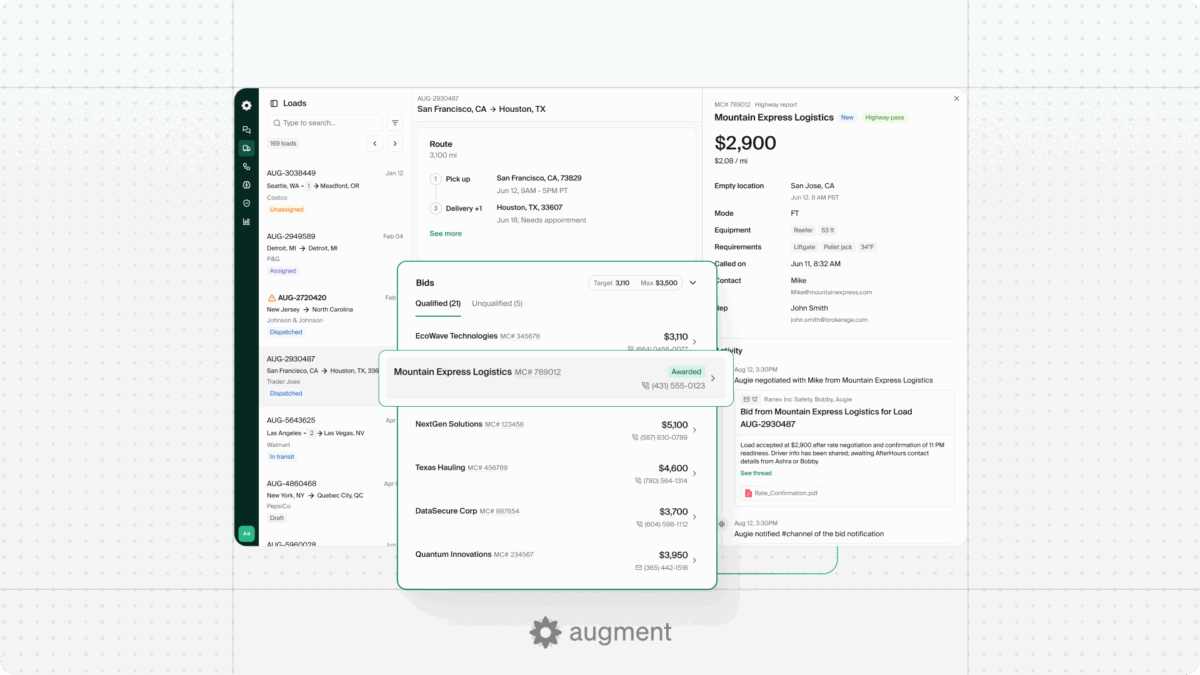
That end-to-end approach is already driving measurable results for customers. Brokers and 3PLs report being able to scale without adding headcount, with some representatives doubling or tripling the number of loads they manage daily. Shippers are seeing tighter SLA adherence and fewer billing disputes, while carriers are experiencing faster payments, reduced service calls, and stronger driver relationships.
The numbers behind those claims are striking: a 40% reduction in invoice delays, billing cycles accelerated by three to eight days, gross margin improvements of two to five percent per load, and 30–50% productivity gains in operations.
Armstrong Transport Group, a $1.3 billion brokerage, is among the firms seeing Augie’s impact firsthand. “If it gets sent to Augie, it gets done,” said William McManus, an operations specialist at Armstrong. “He gives me the context, finds the docs, and even flags issues before they escalate. I finally get to log off when I log off.”
CEO Cameron Ramsdell, CEO of Armstrong, added, “We’ve seen reps go from managing 10 loads a day to 20 or 30—with higher morale and stronger customer service. AI should show up on every line of the P&L—and Augie is already delivering.”
For Abbott, those kinds of outcomes are a sign of where AI in logistics is headed. “Logistics runs on millions of decisions—under pressure, across fragmented systems, and with too many tabs open,” he said. “Augie doesn’t just assist. It takes ownership.” He predicts that within the next 12 to 18 months, AI agents will become the standard, handling the majority of repetitive workflows in logistics.
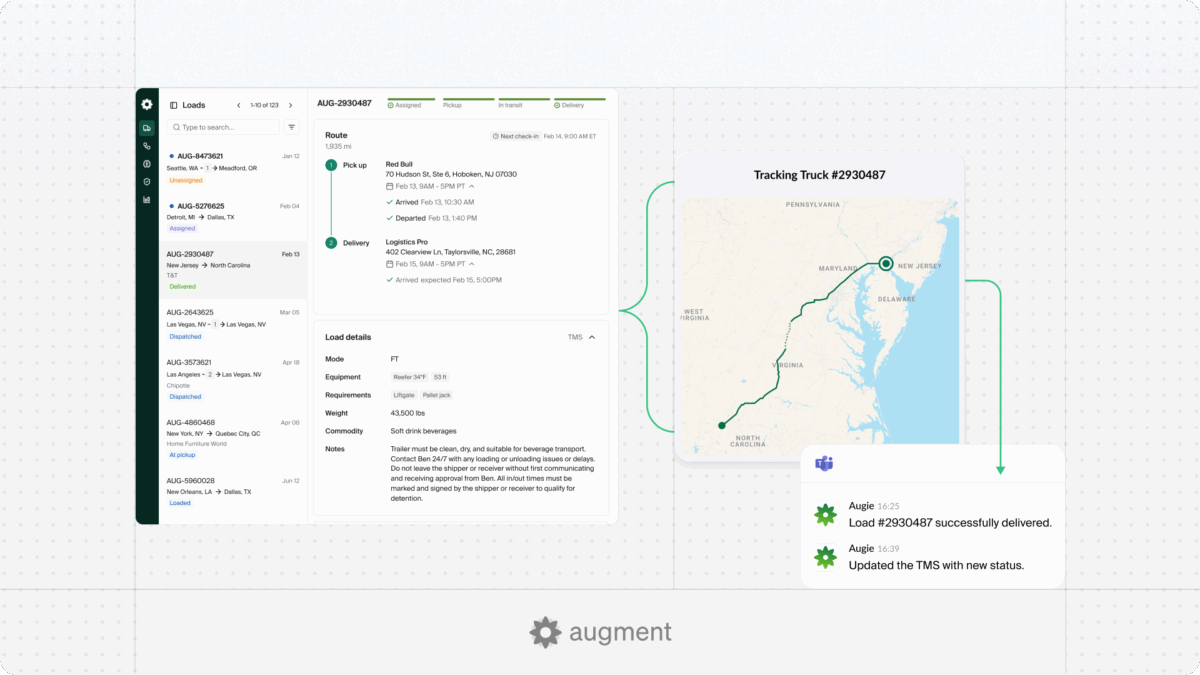
Augment’s roadmap reflects that ambition. Beyond scaling Augie’s front- and back-office coverage, the company plans to build a logistics-native knowledge hub that provides pricing, service, and compliance intelligence across modes and networks. It’s also investing heavily in integrations to ensure Augie can operate seamlessly across the patchwork of systems that define modern freight.
“Freight is essential but often unsung,” Abbott said. “We’re building Augie for the people behind the freight—so they can focus on the work that actually matters.”
Brokerage Compliance Symposium
The day before F3. Every compliance issue you face - fraud exposure, carrier liability, FMCSA rules, cargo theft, insurance gaps - navigated by attorneys and operators defining best practices in a changing industry.
F3 Awards Dinner
The night before F3. FreightTech100 companies honored. FreightTech 25 and Shipper of Choice winners revealed live. Cocktail reception into dinner and live music - 300 industry leaders in one purpose-built room.
F3: Future of Freight Festival
Industry-defining keynotes, rapid-fire technology demos, and industry leaders networking in experiences across Chattanooga - plus the inaugural F3 Awards Dinner featuring the FreightTech and Shipper of Choice reveals.
The day before F3. Every compliance issue you face - fraud exposure, carrier liability, FMCSA rules, cargo theft, insurance gaps - navigated by attorneys and operators defining best practices in a changing industry.
The Signal at Chattanooga Choo Choo • Chattanooga, TN Register NowThe night before F3. FreightTech100 companies honored. FreightTech 25 and Shipper of Choice winners revealed live. Cocktail reception into dinner and live music - 300 industry leaders in one purpose-built room.
The Signal at Chattanooga Choo Choo • Chattanooga, TN Register NowIndustry-defining keynotes, rapid-fire technology demos, and industry leaders networking in experiences across Chattanooga - plus the inaugural F3 Awards Dinner featuring the FreightTech and Shipper of Choice reveals.
The Signal at Chattanooga Choo Choo • Chattanooga, TN Register Now