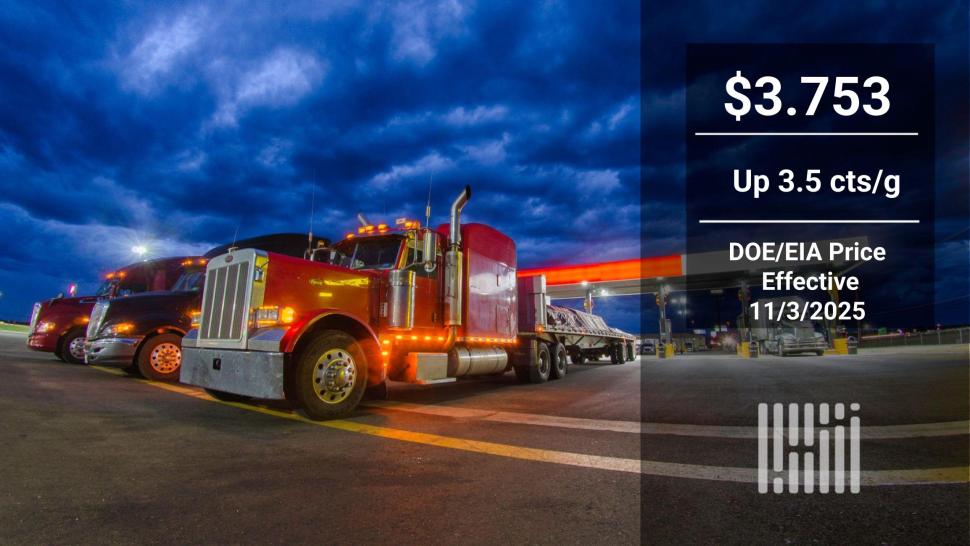
Retail diesel prices measured by the Department of Energy/Energy Information Administration weekly price moved higher for the second consecutive week, with signals beyond the outright price reflecting a tightening diesel market.
The DOE/EIA average weekly retail diesel price increased 3.5 cents/gallon Monday, released Tuesday, to $3.753/g. Combined with last week’s increase, the price used for most fuel surcharges is up 13.3 cts/g in the last two weeks, climbing back to just under where the price stood at the end of September.
With the price of crude mostly stuck in a tight range, the impetus for diesel’s increases are for factors unique to that market. Diesel isn’t riding higher on the back of a crude surge.
That diesel strength can be seen in a straight comparison of front month Brent crude, the global benchmark, to the price of ultra low sulfur diesel on the CME commodity exchange.
The spread between the two of them on a per gallon basis stood at just under 70 cts/g on October 16. But since then, it has moved sharply higher, crossing 90 cts/g on Thursday before slipping back toward 85 cts/g Monday.
In early trading Tuesday, the trend of ULSD outperforming crude had returned. At approximately 10:50 am EST, Brent was down 0.82% while ULSD had risen 0.4%.
On an outright basis, ULSD on CME has traded less than its recent high settlement of $2.4243/g recorded Wednesday. But Monday’s settlement of $2.4053/g was still about 20 cts/g more than where it stood just two weeks earlier.
Helping to drive diesel higher is the continued story of tight inventories. That basis for higher levels got another kick last week, with the release Wednesday of the weekly EIA inventory report for the week ended October 24.
Inventories of non-jet distillates generally rise in the fourth quarter, given that heating oil and European gasoil are used as heating fuels. But the spread between Brent and ULSD suggests stocks are not increasing.
The weekly EIA report backed up that conclusion. U.S inventories of ULSD reported by EIA declined to 112.2 million barrels during a time on the calendar when they are supposed to be rising, building up for winter. It was the first time in five weeks the EIA’s estimate of ULSD stocks had declined.
The decline was to 112.2 million barrels from 115.6 million barrels a week earlier. At 112.2 million barrels, that number is more than it was at that point on the calendar in 2022 and 2023, but slightly less than last year. However, those numbers were all well below historical pre-pandemic levels.
With the diesel market impacted by winter, as a tough winter will divert distillate molecules into the heating oil pool, the general consensus the last three years is that relatively mild winters had saved the diesel and heating oil market from a seasonal price spike. But given the inventory numbers, it may be time for diesel consumers to begin praying for another balmy few months.
The spread between first and second month ULSD also is signaling a growing squeeze on inventories. When stocks are tight for any commodity, the structure of the calendar has the front month price on the curve as the most expensive price, with the next month less than that, the third month further reduced, and so on.
That structure is called backwardation, and it is the opposite of a perfectly balanced market, where prices rise as the calendar moves out, reflecting the cost of storage and the time value of money. That structure is known as contango.
ULSD has been in backwardation for months, reflecting the tight market. But it has tended to hover near 2 cts/g, with the front month price that much higher than the second month.
Recently, however, the spread has shown signs of widening. It reached more than 5 cts/g on Thursday, sunk back to about 3.25 cts/Monday and settled Monday at just under 3 cts/g. But the spread has not consistently been near 3 cts/g since July.
More articles by John Kingston
DAT execs in two forums discuss how it seeks to reshape the freight sector
NMFTA’s freight classification overhaul: surprising shipper preparedness
Beautiful women, open doors and drivers: trucking cybersecurity risks proliferate
Brokerage Compliance Symposium
The day before F3. Every compliance issue you face - fraud exposure, carrier liability, FMCSA rules, cargo theft, insurance gaps - navigated by attorneys and operators defining best practices in a changing industry.
F3 Awards Dinner
The night before F3. FreightTech100 companies honored. FreightTech 25 and Shipper of Choice winners revealed live. Cocktail reception into dinner and live music - 300 industry leaders in one purpose-built room.
F3: Future of Freight Festival
Industry-defining keynotes, rapid-fire technology demos, and industry leaders networking in experiences across Chattanooga - plus the inaugural F3 Awards Dinner featuring the FreightTech and Shipper of Choice reveals.
The day before F3. Every compliance issue you face - fraud exposure, carrier liability, FMCSA rules, cargo theft, insurance gaps - navigated by attorneys and operators defining best practices in a changing industry.
The Signal at Chattanooga Choo Choo • Chattanooga, TN Register NowThe night before F3. FreightTech100 companies honored. FreightTech 25 and Shipper of Choice winners revealed live. Cocktail reception into dinner and live music - 300 industry leaders in one purpose-built room.
The Signal at Chattanooga Choo Choo • Chattanooga, TN Register NowIndustry-defining keynotes, rapid-fire technology demos, and industry leaders networking in experiences across Chattanooga - plus the inaugural F3 Awards Dinner featuring the FreightTech and Shipper of Choice reveals.
The Signal at Chattanooga Choo Choo • Chattanooga, TN Register Now