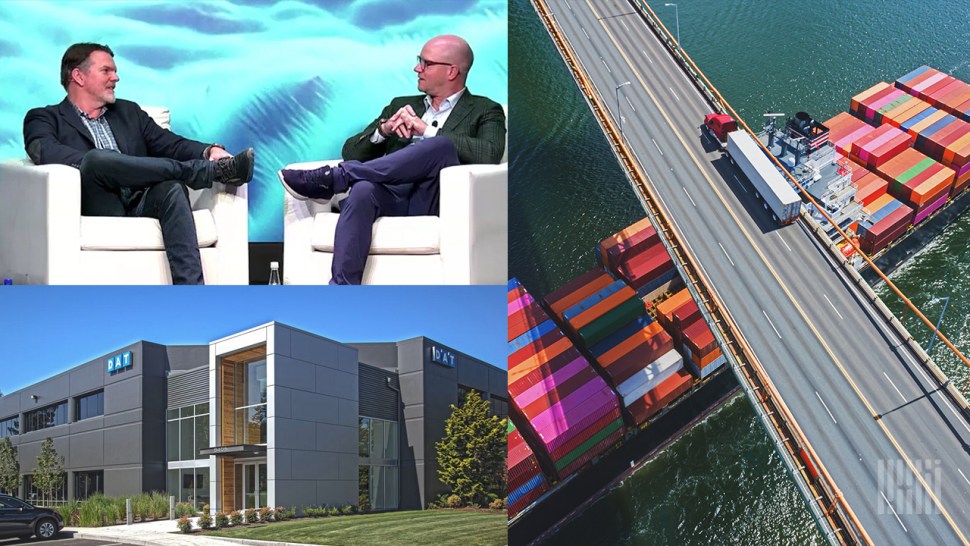
CHATTANOOGA–Roper Technologies has a large portfolio of technology-focused companies. But on its third quarter earnings call Thursday, it was DAT that took center stage in the presentation by Roper executives who were overwhelmingly positive about how the loadboard giant–now a lot more than that–is performing.Coincidentally, Bill Driegert, the executive vice president of the Convoy Platform at DAT, spoke in a fireside chat with FreightWaves and SONAR CEO Craig Fuller a day before the earnings release at the FreightWaves Festival of Freight (F3), discussing the “load board wars.”
Fuller said DAT for many years was perceived as “this really big company that isn’t doing anything, like a sleepy friendly giant. It was sort of a benign monopolist.”
“I recognize that the company is making an effort to make their products better,” Fuller said. “The acquisitions show a road map that was not apparent before.”
The financial performance of DAT was not broken out in the Roper earnings call Thursday, a day after the Driegert fireside chat.
But even as praise was being heaped on the segment, Roper management conceded the Convoy data stack DAT recently bought from Flexport is not profitable. Optimism was the prevailing management view about the ability of the Convoy acquisition to pay off in the long term.
No profits from Convoy purchase yet
Neil Hunn, president and CEO of Roper (NASDAQ: ROP), said in his prepared comments on the earnings call that the acquisition of Convoy was “an unusual transaction for us as it is currently not profitable, but we expect the financial returns over the next several years to be extremely attractive,” according to a transcript.
The tech stack acquired from digital broker Convoy, which shut its doors two years ago, is a prime candidate to scale up, Hunn said. It will do so, he said, by “leveraging DAT’s advantaged customer unit economics for both brokers and carriers to drive sustained growth and profitability.”
Hunn discussed broader trends in AI that are impacting various Roper subsidiaries. These subsidiaries are “already seeing measurable yet early product and commercial results.”
“DAT exemplifies this strategy in action, evolving from a traditional freight matching network to a fully automated freight marketplace powered by AI,” Hunn said. “Through this transformation, DAT is unlocking significant efficiency and economic value for brokers and carriers alike, positioning itself for improved high-quality growth.”
A trifecta of deals
The Convoy tech stack was not the only recent DAT acquisition. It purchased Trucker Tools in December and Outgo in May.
The Trucker Tools app has a wide variety of applications, some as mundane as a guide to truck stops but others more complex like the ability to book a load on the platform.
Outgo is an online tool that offers payment and other financial services to drivers and fleets.
A slide about DAT’s structure presented in conjunction with the earnings report said DAT has “all the components to transform the freight ecosystem.” It listed those capabilities: load board scale, data & analytics, visibility & tracking, payments platform and an automation & compliance platform, with many of those coming out of the recent acquisitions.
The end result is what DAT says is “one-click automation.”
Hunn offered some statistics on DAT. It has more than 1.2 million loads posted and 15 million rate views each day.
Now, with the recent acquisitions in the fold, Hunn said, “DAT is building capabilities across the entire freight automation workflow from carrier vetting to broker carrier matching to AI-driven rate negotiation, load management tracking and finally, payment and settlement.”
The anticipated savings from the capabilities provided by these tools will produce savings of $100 to $200 per load “while giving carriers greater predictability and faster payments on their invoices,” Hunn said.
The Trucker Tools app has a wide variety of applications, some as mundane as a guide to truck stops but others more complex like the ability to book a load on the platform. Outgo is an online tool that offers payment and other financial services to drivers and fleets.
The strategy of the recent acquisitions and folding them into DAT, Hunn said, is the next step after the deep penetration of DAT into the trucking market, and then looking “how do you just scaffold more value on both sides of the network.”
Hunn said the goal is to “integrate the capability into the TMS of every broker so it’s native.” He said early results of the expanded capabilities of the DAT system were “sold out on the broker front.”
Building a Convoy substitute would have been tough
Responding to an analyst’s question, Hunn said the Convoy acquisition was “very much a buy versus build” choice. The algorithms in the Convoy system are “very complicated and complex,” describing them as more machine learning than AI.
“There’s a very large group of talented engineers that came with the acquisition,” Hunn said. “They’re now part of the DAT sort of franchise. And so it’s unique in that it’s money losing at the moment, but it’s like the final piece to sort of manifest the strategy of DAT.”
Driegert said recent management changes that began about two years ago were first focused on stabilizing the main load board, which had experienced various difficulties. But after that, he said, a focus began to switch to product development which became the “acquisition-driven strategy” that manifested itself in the purchases of the Convoy tech stack, Trucker Tools and Outgo.
He added that the Convoy acquisition has been “particularly beneficial” in DAT’s efforts to fight fraud on its platform. Additionally, Trucker Tools provides a wealth of data about its users that can then be integrated into the DAT platform to identify potential scammers. “We can start to parse that all together to get a more accurate data set,” Driegert said.
More articles by John Kingston
China expert Miller: why supply chain ‘choke points’ matter most
Trailer manufacturer Wabash’s nuclear verdict lawsuit settled
Factoring companies squeezed by slowing shipper payments: Alsobrooks
Brokerage Compliance Symposium
The day before F3. Every compliance issue you face - fraud exposure, carrier liability, FMCSA rules, cargo theft, insurance gaps - navigated by attorneys and operators defining best practices in a changing industry.
F3 Awards Dinner
The night before F3. FreightTech100 companies honored. FreightTech 25 and Shipper of Choice winners revealed live. Cocktail reception into dinner and live music - 300 industry leaders in one purpose-built room.
F3: Future of Freight Festival
Industry-defining keynotes, rapid-fire technology demos, and industry leaders networking in experiences across Chattanooga - plus the inaugural F3 Awards Dinner featuring the FreightTech and Shipper of Choice reveals.
The day before F3. Every compliance issue you face - fraud exposure, carrier liability, FMCSA rules, cargo theft, insurance gaps - navigated by attorneys and operators defining best practices in a changing industry.
The Signal at Chattanooga Choo Choo • Chattanooga, TN Register NowThe night before F3. FreightTech100 companies honored. FreightTech 25 and Shipper of Choice winners revealed live. Cocktail reception into dinner and live music - 300 industry leaders in one purpose-built room.
The Signal at Chattanooga Choo Choo • Chattanooga, TN Register NowIndustry-defining keynotes, rapid-fire technology demos, and industry leaders networking in experiences across Chattanooga - plus the inaugural F3 Awards Dinner featuring the FreightTech and Shipper of Choice reveals.
The Signal at Chattanooga Choo Choo • Chattanooga, TN Register Now