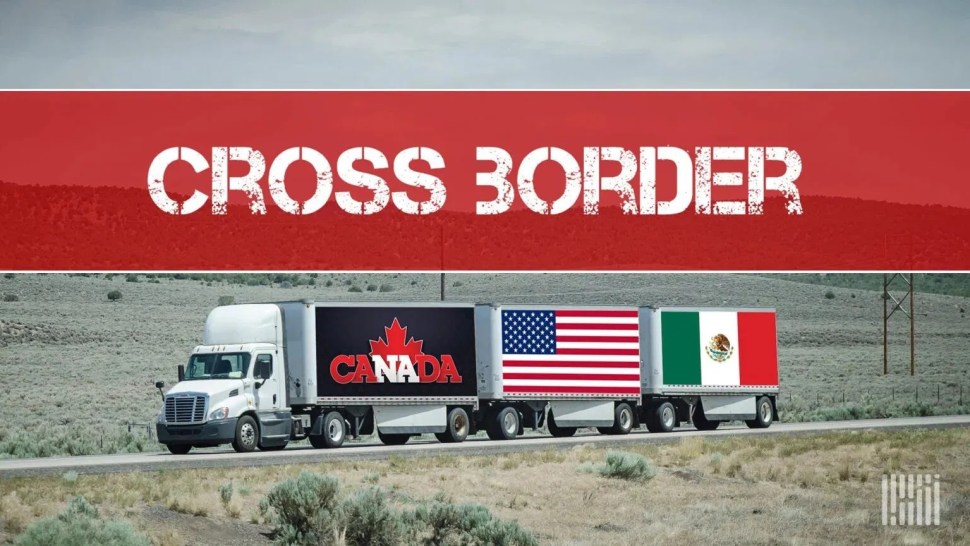
Borderlands Mexico is a weekly rundown of developments in the world of United States-Mexico cross-border trucking and trade. This week in Borderlands Mexico: TCS is betting on Monterrey as cross-border trade gets more complicated; Union Pacific plans 2,000-acre Mainline Texas Industrial Park near Houston; and Former Waco bottling plant to be redeveloped into I-35 distribution center.
TCS is betting on Monterrey as cross-border trade gets more complicated
Transport Capacity Services (TCS) has opened a new office in Monterrey, Mexico, expanding its on-the-ground presence as cross-border freight flows continue to evolve even amid tariff uncertainty, the company said.
The Monterrey expansion strengthens the logistics provider’s ability to manage high-volume, complex freight operations between the U.S. and Mexico. It places bilingual teams closer to manufacturing hubs, carriers and customs partners.
Monterrey has emerged as a focal point for nearshoring activity, with a significant share of new manufacturing investment flowing into northern Mexico in recent years, according to TCS CEO Ben Enriquez.
“Monterrey has become one of the most important regions for nearshoring,” Enriquez said in an interview with FreightWaves. “Forty to 50% of the new companies coming into Mexico are settling in the Monterrey and Saltillo area. For us, it was critical to have a presence there to support customers directly.”
TCS said the new Monterrey office allows the company to better coordinate with Mexican carriers, customs brokers and drayage providers while maintaining alignment with U.S. border operations.
Enriquez said that real-time communication across languages and jurisdictions remains one of the most underestimated challenges in cross-border freight.
“All our staff is bilingual,” Enriquez said. “Having people on the ground in Monterrey allows us to work directly with Mexican carriers and customs agents in Spanish, while coordinating with U.S. partners in English. That helps us move freight efficiently through crossings like Laredo, McAllen, Eagle Pass and El Paso.”
Founded in 2024, TCS focuses on cross-border transportation, cross-docking, intermodal and truckload services, supported by a network of CTPAT-certified carriers and technology-driven freight visibility tools.
Along with Monterrey, TCS has locations in Laredo, Texas; Bentonville, Arkansas; and Mexico City.
While U.S.–Mexico trade continues to face uncertainty around tariffs, driver regulations and potential changes to the U.S.–Mexico-Canada Agreement, Enriquez said the company remains confident in long-term cross-border growth.
“Today the market is soft, but we’re seeing customers who have already invested in manufacturing capacity in Mexico continue to move forward,” he said. “Some projects were paused, but a lot of capacity was already installed before the tariff threats. When U.S. demand picks up, those volumes are going to ramp back up.”
Enriquez also pointed to upcoming regulatory changes — including stricter enforcement of customs compliance in Mexico and expanded English-language proficiency requirements affecting both U.S. CDL holders and B-1 drivers — as factors that could quickly tighten capacity in 2026.
“There are a lot of moving parts right now,” he said. “If drivers start getting sidelined and demand returns, the market could tighten much faster than people expect.”
Union Pacific plans 2,000-acre Mainline Texas Industrial Park near Houston
Union Pacific plans to develop the Mainline Texas Industrial Park, a 2,000-acre master-planned industrial site just outside Houston aimed at serving some of the state’s fastest-growing freight and population corridors.
The park will sit along Union Pacific’s main rail line with access to U.S. 90, Highway 36, Spur 10 and Interstate 69. connecting customers to major domestic markets and international gateways including Laredo, Eagle Pass and El Paso.
The development will include about 1,300 acres of rail-served land and 700 acres for non-rail industrial uses, with potential for more than 20 million square feet of Class A industrial space, according to the railroad.
Union Pacific (NYSE: UNP) operates in 23 western states, helping to connect its customers and communities to the global economy.
Former Waco bottling plant to be redeveloped into I-35 distribution center
A former glass bottle manufacturing facility in Waco, Texas, is set to be redeveloped into a large-scale industrial distribution hub following its sale to a Dallas-based investment firm.
The 1.06 million-square-foot property, which operated as a bottling and glass manufacturing plant for more than 80 years, will be repositioned as the Waco I-35 Logistics Center, a multi-tenant industrial and manufacturing campus, according to Cromwell Commercial Group.
Roughly 907,000 square feet of the site is expected to be converted into divisible distribution space, with units of about 100,000 square feet aimed at logistics and light manufacturing users.
The property’s proximity to Interstate 35 and access to Union Pacific rail service position it to serve Central Texas supply chains without the cost and timeline of ground-up development.
Brokerage Compliance Symposium
The day before F3. Every compliance issue you face - fraud exposure, carrier liability, FMCSA rules, cargo theft, insurance gaps - navigated by attorneys and operators defining best practices in a changing industry.
F3 Awards Dinner
The night before F3. FreightTech100 companies honored. FreightTech 25 and Shipper of Choice winners revealed live. Cocktail reception into dinner and live music - 300 industry leaders in one purpose-built room.
F3: Future of Freight Festival
Industry-defining keynotes, rapid-fire technology demos, and industry leaders networking in experiences across Chattanooga - plus the inaugural F3 Awards Dinner featuring the FreightTech and Shipper of Choice reveals.
The day before F3. Every compliance issue you face - fraud exposure, carrier liability, FMCSA rules, cargo theft, insurance gaps - navigated by attorneys and operators defining best practices in a changing industry.
The Signal at Chattanooga Choo Choo • Chattanooga, TN Register NowThe night before F3. FreightTech100 companies honored. FreightTech 25 and Shipper of Choice winners revealed live. Cocktail reception into dinner and live music - 300 industry leaders in one purpose-built room.
The Signal at Chattanooga Choo Choo • Chattanooga, TN Register NowIndustry-defining keynotes, rapid-fire technology demos, and industry leaders networking in experiences across Chattanooga - plus the inaugural F3 Awards Dinner featuring the FreightTech and Shipper of Choice reveals.
The Signal at Chattanooga Choo Choo • Chattanooga, TN Register Now