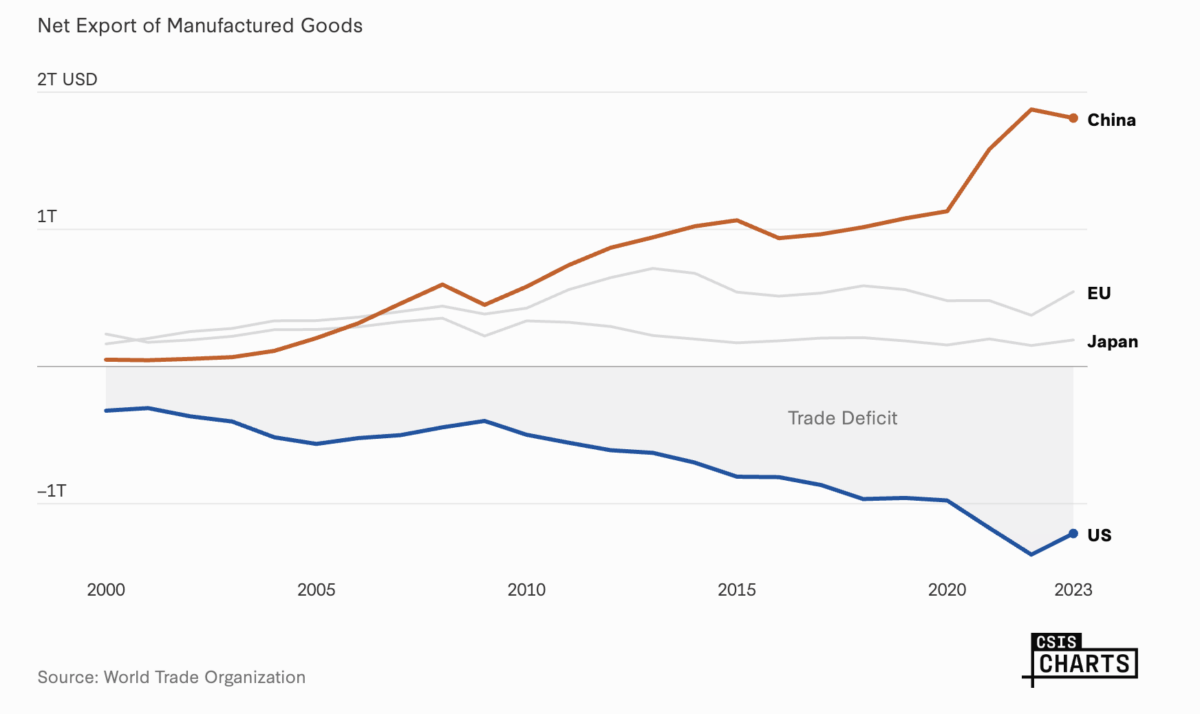
By every metric, China dominates global manufacturing. But how did this country, which was backward and impoverished, with a GDP per capita under $1,000 as late as 1999, transform itself into an industrial powerhouse? And what can other nations, particularly the United States, learn from China’s manufacturing success story?
This is JP Hampstead, co-host with Craig Fuller of the Bring It Home podcast. Welcome to the 21st edition of our newsletter, where we ask how China did it and what the U.S. can and can’t take from the Chinese example.
To understand the rise of Chinese manufacturing, we need to go back. In the late 1970s, China began opening up its economy under Deng Xiaoping’s leadership. This marked a significant shift from the country’s previously closed, centrally planned system to a more market-oriented approach. The timing was perfect: It was the high-water mark of union membership in the U.S., Western companies were seeking ways to reduce production costs, and China offered an abundance of low-cost labor.
Initially, China’s role in global manufacturing was primarily as a low-cost producer of simple, labor-intensive goods. However, over the decades, the country has transformed its manufacturing capabilities, moving up the value chain to produce increasingly sophisticated products. Today, China is not just a hub for textiles and toys but also for high-tech electronics, automotive parts and advanced machinery.
Several aspects of Chinese culture, institutions and public policies have contributed to this manufacturing success. First, there’s the cultural emphasis on hard work and collective achievement. The Chinese workforce is known for its diligence and willingness to put in long hours; alternatively, one could speak of the Chinese people’s pain tolerance and low expectations for quality of life.
Top-down industrial policies from Beijing have been instrumental in China’s manufacturing rise. The Chinese government has consistently prioritized industrial development, offering various incentives to attract foreign investment and technology transfer. These include tax breaks, subsidies and the establishment of special economic zones. The government has also invested heavily in infrastructure – including $153 billion for domestic ports between 2012 and 2019 alone – creating an environment conducive to large-scale manufacturing operations.
Another key factor is China’s vast and well-developed supply chain ecosystem. The concentration of suppliers, assemblers and logistics providers in manufacturing clusters allows for rapid prototyping, efficient production and quick turnaround times. This ecosystem is particularly evident in regions like Shenzhen, which has become a global hub for electronics manufacturing.
However, it’s important to note that China’s manufacturing success hasn’t come without high costs. Issues such as intellectual property infringement, labor rights concerns and environmental degradation have been persistent problems. Beijing is still choked with vast slums.
So, what can the United States learn from China? While some aspects of China’s approach may not be replicable or desirable in the U.S. context, there are certainly lessons to be drawn.
First, the importance of a coherent, long-term industrial policy cannot be overstated. The U.S. could benefit from a more strategic approach to supporting its manufacturing sector, including targeted investments in key industries and technologies.
Second, the U.S. could take cues from China’s emphasis on vocational education and training. Strengthening partnerships between educational institutions and industry could help create a workforce better aligned with the needs of modern manufacturing.
Third, the development of manufacturing ecosystems or clusters, similar to those in China, could enhance efficiency and innovation in U.S. manufacturing. This might involve incentives for co-location of suppliers and manufacturers in specific regions, or even the creation of special economic zones. Balaji Srinivasan recently tweeted in support of a “special Elon zone” without taxes or regulations around SpaceX’s Starbase in Texas.
But the U.S. can’t simply replicate China’s formula for success. Our federal government is divided and often at cross-purposes with itself, making ambitious policies difficult to achieve; our hard-tech sector often bears the cost of R&D that benefits the entire world; American workers have high expectations for their quality of life. So the U.S. must forge its own path to manufacturing competitiveness.
While China’s manufacturing success story offers valuable insights, the key for the U.S. lies in adapting relevant lessons to its own unique context and perhaps a strategy that leans into innovation rather than sheer scale, automation rather than cheap labor, critical machines rather than retail goods, and sustainable partnerships between labor and management.
Quotable
“China’s door of opening up will not be closed but will only open wider, and our business environment will only get better.”
– China Vice Premier Ding Xuexiang at Davos 2025
Infographic
News from around the web
Nvidia to Manufacture American-Made AI Supercomputers in US for First Time
Within the next four years, Nvidia plans to produce up to half a trillion dollars of AI infrastructure in the United States through partnerships with TSMC, Foxconn, Wistron, Amkor and SPIL. These world-leading companies are deepening their partnership with Nvidia, growing their businesses while expanding their global footprint and hardening supply chain resilience.
Novartis plans to invest $23 billion in US sites as Trump renews drug tariff threats
Swiss drugmaker Novartis said on Thursday it plans to spend $23 billion to build and expand 10 facilities in the U.S., as it grapples with renewed threats of drug import duties from the Trump administration. Novartis said it plans to build six new manufacturing plants, some of which will make raw pharmaceutical ingredients, as well as a new R&D site in San Diego.
LVMH mulls moving more manufacturing to the US amid continuing tariff chaos
On LVMH’s first-quarter 2025 earnings call on Monday, the French luxury giant revealed slightly lowered sales while highlighting recent successes like the debut of Sarah Burton designing for Givenchy and Tag Heuer’s return to sponsoring Formula 1.
But the question on every analyst’s mind was: How is LVMH feeling about tariffs? President Donald Trump’s rollout of disruptive tariffs has been causing headaches for fashion brands for weeks. LVMH is a leader in the fashion space, and CEO Bernard Arnault has close ties to Trump. The company’s reaction to the tariff rollout could serve as an indicator for the rest of the industry of just how dire things could be.
Most recent episode
Brokerage Compliance Symposium
The day before F3. Every compliance issue you face - fraud exposure, carrier liability, FMCSA rules, cargo theft, insurance gaps - navigated by attorneys and operators defining best practices in a changing industry.
F3 Awards Dinner
The night before F3. FreightTech100 companies honored. FreightTech 25 and Shipper of Choice winners revealed live. Cocktail reception into dinner and live music - 300 industry leaders in one purpose-built room.
F3: Future of Freight Festival
Industry-defining keynotes, rapid-fire technology demos, and industry leaders networking in experiences across Chattanooga - plus the inaugural F3 Awards Dinner featuring the FreightTech and Shipper of Choice reveals.
The day before F3. Every compliance issue you face - fraud exposure, carrier liability, FMCSA rules, cargo theft, insurance gaps - navigated by attorneys and operators defining best practices in a changing industry.
The Signal at Chattanooga Choo Choo • Chattanooga, TN Register NowThe night before F3. FreightTech100 companies honored. FreightTech 25 and Shipper of Choice winners revealed live. Cocktail reception into dinner and live music - 300 industry leaders in one purpose-built room.
The Signal at Chattanooga Choo Choo • Chattanooga, TN Register NowIndustry-defining keynotes, rapid-fire technology demos, and industry leaders networking in experiences across Chattanooga - plus the inaugural F3 Awards Dinner featuring the FreightTech and Shipper of Choice reveals.
The Signal at Chattanooga Choo Choo • Chattanooga, TN Register Now