




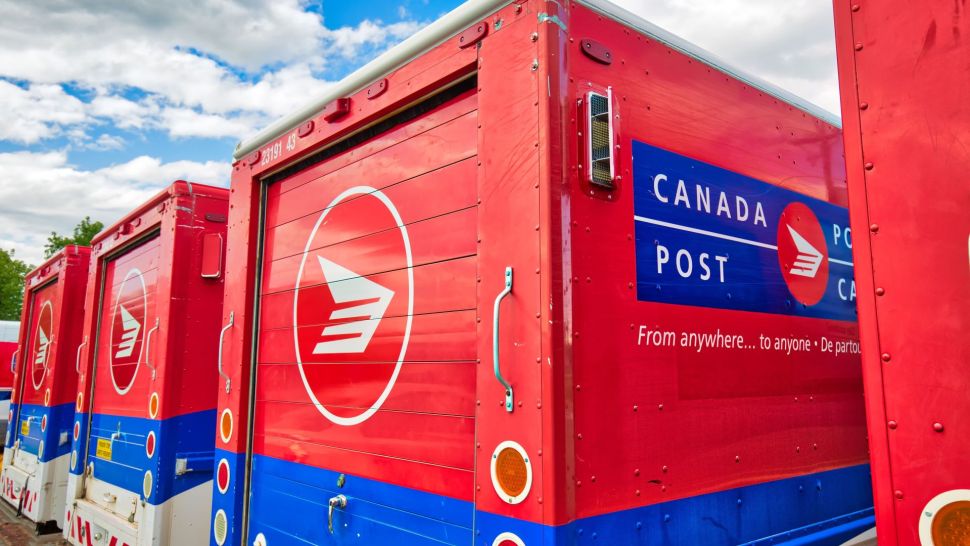
Mail carriers will shift from a nationwide strike action to local rotating strikes, beginning Saturday, the Canadian Union of Postal Workers said, marking the fourth time since May the union has changed the way it has withheld work to pressure Canada Post into a collective bargaining agreement.
Local delivery units will be notified close to their scheduled shifts whether they will stay at home, the CUPW announced Thursday night.
But Canada Post said mail delivery won’t restart until next week as it plans for the orderly restart of national operations. All service guarantees for mail and parcels will be suspended because the rotating strikes will make it difficult to provide reliable service to customers.
Union officials characterized the move as a compromise that allows the restart of mail and parcels after a two-week shutdown of the national postal service, while it continues to press the case for better contract terms for its members. Mail carriers have been working for nearly two years since their last contract expired.
CUPW’s 50,000 members went on strike after the Canadian government instructed Canada Post to close some rural post offices, transition to community boxes instead of home delivery, and reduce delivery frequency as part of a broader transformation aimed at restoring financial stability following years of losses. Canada Post subsequently said it planned to rollback its previous contract proposal and cut thousands of jobs, through attrition and other means.
“We did not take the decision to move to a nation-wide strike lightly. . . Yet, we could not stand by as the government announced its plans to allow Canada Post to gut our postal service and slash thousands of our jobs. Contract after contract, this employer has sought to chip away at postal services, worker rights and good jobs, and its latest offers are an outright attack on public service,” CUPW National President Jan Simpson said in a statement.
Critics say Canada Post hasn’t adapted its operations to reflect the secular decline in mail volumes during the digital age and rising competition from private parcel carriers that are proving cheaper and more reliable. The postal operator says it needs the union to agree to changes in work rules, such as allowing adjustable routes and work levels, rather than fixed assignments, hiring part-time workers and weekend parcel delivery.
Mail carriers went on strike for 32 days late last year, before the government intervened and commissioned a study on Canada Post’s structural problems. In May, the union declined to work overtime and last month switched to a ban on carrying mass market mail.
“This prolonged period of instability . . . has significantly impacted Canadians and Canadian businesses, often without warning. As a result, they have moved to other carriers or are avoiding Canada Post altogether. The move to a different form of strike activity will not change that,” Canada Post said in a statement Friday afternoon. “The impact on the company’s already dire financial position is significant and mounting. With continued uncertainty and the expiry of collective agreements, Canada Post will be required to adjust operations to its current business realities moving forward.”
Mail carriers, who are seeking a 19% pay increase over four years versus Canada Post’s 13.6% offer, say their pay isn’t keeping up with the rising cost of living. Many people don’t realize what is actually involved in delivering the mail and that mail carriers take great pride in their jobs, they add.
“Most of us are at the depots or post offices to sort our mail before the sun rises. While many postal workers are done delivering the mail by noon, they’ve already been working for seven hours at that point. We wish that when it was raining outside or there were three feet of snow on the ground and two inches of ice, that we could just turn around and say, ‘I don’t feel like working today!’ That’s not how our job works,” a Canada Post worker said in an email correspondence.
Union raises complaints with government ministers
Also on Thursday, union leaders met with Joël Lightbound, minister of government transformation, public works and procurement, and his staff to raise concerns about the government’s planned cutbacks and their impact on service levels. Lightbound has oversight of Canada Post.
They complained that many of Canada Post’s troubles are the result of management mistakes that workers shouldn’t pay the price for. CUPW, for example, argued that Canada Post has added hundreds of supervisory positions over the last five years, while cutting maintenance, sorting and delivery jobs, resulting in a top-heavy organization.
The union also said it suspects management has been funneling parcels to Purolator, its overnight express subsidiary, which is contributing to Canada Post’s revenue declines and allowing the company to bypass new legislation banning the use of replacement workers during strikes or lockouts. The legislation was a source of contention earlier this year when workers at DHL Express Canada went on strike.

CUPW also said Canada Post appears to be using “deceptive” data to show parcel volumes have dropped by more than 50% this year because of the ongoing labor uncertainty and that the company’s share of the parcel market is down by a similar amount since 2019. Officials urged Lightbound to conduct a full public comment period before implementing any major changes at the postal operator.
The mail carriers’ fight for better working conditions and middle-class living standards hasn’t generated a large amount of public sympathy so far, with citizens upset about being cut off from mail service and merchants facing few options for sending parcels to customers.
Some parcel sector professionals have scolded CUPW for unrealistic demands considering the downward spiral in Canada Post volumes and finances.
“For several years now, I have been questioning the viability of postal service in Canada. Rates have gone way up, finding places to purchase stamps is a crap shoot at best, the amount of junk mail I receive is ridiculous,” a Canada Post residential customer said in an email to FreightWaves. “I realize the service is doomed and will probably soon be replaced by private firms for parcel delivery. It is time for CUPW to open their eyes and try working harder to justify their jobs rather than continue to hold their customers for ransom.”
Meanwhile, Simpson, CUPW’s president, complained to Minister of Labor Patti Hajdu that the government’s repeated interventions have helped Canada Post avoid serious bargaining, undermining the collective bargaining process.
“Over the course of these negotiations, there has been a repeated and troubling pattern of political intervention that has delayed, disrupted, and ultimately disrespected the bargaining process. Instead of fostering genuine dialogue and progress, the Liberal government and Canada Post have made a mockery of collective bargaining, an institution meant to protect the rights of workers and ensure fair outcomes,” she said in a letter on Wednesday.
Canada Post’s revised proposal is “based on Minister Lightbound’s unilateral implementation of the Kaplan Report [the government ordered study] — with no consultation with the union or the public. This is not bargaining. It is stalling. It is a deliberate attempt to frustrate and demoralize workers while misleading the public into blaming postal workers, all to shield the corporation from accountability for its mismanagement and refusal to bargain in good faith,” Simpson said.
Click here for more FreightWaves/American Shipper stories by Eric Kulisch.
RELATED STORIES:
Canada Post reduces contract offer to striking workers, warns of job cuts
Striking Canada Post workers ‘endanger’ future parcel business, execs say
Canadian government to end home delivery in Canada Post reform
Brokerage Compliance Symposium
The day before F3. Every compliance issue you face - fraud exposure, carrier liability, FMCSA rules, cargo theft, insurance gaps - navigated by attorneys and operators defining best practices in a changing industry.
F3 Awards Dinner
The night before F3. FreightTech100 companies honored. FreightTech 25 and Shipper of Choice winners revealed live. Cocktail reception into dinner and live music - 300 industry leaders in one purpose-built room.
F3: Future of Freight Festival
Industry-defining keynotes, rapid-fire technology demos, and industry leaders networking in experiences across Chattanooga - plus the inaugural F3 Awards Dinner featuring the FreightTech and Shipper of Choice reveals.
The day before F3. Every compliance issue you face - fraud exposure, carrier liability, FMCSA rules, cargo theft, insurance gaps - navigated by attorneys and operators defining best practices in a changing industry.
The Signal at Chattanooga Choo Choo • Chattanooga, TN Register NowThe night before F3. FreightTech100 companies honored. FreightTech 25 and Shipper of Choice winners revealed live. Cocktail reception into dinner and live music - 300 industry leaders in one purpose-built room.
The Signal at Chattanooga Choo Choo • Chattanooga, TN Register NowIndustry-defining keynotes, rapid-fire technology demos, and industry leaders networking in experiences across Chattanooga - plus the inaugural F3 Awards Dinner featuring the FreightTech and Shipper of Choice reveals.
The Signal at Chattanooga Choo Choo • Chattanooga, TN Register Now