




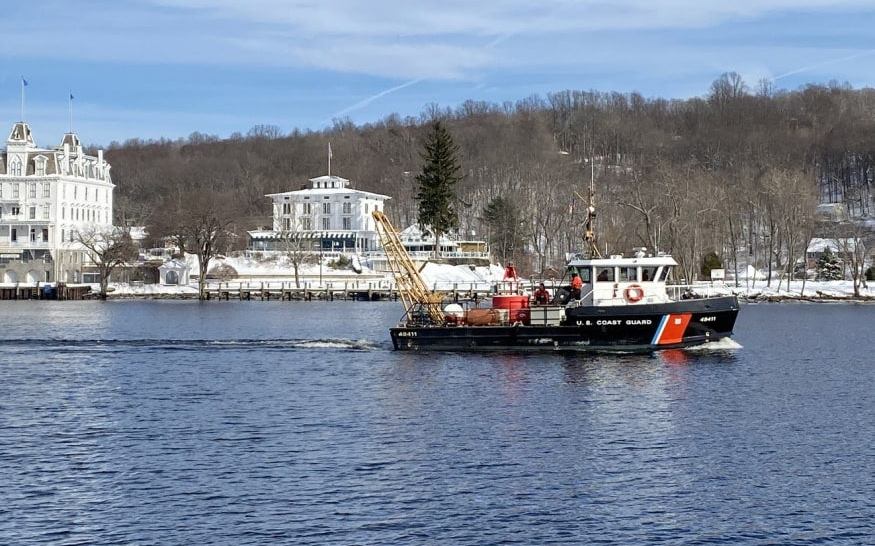
The Coast Guard has launched its icebreaking season, in anticipation of winter’s low temperatures impacting ports, waterways and harbors in the Northeast over the coming months.
Operation Reliable Energy for Northeast Winters (RENEW) is the Coast Guard’s regionwide effort to ensure communities have the security, supplies, energy and emergency resources they need throughout the season.
Of all the heating oil used in the United States, more than 85% is consumed in the Northeast; and 90% of that oil is delivered by ships on waterways maintained by the Coast Guard.
According to the Coast Guard, its domestic icebreaking operations are intended to “facilitate a reasonable expectation of navigability for commercial vessel traffic during ice season,” as well as “minimize waterway closures by performing regular icebreaking, track maintenance and escorts when necessary.”
Coast Guard crews are currently busy replacing the familiar aids to navigation with special buoys designed to repel ice accumulation. These buoys can also withstand the immense pressure that flowing ice exerts on stationary objects in waterways, ensuring Northeast aids to navigation remain lighted and on station.
Officials with the Coast Guard’s 1st District — responsible for northern New Jersey, New York, Connecticut, Rhode Island, Massachusetts, New Hampshire, Vermont and Maine — told FreightWaves it has two 225-foot sea-going buoy tenders and four 175-foot coastal buoy tenders. They work the larger buoys while Aids to Navigation Teams (ANTs) handle the smaller ones.
Coast Guard Aids To Navigation Team (ANT) replaces summer buoys with seasonal winter buoys along the Connecticut River. (Photo: U.S. Coast Guard)

Within the New England region, the Coast Guard has 11 ice breaking tugs — three medium (18 to 36 inches of ice) and eight light (12 to 18 inches of ice). The 1st District also has two sea-going buoy tenders capable of ice breaking.
During a typical winter, they focus primarily on waterways that are known to freeze first. These are the Portland Harbor and Penobscot Rivers in Maine, the Hudson River in Nee York, as well as the Connecticut River.
Without the efforts of the Coast Guard icebreaking fleet and the excellent support from their maritime industry partners, it would be nearly impossible to provide dependable energy deliveries to the Northeast in winter. These strong relationships help keep vital Northeast ports open year-round.
Brokerage Compliance Symposium
The day before F3. Every compliance issue you face - fraud exposure, carrier liability, FMCSA rules, cargo theft, insurance gaps - navigated by attorneys and operators defining best practices in a changing industry.
F3 Awards Dinner
The night before F3. FreightTech100 companies honored. FreightTech 25 and Shipper of Choice winners revealed live. Cocktail reception into dinner and live music - 300 industry leaders in one purpose-built room.
F3: Future of Freight Festival
Industry-defining keynotes, rapid-fire technology demos, and industry leaders networking in experiences across Chattanooga - plus the inaugural F3 Awards Dinner featuring the FreightTech and Shipper of Choice reveals.
The day before F3. Every compliance issue you face - fraud exposure, carrier liability, FMCSA rules, cargo theft, insurance gaps - navigated by attorneys and operators defining best practices in a changing industry.
The Signal at Chattanooga Choo Choo • Chattanooga, TN Register NowThe night before F3. FreightTech100 companies honored. FreightTech 25 and Shipper of Choice winners revealed live. Cocktail reception into dinner and live music - 300 industry leaders in one purpose-built room.
The Signal at Chattanooga Choo Choo • Chattanooga, TN Register NowIndustry-defining keynotes, rapid-fire technology demos, and industry leaders networking in experiences across Chattanooga - plus the inaugural F3 Awards Dinner featuring the FreightTech and Shipper of Choice reveals.
The Signal at Chattanooga Choo Choo • Chattanooga, TN Register Now