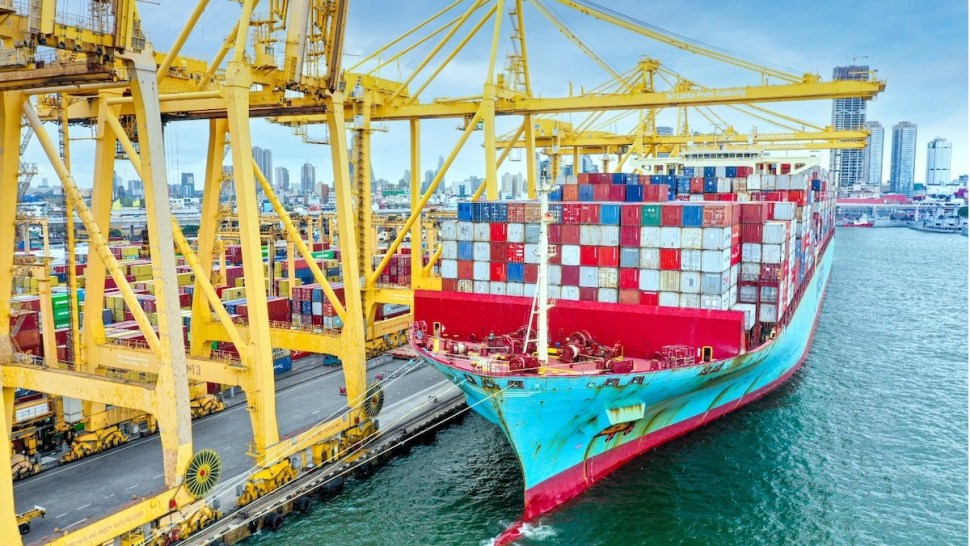
Just when it looked safe to go back in the water, the United States and Iran restart hostilities, and container rates on the busiest U.S. trade lane near a three-year high.
Prices on the benchmark Asia-U.S. trans-Pacific levelled off 8% higher than the previous week, according to SONAR data analyst Freightos, as rates have yet to reflect declining fuel costs.
“Peak season demand continues to push rates higher – though the early start to this year’s busy season may mean volumes are already near their peak,” Freightos (NASDAQ: CRGO) research chief Judah Levine wrote in a weekly note to clients.
General rate increases and peak season surcharges by carriers that took effect July 1 added about $1,000 per forty foot equivalent unit across major east-west lanes, said Levine. That’s brought total trans-Pacific increases to more than $3,000 per FEU since late May.
“West Coast rates are around $6,700 per FEU and East Coast rates are leveling off near $9,000 per FEU,” Levine said.
Mideast tensions flared Tuesday amid Iranian strikes and U.S. retaliation in the most serious escalation since the ceasefire began. President Donald Trump, meeting in Turkey with NATO leaders, said that the fragile ceasefire was ‘over’.
The rejoined war is particularly ill-timed for Maersk (OTC: AMKBY). The Danish liner this week announced what is supposed to be a gradual return to the Suez Canal-Red Sea route as part of its Gemini service with Hapag-Lloyd. Maersk earlier this year saw a similar return halted nearly before it began as violence spread through the Mideast. Houthi rebels in Yemen have again warned of violence directed at Israel-linked shipping.
Levine said that while crude oil prices have fallen back to pre-war levels, supply is recovering faster than expected and raising concerns of oversupply.
“Bunker and jet fuel prices are easing but remain 20%-30% above pre-war levels, as refined products take longer to normalize than crude,” he said.
Despite liners deploying record capacity, Europe rates have also surged. with Asa-North Europe at about $5,400 per FEU and Mediterranean prices passing $7,000 per FEU.
“Carriers have another about $2,000/FEU in mid-July increases planned,” said Levine, “but like on the trans-Pacific, early demand peaking could limit how much sticks.”
He said any rate relief could be slowed by backlogs of rolled cargo – delayed or shifted from schedule – and significant congestion at major Asia hubs including Shanghai, Ningbo and Yantian in China, Singapore, South Korea’s Busan and Colombo in Sri Lanka.
Read more articles by Stuart Chirls here.
Read more:
A peace deal in the Persian Gulf could signal a return of global shipping to the Suez Canal
Former FMC chief Sola to lead Thorn Run LatAm business team
Hormuz in the rearview as Asia-US ocean container rates soar past $7,900
FedEx sells supply chain unit to CMA CGM for $1.4B
Wartime economy: Maersk lifts full-year guidance on strong demand
Brokerage Compliance Symposium
The day before F3. Every compliance issue you face - fraud exposure, carrier liability, FMCSA rules, cargo theft, insurance gaps - navigated by attorneys and operators defining best practices in a changing industry.
F3 Awards Dinner
The night before F3. FreightTech100 companies honored. FreightTech 25 and Shipper of Choice winners revealed live. Cocktail reception into dinner and live music - 300 industry leaders in one purpose-built room.
F3: Future of Freight Festival
Industry-defining keynotes, rapid-fire technology demos, and industry leaders networking in experiences across Chattanooga - plus the inaugural F3 Awards Dinner featuring the FreightTech and Shipper of Choice reveals.
The day before F3. Every compliance issue you face - fraud exposure, carrier liability, FMCSA rules, cargo theft, insurance gaps - navigated by attorneys and operators defining best practices in a changing industry.
The Signal at Chattanooga Choo Choo • Chattanooga, TN Register NowThe night before F3. FreightTech100 companies honored. FreightTech 25 and Shipper of Choice winners revealed live. Cocktail reception into dinner and live music - 300 industry leaders in one purpose-built room.
The Signal at Chattanooga Choo Choo • Chattanooga, TN Register NowIndustry-defining keynotes, rapid-fire technology demos, and industry leaders networking in experiences across Chattanooga - plus the inaugural F3 Awards Dinner featuring the FreightTech and Shipper of Choice reveals.
The Signal at Chattanooga Choo Choo • Chattanooga, TN Register Now