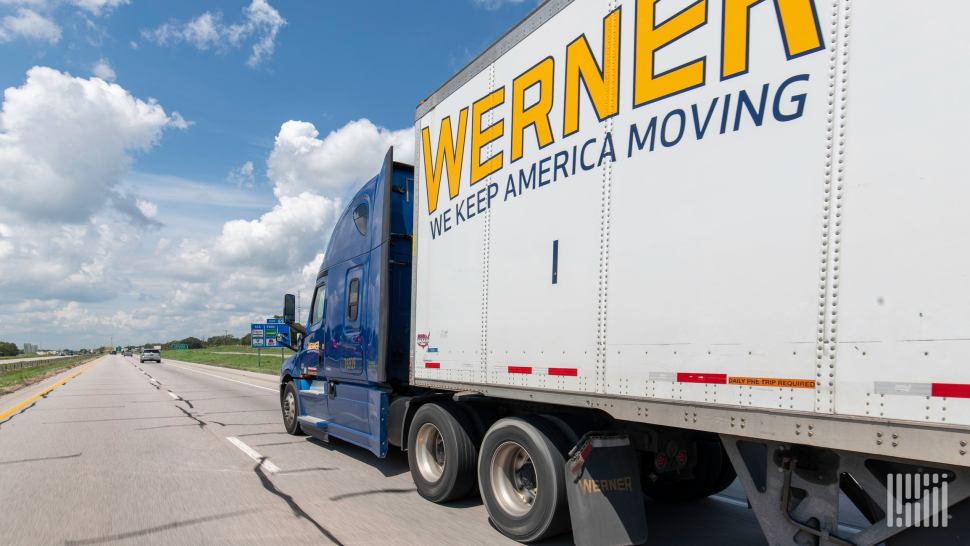
Deadlines are looming for all briefs to be filed with the Texas Supreme Court as it decides whether to review the enormous verdict against Werner Enterprises growing out of a 2014 fatal wreck. With interest, the sum now stands above $100 million.
A primary brief was filed in October by attorneys for the Blake family, which suffered one death, one catastrophic brain injury and other injuries in the Dec. 30, 2014, West Texas crash.
On Feb. 15, attorneys for Werner (NASDAQ: WERN) filed a brief for the company, and earlier this month the Texas Trucking Association filed a friend-of-the-court brief.
The Supreme Court’s page dedicated to the case lists March 6 as the final date for any respondents to file with the court.
Werner’s legal brief reviews well-trod ground on the accident and what happened in a lower court in 2018, when the decision against Werner was first handed down.
But it and the Blake brief also weigh in on the issue of extending liability out to Werner, as it appears clear that the trucking industry is concerned that precedents set in the case could impact future verdicts against carriers.
The facts of the accident are not in dispute. A pickup truck heading east on Interstate 20 in West Texas driven by Trey Salinas and ferrying members of the Blake family hit a black ice patch, streaked across a more than 10-yard-wide median and crashed into a westbound Werner truck driven by Shiraz Ali. Winter storm watches were in effect. One of the Blake children died, and a second was severely injured. Other passengers had less serious injuries.
The Blakes’ core argument is that Ali had not sufficiently slowed his truck to compensate for the weather. If he had, the Werner truck would not have been where it was when the pickup driven by Salinas crossed the median.
In its brief, Werner’s attorneys summed up the trial court’s ruling as saying that Ali “owed a duty to reasonably foresee that the Blakes’ vehicle might careen into his path.”
In apportioning blame, the lower court jury assigned 70% to Werner on one of the key questions of liability and 30% on another liability issue. On the former question, Salinas’ blame was assessed at 16%.
The arguments leveled against Werner by attorneys for the Blakes in their attempt to put blame on the carrier involved such disparate issues as driver training (along with a borderline personal attack on the person who filled the company’s role as head of training), the demand for on-time delivery, and the lack of a control system that could have instructed Ali to get off the road.
Appeals court upholds lower court ruling
The lower court award of just under $90 million was appealed, and ultimately the full Court of Appeals for the 14th District of Texas grabbed the case before a three-judge appellate court panel could issue its ruling. In a 5-4 decision, the justices ruled in favor of the Blakes. (Interest fees on the initial award resulted in the case being worth more at every stop through the judicial system).
The briefs filed by attorneys for the Blakes and for Werner both provide significant discussion of the “Admission Rule.” Attorneys for the Blakes describe the rule as “[barring] derivative-liability claims like negligent training and supervision when the employer concedes vicarious liability.”
They said the rule was “once the majority rule [but] the modern trend is to reject the rule.”
The Admission Rule is a “relic” of a period before juries could hand down very specific proportionate blame for an accident, according to the Blakes’ attorneys, and “conceals all the ways the employer contributed to the harm except its driver’s conduct, resulting in a fictional apportionment where much of the employer’s responsibility is redistributed among other parties.”
Dissent cited by Werner on issue of Admission Rule
Justice Randy Wilson, in a dissent to the 5-4 vote, wrote that the Admission Rule holds that if an employer acknowledges one of its employees “was acting in the course and scope of his employment when the employee allegedly engaged in negligent conduct (that) bars a party allegedly injured by the employee’s negligence from pursuing derivative theories of negligence against the employer.” His minority argument was that the Admission Rule should have barred the enormous liability claim against Werner, which employed Ali.
Attorneys for Werner concur and say the issues in the case could be precedent-setting. The brief says the “question [has] never [been] definitely resolved by this Court: whether a claimant injured by a person acting in the course and scope of employment may pursue derivative negligence theories against an employer” if the employer concedes the worker was performing duties for the employer.
Werner’s brief called Wilson’s dissent “powerful” but conceded that while courts recognize the Admission Rule, they aren’t in agreement on what its impact can be.
By not limiting liability down the line, the Werner attorneys argue, it effectively defined a driver’s duty as “one owed to the whole world.” “If affirmed, the trial court’s judgment will establish that a driver and his or her employer may be held liable for injuries to other motorists no matter how improbable, fantastic, or farfetched,” Werner said in its brief. “Because that result has no basis in Texas law, reversal of the trial court’s judgment is necessary.”
In its amicus brief, the Texas Trucking Association says the Admissions Rule helps provide “appropriate boundaries for argumentation on employer liability and reduce the likelihood of error.”
“Had Ali been driving outside the course and scope of his employment, [the Blakes] may have been able to use derivative liability theories like negligent hiring, training, entrustment, or supervision to find Werner responsible for Ali’s actions,” the association writes. “But when an employer stipulates to course and scope — as Werner did here — the employer’s negligence is no longer in doubt, so long as the employee is found to have been negligent.”
Werner attorneys also are raising the issue of the charge to the lower court jury, saying it improperly mixed issues that they believe should have remained separate, affecting the final verdict.
More articles by John Kingston
If truckers haul bread and cakes, is their business baking or trucking?
State of Freight takeaways: Is a weak February the bottom of the cycle?
Live on stage: The complex relationship between a trucking job and life
Brokerage Compliance Symposium
The day before F3. Every compliance issue you face - fraud exposure, carrier liability, FMCSA rules, cargo theft, insurance gaps - navigated by attorneys and operators defining best practices in a changing industry.
F3 Awards Dinner
The night before F3. FreightTech100 companies honored. FreightTech 25 and Shipper of Choice winners revealed live. Cocktail reception into dinner and live music - 300 industry leaders in one purpose-built room.
F3: Future of Freight Festival
Industry-defining keynotes, rapid-fire technology demos, and industry leaders networking in experiences across Chattanooga - plus the inaugural F3 Awards Dinner featuring the FreightTech and Shipper of Choice reveals.
The day before F3. Every compliance issue you face - fraud exposure, carrier liability, FMCSA rules, cargo theft, insurance gaps - navigated by attorneys and operators defining best practices in a changing industry.
The Signal at Chattanooga Choo Choo • Chattanooga, TN Register NowThe night before F3. FreightTech100 companies honored. FreightTech 25 and Shipper of Choice winners revealed live. Cocktail reception into dinner and live music - 300 industry leaders in one purpose-built room.
The Signal at Chattanooga Choo Choo • Chattanooga, TN Register NowIndustry-defining keynotes, rapid-fire technology demos, and industry leaders networking in experiences across Chattanooga - plus the inaugural F3 Awards Dinner featuring the FreightTech and Shipper of Choice reveals.
The Signal at Chattanooga Choo Choo • Chattanooga, TN Register Now