When truckers pull in to refuel their vehicles these days, there are two prices that are shocking.
One is just how much the price of diesel has risen. The SONAR DTS.USA Truckstop average retail diesel price was $5.18/gallon Friday. On March 2, it was $3.81/g.
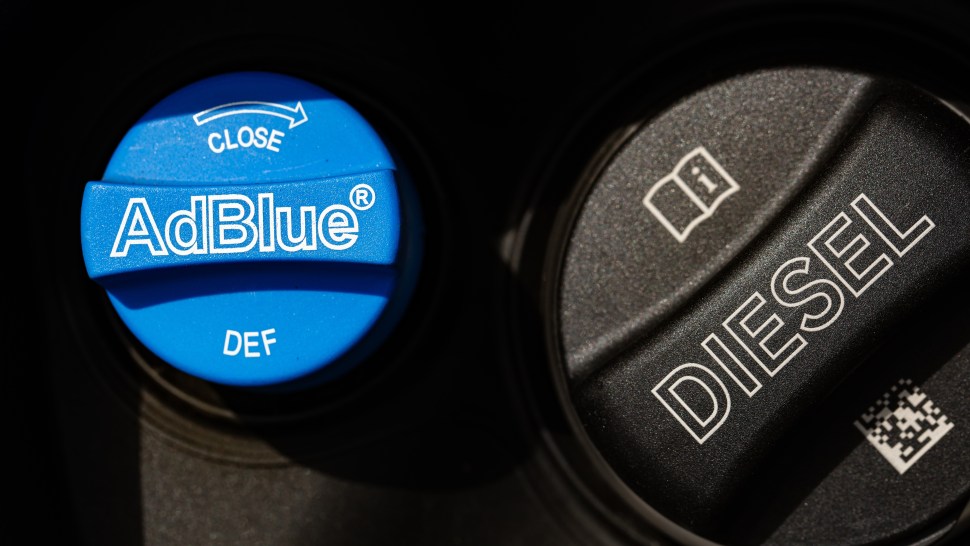
The second shocker is the fact that the retail price of diesel exhaust fluid (DEF) appears to be holding firm at levels where it was prior to the start of the Iran war, despite the fact that the raw material used to make it has seen enormous increases in the spot market.
That raw material to produce DEF is urea. Urea’s primary raw material input is natural gas, and the Middle East has long been a source of urea exports, given its abundant natural gas.
Big sellers haven’t moved
Increases in the price of urea would normally be expected to translate to higher prices for DEF. But based on data from two major travel center chains, that has not happened yet.
Pilot Travel Centers (NYSE: BRK-B) has a downloadable spreadsheet of all fuel and DEF prices through its network of more than 800 outlets.
A comparison of the DEF prices embedded in those spreadsheets shows that there have been virtually no increases in DEF prices throughout the system since March 1, when the U.S. and Israel launched its attack on Iran. Any changes have been few in number and are no more than 10 cents per gallon.
The most common price found for retail DEF through the Pilot Flying J chain is between $4.299/g and $4.599/g.
“Pilot works hard to maintain supply to meet the needs of our customers,” a spokesman for the company said in an email to FreightWaves when asked about the stability in DEF prices. “We do not have anything else to add at this time.”
Love’s Travel Centers also lists retail fuel and DEF prices on its website and like Pilot has a downloadable spreadsheet.
FreightWaves did not begin downloading the Love’s data until the past few days so can not make a comparison with its pre-Iran war prices.
But a review of Love’s DEF prices shows its retail numbers are in line with where Pilot Flying J is. And a Love’s spokeswoman confirmed to FreightWaves Thursday that the company had not increased retail DEF prices since the start of hostilities.
Argus Media has extensive coverage of both the urea and DEF markets. According to its data supplied to FreightWaves, the FOB Egypt price for urea, which is considered a key international benchmark, was $482.50/mt on February 27, the last daily assessment prior to the start of the military action. By March 13, it had risen to $712.50/mt, before falling back Monday to $705/mt.
Complex pricing system
Suzie Skipper, an editor at Argus, said DEF pricing in the U.S. begins with the price of urea liquor, a derivative product of urea. Urea’s primary market is as a fertilizer.
Urea liquor is priced at a premium to the Argus benchmark price of urea in New Orleans. That premium, she said, is usually negotiated on an annual basis and is in place for a full 12 months.
The base price of urea in New Orleans is subject to daily change. But contract DEF prices tied to it generally only change monthly, Skipper said.
That quirk in urea liquor pricing could be the reason why retail DEF is holding steady. But at the same time, retail DEF prices will not be able to hold back the realities of the urea market forever.
Skipper said at times of high volatility–like the late 2021-2022 market that sent urea and DEF prices soaring–the DEF spot price can be changed more than once a month. And it did in March, moving on March 5 and March 13.
But based on the numbers at the two major travel stops, that hasn’t impacted retail prices, at least not yet.
Bananas market for the raw material
Harry Minihan, Skipper’s colleague at Argus, said the Middle East urea market as measured by the Egypt price was “going bananas. And it’s no real surprise, given how important the Middle East is to the urea market.”
While all the focus has been on oil and to a lesser degree natural gas, the tight relationship between fertilizer production and natural gas–which the Middle East has huge quantities–have sent prices climbing for numerous fertilizers like urea.
“The Qataris have announced a full cutdown of their urea production, and the others are effectively closed off because they can’t traverse the Strait particularly well,” Minihan said.
Countries in the Gulf region supply the urea market with about 20% of world supply, he added.
Minihan described the process to produce urea: “You take natural gas and you crack it and combine it with atmospheric nitrogen to create ammonia, and then ammonia is mixed with carbon dioxide to create urea.”
The urea market is getting a break in terms of the calendar, because major markets in South Asia and Brazil, including India and Pakistan, are not at a spot in the growing calendar where they would be buying large amounts of urea for fertilizer. “So that is a bit of a saving grace,” he said.
More articles by John Kingston
Five takeaways from State of Freight: Already strong market gets a wartime jolt
Ohio jury awards $22.5 million in TQL pregnancy case
Dalilah’s Law that tightens CDL issuance gets House committee OK
Brokerage Compliance Symposium
The day before F3. Every compliance issue you face - fraud exposure, carrier liability, FMCSA rules, cargo theft, insurance gaps - navigated by attorneys and operators defining best practices in a changing industry.
F3 Awards Dinner
The night before F3. FreightTech100 companies honored. FreightTech 25 and Shipper of Choice winners revealed live. Cocktail reception into dinner and live music - 300 industry leaders in one purpose-built room.
F3: Future of Freight Festival
Industry-defining keynotes, rapid-fire technology demos, and industry leaders networking in experiences across Chattanooga - plus the inaugural F3 Awards Dinner featuring the FreightTech and Shipper of Choice reveals.
The day before F3. Every compliance issue you face - fraud exposure, carrier liability, FMCSA rules, cargo theft, insurance gaps - navigated by attorneys and operators defining best practices in a changing industry.
The Signal at Chattanooga Choo Choo • Chattanooga, TN Register NowThe night before F3. FreightTech100 companies honored. FreightTech 25 and Shipper of Choice winners revealed live. Cocktail reception into dinner and live music - 300 industry leaders in one purpose-built room.
The Signal at Chattanooga Choo Choo • Chattanooga, TN Register NowIndustry-defining keynotes, rapid-fire technology demos, and industry leaders networking in experiences across Chattanooga - plus the inaugural F3 Awards Dinner featuring the FreightTech and Shipper of Choice reveals.
The Signal at Chattanooga Choo Choo • Chattanooga, TN Register Now