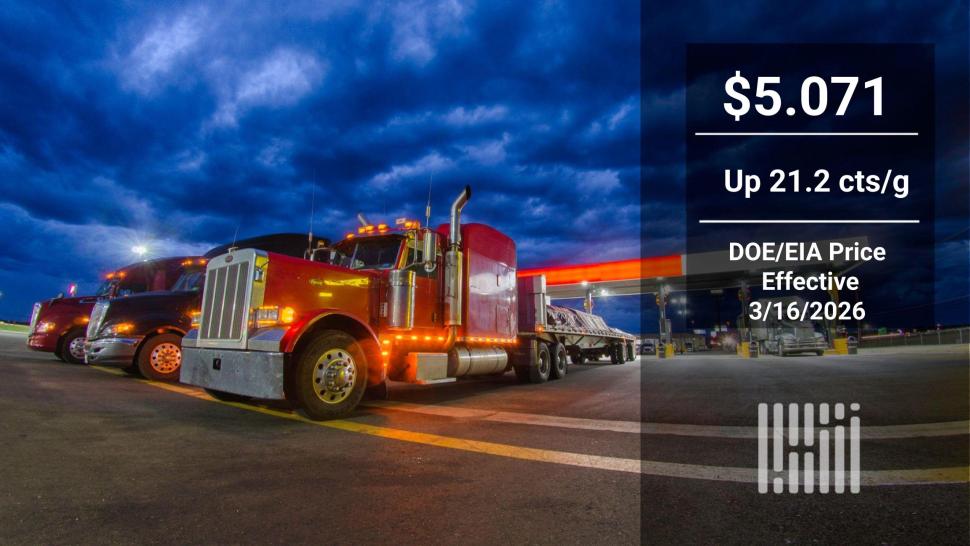
Prior to this week, there had been 32 times when the Department of Energy/Energy Information Administration average weekly retail diesel price topped $5/gallon. All of them came in 2022.
That number now totals 33, with the latest price of $5.071/g smashing through the $5 mark, up 21.2 cts/g from last week’s $4.859/g number. That price in turn was up 96.2 cts/g from the prior week.
It was the ninth consecutive week the benchmark price used for most fuel surcharges rose. The DOE/EIA price was $3.459/g before that run of higher prices began. The latest price is now $1.612/g more than that.
The diesel retail market is apparently volatile enough that there is a gap between the DOE/EIA price and the AAA average daily retail diesel price. That was posted for Tuesday at $5.044/g.
Ultra low sulfur diesel on the CME commodity exchange settled at $2.596/g on February 27, the last day of trading before the U.S. and Israel launched their coordinated attack on Iran, followed by Iranian counterattacks. The highest settlement since then was recorded Friday at $4.0147/g, an increase of $1.4187/g.
The DOE/EIA price recorded on March 2 was $3.897/g. That would not have reflected any movement in the price from the Iran war, since it had just begun. But in the last two weeks, that retail number has increased by $1.174/g, lagging the futures increase by about 24.5 cts/g. That gap may look large but given the enormous pace of futures price increases, it actually has captured much of the futures market increase rapidly.
Futures market heading higher Tuesday
A sharp drop in the ULSD price on CME Monday has been followed by an increase Tuesday that wiped out the Monday declines and shot higher than that. At about 10:40 a.m., ULSD on CME was up 20.44 cts/g, a gain of 5.33%, to $4.0419/g.
The focus in the market remains on the Strait of Hormuz. But it is important to note what is occurring behind that bottleneck waterway, where the inability to move crude to market is resulting in continued shutdown of production.
Recent news reports quoted Rystad Energy, a well-respected energy analytics firm, as saying that the Middle East has lost more than 12-million barrels/day of production since “Iran effectively closed the Strait of Hormuz.”
Rystad estimated that number at about 7% of global petroleum liquids demand. It also said the worst-case scenario was a decline to about 6 million b/d of remaining production, which would be about a 70% decline from pre-war Middle East output levels.
The Rystad report was highlighted by the OPIS energy news service in a report Monday.
The report said the 14 million b/d of Middle East output that remains operating is “fragile.”
“About 1.5 million b/d from Kuwait and Iraq is holding only because domestic refineries are still running; as storage fills, output will likely be cut further,” the OPIS report said. “Another 6.5 million b/d depends on bypass pipelines — the UAE’s ADCOP line to Fujairah and Saudi Arabia’s East-West line to Yanbu — infrastructure that has already been targeted in attacks and constrained by tanker availability.”
The Yanbu report is on the Red Sea at the western terminus of a pipeline that crosses Saudi Arabia, so tankers loading there do not need to transit the Strait of Hormuz.
Trying to find another way
But necessity is the mother of invention. Bloomberg reported that Iraq is “in talks with Iran to allow some of its oil tankers to pass through the Strait of Hormuz,” quoting Iraqi oil minister Hayyan Abdulghani.
The Bloomberg report said Iraqi production is down to about 1.5 million b/d to 1.6 million b/d that is mostly being consumed by domestic refineries and for electricity generation. Its pre-war production was near 4.2 million b/d.
More articles by John Kingston
Derek Barrs defends FMCSA’s bold moves at TCA
6th Circuit rejects NLRB’s Cemex rule, dealing blow to unionization efforts
New Jersey delivery firm will reclassify independent drivers as employees
Brokerage Compliance Symposium
The day before F3. Every compliance issue you face - fraud exposure, carrier liability, FMCSA rules, cargo theft, insurance gaps - navigated by attorneys and operators defining best practices in a changing industry.
F3 Awards Dinner
The night before F3. FreightTech100 companies honored. FreightTech 25 and Shipper of Choice winners revealed live. Cocktail reception into dinner and live music - 300 industry leaders in one purpose-built room.
F3: Future of Freight Festival
Industry-defining keynotes, rapid-fire technology demos, and industry leaders networking in experiences across Chattanooga - plus the inaugural F3 Awards Dinner featuring the FreightTech and Shipper of Choice reveals.
The day before F3. Every compliance issue you face - fraud exposure, carrier liability, FMCSA rules, cargo theft, insurance gaps - navigated by attorneys and operators defining best practices in a changing industry.
The Signal at Chattanooga Choo Choo • Chattanooga, TN Register NowThe night before F3. FreightTech100 companies honored. FreightTech 25 and Shipper of Choice winners revealed live. Cocktail reception into dinner and live music - 300 industry leaders in one purpose-built room.
The Signal at Chattanooga Choo Choo • Chattanooga, TN Register NowIndustry-defining keynotes, rapid-fire technology demos, and industry leaders networking in experiences across Chattanooga - plus the inaugural F3 Awards Dinner featuring the FreightTech and Shipper of Choice reveals.
The Signal at Chattanooga Choo Choo • Chattanooga, TN Register Now