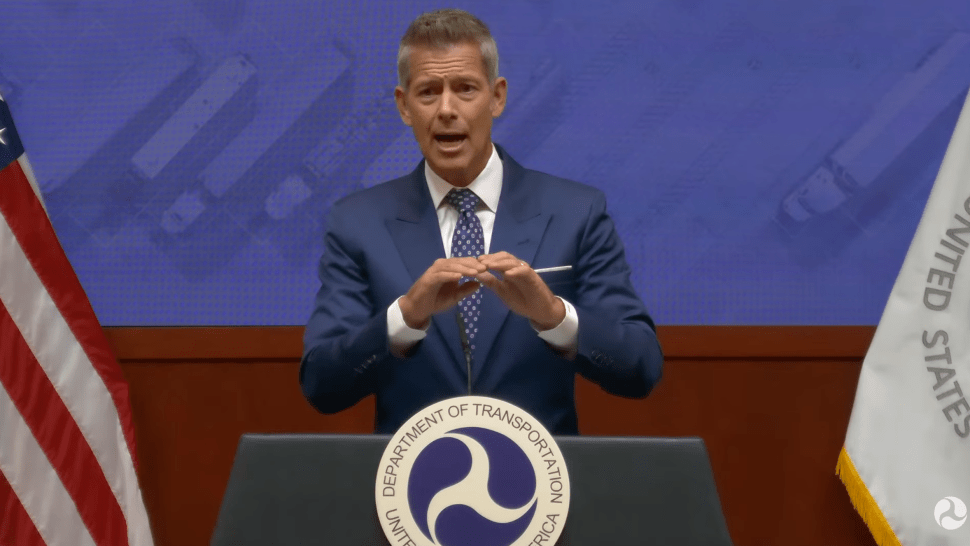
During a press conference on commercial driver’s license (CDL) enforcement, U.S. Transportation Secretary Sean Duffy responded to a reporter’s questions about the truck driver shortage and the potential impacts of stricter rule enforcement. The discussion focused on workforce challenges in the trucking industry and the Department of Transportation’s (DOT) approach to addressing them.
The press conference outlined the DOT’s measures to address unlawfully issued CDLs and non-English proficient drivers. A reporter raised concerns about labor shortages and supply chain effects, prompting Duffy to provide his perspective.
The Reporter’s Question
The reporter asked about the demands of trucking jobs and the administration’s plans. “There is a shortage of people who want these jobs,” the reporter said. “They’re very long hours; sometimes the pay may not be as competitive. So, given that shortfall of American workers to take those jobs, what is the Trump administration doing to skill up those workers to create that domestic labor supply?”
The reporter also inquired about enforcement implications: “And if you would start enforcing these rules strictly, are you concerned that the absence of non-citizens is going to lead to shortages in truck driving that will then affect supply chains, transportation networks, etc.?”
Duffy’s Response: ‘Different Data Than I Have’
Duffy acknowledged the question and offered his view. “Fantastic question,” he said. “And I think you have different data than I have. There’s a lot of Americans who want to get behind the wheel of a big rig. These are, and have been, really great-paying jobs.”
He linked the perceived shortage to competition from drivers without proper credentials. “But when you bring someone in who doesn’t have a driver’s license, they’ll drive that truck for a much lower rate—or someone who unlawfully got their license will drive that rig for a much lower rate,” Duffy explained. “And so, what has happened in the industry is it’s driven prices down, and a lot of companies are now starting to go out of business.”
Duffy rejected the idea of a driver deficit. “So, I do not buy the idea that there aren’t enough American truck drivers to meet demands in this country,” he said. He described it as a constructed issue: “And it was concocted in a way for people to come into our country to get commercial driver’s licenses unlawfully, then get behind the wheel. And I don’t think that is the appropriate approach.”
Highlighting U.S. truckers’ professionalism, Duffy compared them to other roles. “We have a long history of great American truck drivers who are almost like air traffic controllers or pilots,” he said. “They take their jobs very seriously—what they do on American roads—it’s not just their lives [at stake]. And so, I think you’ll see American truck drivers fill the space when we do what’s right and take out these unlawful drivers.”
Emphasis on Safety and Promotion
Duffy underscored the importance of safety. “Just a side note: We should never compromise safety,” he stated. “We should never say, ‘Put a non-qualified driver in a big rig, 18-wheeler, set them loose on our roads.'”
He suggested promoting the industry to attract drivers. “If you need more drivers, make the case: Tell people how great the industry is, how much you can make in a year by driving a truck, and it will be met with—I think—a number of applicants,” he said. “We need those new trucks.”
Duffy concluded with confidence in the supply chain. “So, I feel very confident that if we take out the unlawful, untrained, non-English-speaking drivers, we will not have an issue on our roadways,” he said. “We will not have issues with our deliveries. Products will move, but they’ll move safer because better drivers—who are driving those big rigs—who have legal licenses and can actually speak the English language.”
Brokerage Compliance Symposium
The day before F3. Every compliance issue you face - fraud exposure, carrier liability, FMCSA rules, cargo theft, insurance gaps - navigated by attorneys and operators defining best practices in a changing industry.
F3 Awards Dinner
The night before F3. FreightTech100 companies honored. FreightTech 25 and Shipper of Choice winners revealed live. Cocktail reception into dinner and live music - 300 industry leaders in one purpose-built room.
F3: Future of Freight Festival
Industry-defining keynotes, rapid-fire technology demos, and industry leaders networking in experiences across Chattanooga - plus the inaugural F3 Awards Dinner featuring the FreightTech and Shipper of Choice reveals.
The day before F3. Every compliance issue you face - fraud exposure, carrier liability, FMCSA rules, cargo theft, insurance gaps - navigated by attorneys and operators defining best practices in a changing industry.
The Signal at Chattanooga Choo Choo • Chattanooga, TN Register NowThe night before F3. FreightTech100 companies honored. FreightTech 25 and Shipper of Choice winners revealed live. Cocktail reception into dinner and live music - 300 industry leaders in one purpose-built room.
The Signal at Chattanooga Choo Choo • Chattanooga, TN Register NowIndustry-defining keynotes, rapid-fire technology demos, and industry leaders networking in experiences across Chattanooga - plus the inaugural F3 Awards Dinner featuring the FreightTech and Shipper of Choice reveals.
The Signal at Chattanooga Choo Choo • Chattanooga, TN Register Now