




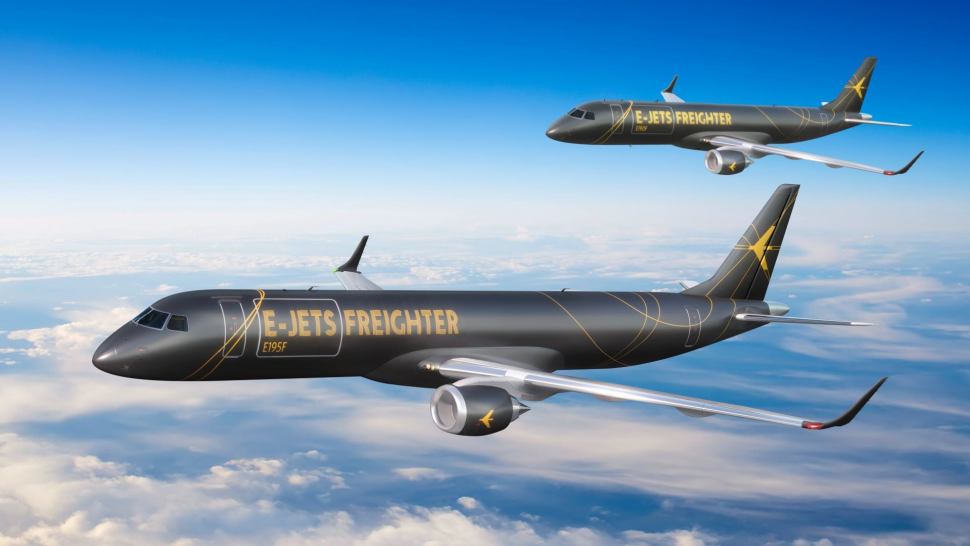
Brazilian aircraft manufacturer Embraer has received its first firm order for up to 10 conversions of the E190/E195 passenger jet to a freighter from an undisclosed customer, underscoring the continued strong demand for all-cargo aircraft of all sizes even as the global economy begins to cool down.
Aircraft for conversion will come from the customer’s current E-Jet fleet. Deliveries are scheduled to begin in 2024, Embraer said in a news release Friday.
In early May, Nordic Aviation Capital, a leasing company that specializes in regional aircraft, signed a nonbinding letter of intent for retrofits on up to 10 E190/195s.
E190s and E195s are small narrowbody aircraft that fall between the standard Boeing 737 and large turboprops. Embraer says the E190F will have a payload of 23,600 pounds, while the E195F will carry up to 27,100 pounds.
Embraer launched the E-Jet conversion program in early March as a modern, fuel-efficient, less-polluting replacement for aging freighters in its size class, such as the MD-80 and CRJ200. It also has the potential to fit a niche within express carrier networks, covering short, regional routes on a daily basis. Embraer says E-Jet freighters will have 50% more volume capacity and three times the range of large cargo turboprops and up to 30% lower operating costs than older 737 converted freighters. It’s not clear if the cost comparison applies to the 737-800, the newest version of the 737 to be reconfigured for dedicated cargo use.
One potential drawback for the E190/195 is that the fuselage’s unique diameter prevents it from carrying standard-size containers that are interchangeable with other aircraft. Instead, the plane will likely require 88-inch-by-108-inch containers or pallets.
Embraer projects a market of about 700 aircraft that could be retrofitted for dedicated cargo operation over the next 20 years. It says there are a number of 10- to 15-year-old E190/195 aircraft that are already good candidates for cargo transformation.
Passenger-to-freighter conversions require extensive alterations, including removal of seats, the addition of a wider cargo door on the main deck, a reinforced floor to handle heavy containers, a rigid barrier in front of the cockpit, a smoke detection system and a cargo handling system to maneuver containers on and off the aircraft.
The market for freighter conversions has mushroomed during the past three years because of strong growth in trade and e-commerce, combined with decreased flying by passenger airlines and less expensive used aircraft as airlines downsize or switch to more fuel-efficient aircraft for their passenger business.
Embraer will carry out the reconfigurations at its facilities in Brazil.
Click here for more FreightWaves/American Shipper stories by Eric Kulisch.
RECOMMENDED READING:
Lufthansa invests in next-gen Boeing 777-8 freighters
LATAM locks in expansion plan with Boeing 767 converted freighters
Brokerage Compliance Symposium
The day before F3. Every compliance issue you face - fraud exposure, carrier liability, FMCSA rules, cargo theft, insurance gaps - navigated by attorneys and operators defining best practices in a changing industry.
F3 Awards Dinner
The night before F3. FreightTech100 companies honored. FreightTech 25 and Shipper of Choice winners revealed live. Cocktail reception into dinner and live music - 300 industry leaders in one purpose-built room.
F3: Future of Freight Festival
Industry-defining keynotes, rapid-fire technology demos, and industry leaders networking in experiences across Chattanooga - plus the inaugural F3 Awards Dinner featuring the FreightTech and Shipper of Choice reveals.
The day before F3. Every compliance issue you face - fraud exposure, carrier liability, FMCSA rules, cargo theft, insurance gaps - navigated by attorneys and operators defining best practices in a changing industry.
The Signal at Chattanooga Choo Choo • Chattanooga, TN Register NowThe night before F3. FreightTech100 companies honored. FreightTech 25 and Shipper of Choice winners revealed live. Cocktail reception into dinner and live music - 300 industry leaders in one purpose-built room.
The Signal at Chattanooga Choo Choo • Chattanooga, TN Register NowIndustry-defining keynotes, rapid-fire technology demos, and industry leaders networking in experiences across Chattanooga - plus the inaugural F3 Awards Dinner featuring the FreightTech and Shipper of Choice reveals.
The Signal at Chattanooga Choo Choo • Chattanooga, TN Register Now