




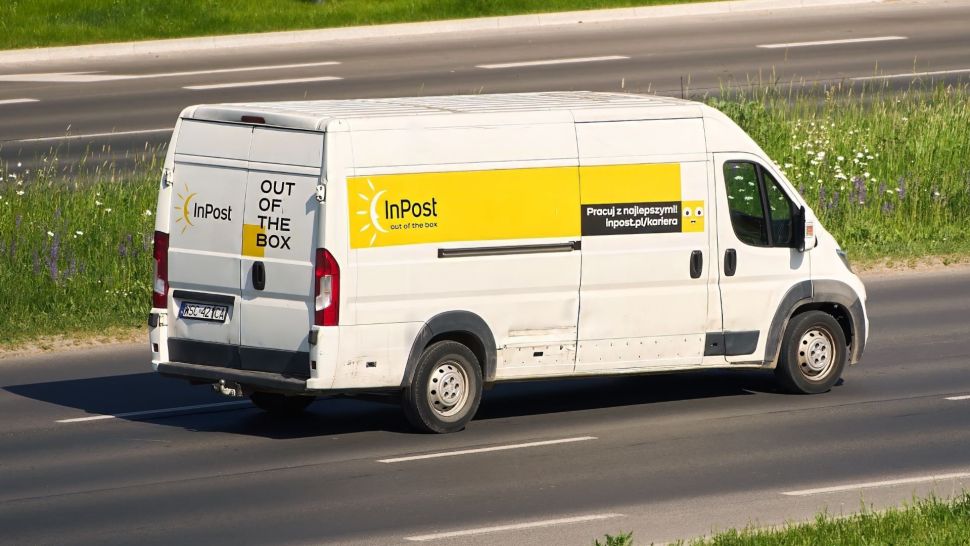
A consortium of private investors led by FedEx on Monday reached an agreement on an all-cash offer to buy publicly traded InPost, a fast-growing express delivery firm based in Poland for 7.8 billion euros (equivalent to $9.2 billion) as FedEx moves to capture a larger share of the of the European B2C market.
FedEx (NYSE: FDX), which would take a 37% stake in InPost through a roughly $2.6 billion contribution, is partnered with private equity firm Advent; investment company A&R, which is controlled by InPost founder Rafal Brzoska and currently owns 12% of InPost shares; and PPF Group, a large investment and industrial holding company.
FedEx’s minority stake will allow the parcel logistics integrator to quickly tap into the rapid growth of out-of-home parcel delivery across key European markets and allow global customers to access InPost’s network, where parcel volumes have quadrupled over five years as consumers increasingly make retail purchases online.
The financial backing will help InPost continue its expansion across Europe and install more automated parcel machines. The companies said in their announcement that there is an opportunity to significantly grow InPost’s out-of-home delivery network across Europe with rising consumer demand for frictionless delivery service.
InPost specializes in out-of-home delivery, using a network of 61,000 parcel lockers and more than 34,000 pick-up/drop-off points in several countries to support more than 100,000 e-commerce sellers. It also offers front-door service. InPost last year acquired Yodel for $144 million, making it the third-largest independent parcel operator in the UK, and Spain-based courier Sending. Before that it took over Mondial Relay in France. The carrier’s parcel volumes in 2025 increased 25% to more than 1.4 billion.
InPost is growing financially, as well as geographically. It posted $300 million in adjusted earnings before interest, taxes and appreciation during the third quarter. It reported a record peak season, with fourth quarter volumes of 417.6 million pieces up 30% year over year. Analysts say InPost has been smart in acquiring slow-growth last-mile delivery companies at scale and shifting their focus from home to out-of-home delivery, which is much less expensive.
Under the tentative deal, Advent will also hold 37% of InPost, with A&R owning 16% and PPF holding 10%. InPost will continue to operate as a standalone company, with Brzoska as CEO.
The buyers said they support InPost’s strategy to further expand its European footprint in France, Spain, Portugal, Italy, Benelux and the United Kingdom, the largest e-commerce market in Europe. The investment also will allow InPost to further develop its mobile app, which allows retail consumers to open automated parcel lockers, track shipments, receive arrival notices and make “labelless” returns.
Parcel industry practitioners, some of whom have questioned FedEx’s strategy in recent years, complimented the parcel giant for the deal.
Andre Veskimeister, the founder and CEO of parcel locker platform and delivery companies based in Europe, said on LinkedIn that InPost is Europe’s best out-of-home delivery company.
“InPost didn’t just build a locker network — they built the operating system for out-of-home delivery at scale. They cracked consumer adoption, network economics, retailer integration, and regulatory navigation across multiple European markets. That knowledge is priceless” for FedEx, he wrote.
FedEx, Veskimeister added, gets strategic infrastructure that could lead to FedEx-branded locker deployments or some type of longer-term integration with InPost. Either way, FedEx is positioning for a high-margin parcel business where out-of-home delivery will be the primary activity over residential delivery.
“Building on our success in Poland, this transaction will support our next phase of growth as we continue to grow across Europe. By partnering with the long‐term financial and strategic investors of the consortium who know our business and the industry well, we benefit from the expertise, stability and resources needed to capitalize on the strong tailwinds including increasing e-commerce penetration, rising consumer demand for speed and convenience and the shift towards more sustainable delivery solutions,” said Brzoska in the announcement. “Together, we will strengthen our network and reach more consumers with enhanced fast and flexible delivery options as we continue our objective of redefining the European e-commerce sector.”
Once the deal is finalized, FedEx will enter into arm’s length commercial agreements that will enable both businesses to benefit from each other’s respective strengths. InPost will gain access to FedEx’s global air and ground delivery network, while FedEx plugs into InPost’s last-mile delivery network — giving consumers easier access to shopping platforms outside of Europe.
FedEx, which has a large footprint in Europe through its 2016 acquisition of TNT Express and a primary air hub in Paris, said the deal will help it make faster inroads into out-of-home delivery across key European markets and enable more efficient consumer delivery, improving profitability and returns in its European operations.
“FedEx has a global network that powers the industrial economy, and InPost has a strong and successful presence in Europe’s out-of-home delivery segment. . . . Our investment in InPost reflects our disciplined approach to capital allocation and long-term value creation. Together with InPost’s leadership and our fellow consortium members, we see a clear path to unlocking growth, improving the efficiency of our B2C last-mile operations, enhancing returns, and better serving customers across Europe,” said FedEx CEO Raj Subramaniam.
FedEx also could benefit from InPost’s expertise should to decide to pursue a parcel locker strategy in the U.S., where lockers have yet to catch on because of the sprawling suburban and rural landscape compared to Europe where the population is more concentrated in urban areas.
FedEx can further leverage its brand across Europe by putting its logo on tens of thousands of InPost automated parcel lockers and offer enhanced e-commerce pick-up and delivery service across those lockers to more profitably grow B2C business in Europe, said Dean Maciuba, the head of Crossroads Parcel Consulting, on LinkedIn. InPost could teach FedEx how to develop parcel locker networks and take on Amazon in that space, he added.
“FedEx and UPS surcharges related specifically to ecommerce residential delivery in the U.S. are skyrocketing and putting margin pressure on e-commerce merchants to justify free delivery and/or driving up the cost of products. An expanded automated parcel locker network across the U.S. will help to keep the cost of the e-commerce transaction down, which is good for the consumer, the merchants and the parcel carrier,” Maciuba said, adding that the U.S. Postal Service should open cut a deal to set up FedEx lockers at post offices.
The consortium said its offer of 15.60 euros per share represents a 50% premium to InPost’s share price of 10.40 euros on Jan. 2 and a 17% premium to Friday’s closing price. The deal is expected to close in the second half of the year, subject to shareholder and regulatory approval. The partners will mostly use equity to fund the sale, but will also borrow a portion of the necessary funds. If InPost accepts a competing offer it will be required to pay the consortium a termination fee of $78 million.
Click here for more FreightWaves/American Shipper stories by Eric Kulisch.
Write to Eric Kulisch at ekulisch@freightwaves.com.
RELATED STORIES:
InPost partners with Bloq.it to install 20K parcel lockers
Polish parcel powerhouse InPost buys Spanish delivery provider
Veho to flex delivery speeds for price-sensitive e-commerce sellers
Brokerage Compliance Symposium
The day before F3. Every compliance issue you face - fraud exposure, carrier liability, FMCSA rules, cargo theft, insurance gaps - navigated by attorneys and operators defining best practices in a changing industry.
F3 Awards Dinner
The night before F3. FreightTech100 companies honored. FreightTech 25 and Shipper of Choice winners revealed live. Cocktail reception into dinner and live music - 300 industry leaders in one purpose-built room.
F3: Future of Freight Festival
Industry-defining keynotes, rapid-fire technology demos, and industry leaders networking in experiences across Chattanooga - plus the inaugural F3 Awards Dinner featuring the FreightTech and Shipper of Choice reveals.
The day before F3. Every compliance issue you face - fraud exposure, carrier liability, FMCSA rules, cargo theft, insurance gaps - navigated by attorneys and operators defining best practices in a changing industry.
The Signal at Chattanooga Choo Choo • Chattanooga, TN Register NowThe night before F3. FreightTech100 companies honored. FreightTech 25 and Shipper of Choice winners revealed live. Cocktail reception into dinner and live music - 300 industry leaders in one purpose-built room.
The Signal at Chattanooga Choo Choo • Chattanooga, TN Register NowIndustry-defining keynotes, rapid-fire technology demos, and industry leaders networking in experiences across Chattanooga - plus the inaugural F3 Awards Dinner featuring the FreightTech and Shipper of Choice reveals.
The Signal at Chattanooga Choo Choo • Chattanooga, TN Register Now