




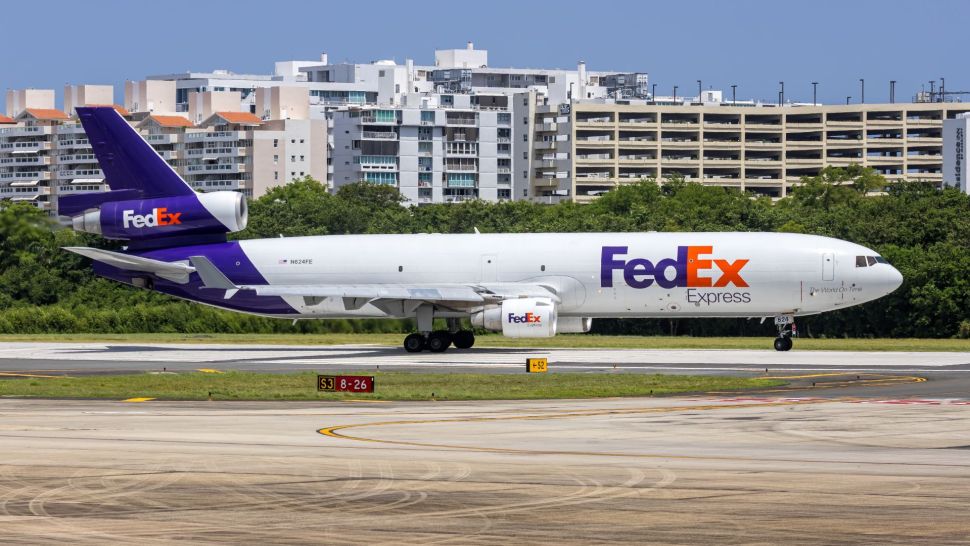
FedEx Corp. expects minimal shipping disruption from grounding its MD-11 freighter fleet because mandated inspections can be completed relatively quickly and the carrier has already deployed alternative aircraft to compensate for the lost capacity, Chief Financial Officer John Dietrich said Tuesday.
The Federal Aviation Administration on Saturday ordered FedEx, UPS and Western Global Airlines to pause MD-11 activity following the catastrophic crash of a UPS MD-11 last week in Louisville, Kentucky, that killed 14 people. Inspections are believed to be focusing on the engines and engine mounts after the left-wing engine and pylon detached on Flight 2976 during takeoff.
FedEx (NYSE: FDX) mechanics, working closely with Boeing and the FAA, will begin inspecting 25 aircraft in the operating fleet within the next few days. The express delivery and logistics giant owns 34 MD-11s, but six are inactive and three are maintained as spares, Dietrich said.
“It’s important to note that once the aircraft is inspected and released those aircraft will start to get back into the fleet on a one-off, tail-by-tail basis. It’s not like we’re waiting for the whole fleet to be inspected before concluding whether they can safely go back into service,” Dietrich said during a presentation at the Baird Global Industrial Conference in Chicago that was livestreamed.
That’s good news because it is peak shipping season for the logistics world, as retailers rush goods to stores and households for the fast-approaching holidays, and every aircraft is needed to meet demand.
FedEx, the largest cargo airline in the world, is leveraging the flexibility of its global network to replace the MD-11 transport capacity.
In addition to activating spare aircraft, FedEx is postponing routine scheduled maintenance on aircraft that still have time before their flight hour limit expires, and routing shipments to commercial airline partners, said Dietrich.
Another lever FedEx has pulled is shifting more packages to its domestic ground network because 18 of the 25 MD-11s in operation currently operate domestically, he added.
FedEx is also able to count the grounded cargo jets towards the FAA’s target for airlines to cut flight schedules to relieve pressure on the air traffic control system during the government shutdown. The restrictions went into effect on Friday at 40 airports. Cancellations started at 4% of flights and are scheduled to reach 10% by Nov. 14, but a congressional agreement to reopen the government could be finalized by Thursday and lead the FAA to soon rescind the industry directive.
“I met with executives from Boeing. There’s a deep sense of cooperation, urgency, working with the regulators, to get through this period as quickly as possible,” CEO Raj Subramaniam told investors and analysts at the event.
Click here for more FreightWaves/American Shipper stories by Eric Kulisch.
RELATED STORIES:
UPS pilots mourn loss of colleagues killed in plane crash
UPS and FedEx halt MD-11 flying to conduct safety review
UPS begins phaseout of older MD-11 cargo jets
Cargo airlines, shippers face mixed impact from FAA flight restrictions
NTSB crash investigators try to minimize disruptions for UPS customers
Brokerage Compliance Symposium
The day before F3. Every compliance issue you face - fraud exposure, carrier liability, FMCSA rules, cargo theft, insurance gaps - navigated by attorneys and operators defining best practices in a changing industry.
F3 Awards Dinner
The night before F3. FreightTech100 companies honored. FreightTech 25 and Shipper of Choice winners revealed live. Cocktail reception into dinner and live music - 300 industry leaders in one purpose-built room.
F3: Future of Freight Festival
Industry-defining keynotes, rapid-fire technology demos, and industry leaders networking in experiences across Chattanooga - plus the inaugural F3 Awards Dinner featuring the FreightTech and Shipper of Choice reveals.
The day before F3. Every compliance issue you face - fraud exposure, carrier liability, FMCSA rules, cargo theft, insurance gaps - navigated by attorneys and operators defining best practices in a changing industry.
The Signal at Chattanooga Choo Choo • Chattanooga, TN Register NowThe night before F3. FreightTech100 companies honored. FreightTech 25 and Shipper of Choice winners revealed live. Cocktail reception into dinner and live music - 300 industry leaders in one purpose-built room.
The Signal at Chattanooga Choo Choo • Chattanooga, TN Register NowIndustry-defining keynotes, rapid-fire technology demos, and industry leaders networking in experiences across Chattanooga - plus the inaugural F3 Awards Dinner featuring the FreightTech and Shipper of Choice reveals.
The Signal at Chattanooga Choo Choo • Chattanooga, TN Register Now