




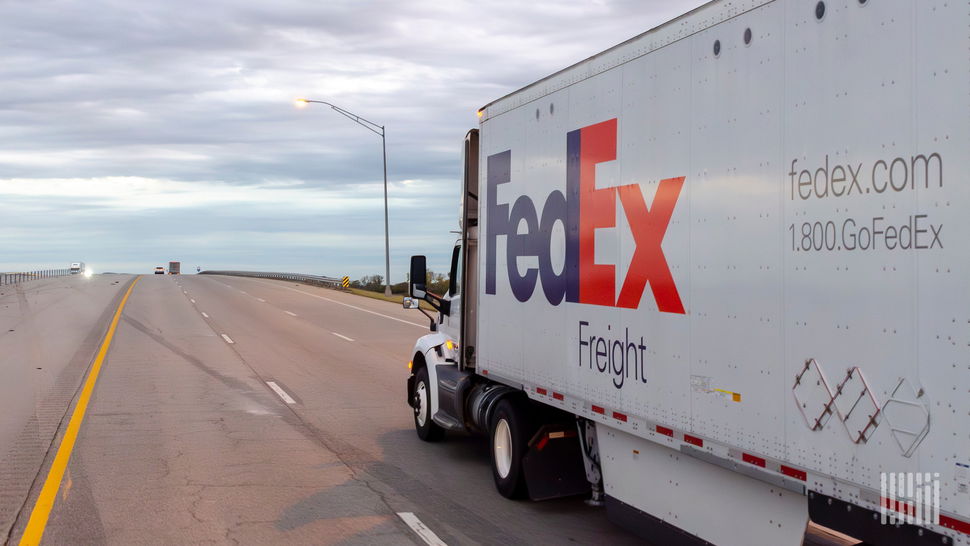
WASHINGTON — FedEx Corp. predicts higher costs on its linehaul and delivery routes as well as those of rivals if the Biden administration approves waivers governing truck driver meal and rest breaks in California and Washington.
In comments filed with the Federal Motor Carrier Safety Administration, FedEx (NYSE: FDX) asserted that if the FMCSA were to waive its preemption over the two states’ meal and rest break (MRB) laws — which would make interstate carriers subject to the stricter state rules — it will cause financial havoc as well as decrease safety.
“State rules on meal periods and rest breaks require FedEx and other transportation companies to revise routes, as well as compensation plans and policies, at a great operational cost,” wrote FedEx Corporate Vice President Clement Klank.
“The addition of this break time, some of which is paid time, increases labor costs to the tune of multiple millions of dollars each year.”
Moreover, according to Klank, “unnecessary but required breaks increase the length of a driver’s workday and their time away from home, having a negative impact on both driver fatigue and driver morale.”
In California, truck drivers must be provided a 30-minute meal break if they work more than five hours in a day, and drivers who work a shift of 10 hours or more are entitled to a second 30-minute meal break. Drivers are also entitled to a 10-minute rest period for each four hours that they work in a day. Washington’s rules are similar.
In contrast, federal break rules require that truck drivers only take a 30-minute break after eight hours of driving time (instead of on-duty time) and allow an on-duty/not driving period to qualify as the required break.
Under pressure to reduce injuries and deaths from crashes involving heavy trucks, FMCSA in August 2023 notified the trucking industry that it would entertain requests to waive agency decisions made in 2018 and 2020 that ruled federal hours-of-service rules (HOS) preempt MRB laws in California and Washington, respectively, for interstate trucking. (The preemption didn’t affect the states’ ability to enforce their MRB laws on drivers registered to haul only within the state.)
The two Trump-era decisions, made in response to petitions filed by the American Trucking Associations and the Washington Trucking Association, determined that MRB rules in those states are more stringent than federal regulations, a criteria that opens the door for federal preemption.
In last year’s notice, FMCSA encouraged those requesting a waiver not to argue that the agency’s 2018 and 2020 determinations were wrong procedurally, but rather to show whether intrastate drivers in California or Washington still subject to those states’ MRB laws are safer than interstate drivers.
FMCSA also encouraged applicants to address whether requiring interstate carriers to comply with the stricter MRB laws could exacerbate truck parking shortages in those states — and if so, how to mitigate that effect if a waiver were granted.
In addition, waiver applicants were asked to address whether applying California or Washington’s MRB laws to interstate haulers would deter those carriers from hauling in those states, and if so, if that could end up weakening the national supply chain.
Subsequent waiver petitions were filed late last year by the Teamsters union, truck safety advocates and the state of California, and FedEx is now warning of the fallout if they were to be approved. The truck parking shortage, coupled with California’s “arbitrary, mandatory break intervals,” may lead to more drivers parking at unsuitable locations, Klank stated.
“For FedEx, linehaul drivers must park for breaks at gas stations, truck stops, restaurants or, when those are not available at the time/place required, drivers must stop at interstate truck ramps. Local pickup/delivery drivers must plan ahead for their routes each day so that they are able to find a parking spot at either a restaurant, convenience store, parking lot, business, or side street.”
State-required MRBs also prevent FedEx companies from using efficient network designs to their full potential, he argued. “Forced stops cause an unreasonable burden on interstate commerce by requiring transportation companies and drivers to lengthen or modify routes and schedules in order to ensure that drivers take prescribed breaks.”
Waiver petitioners justify safety costs
In their petitions to waive federal preemption in California and Washington, the Teamsters and truck crash victim advocates disputed such arguments.
“If a lack of parking really does have the negative effect on safety that the agency and industry players claim, the agency should take steps to directly address that issue through its rulemaking powers, or by supporting separate efforts at the state and federal level to legislatively address these parking issues,” the labor union stated in its waiver petition.
“The agency should not place the burden of that issue on drivers, who are not the ones that created or have control over any parking issue that does exist.”
Regarding burdens on commerce, the Truck Safety Coalition stated on its own waiver request that such an assertion “is offensive to truck crash victims and anyone who cares about roadway safety.” The group contends that FMCSA’s concern stems from claims made by the large truck company lobbyists.
“Paying [the cost that] safety requires necessarily reintroduces a previously externalized cost back into supply chain stakeholders, where it always belonged,” TSC stated. “If those who have shirked paying this cost for generations balk at paying the cost now, TSC fails to see that as a ‘burden on commerce.’ Rather, it was always the responsibility of commerce who unjustly foisted this burden on taxpayers and crash victims for far too long.”
Related articles:
Supply Chain AI Symposium
Past the hype. Join operators, founders, and enterprise leaders figuring out how to deploy AI in supply chain.
F3: Future of Freight Festival
Industry-defining keynotes, rapid-fire technology demos, and industry leaders networking in experiences across Chattanooga - plus the inaugural F3 Awards Dinner featuring the FreightTech and Shipper of Choice reveals.
Past the hype. Join operators, founders, and enterprise leaders figuring out how to deploy AI in supply chain.
The Old Post • Chicago, IL Register NowIndustry-defining keynotes, rapid-fire technology demos, and industry leaders networking in experiences across Chattanooga - plus the inaugural F3 Awards Dinner featuring the FreightTech and Shipper of Choice reveals.
The Signal at Chattanooga Choo Choo • Chattanooga, TN Register Now
Brian Edward Harris
Fedex should stop being greedy.
Anon1981
Look at the facts in 90 percent of truck crashes. The victim is not a victim but rather the perpetrator. You can’t drive recklessly around these big vehicles and then cry victim when you get rum over cause you tried to cut one off while braking to hit the exit ramp. God forbid you slow down and get in the proper lane to exit or my God merge on the freeway doing 30 in a 70 and the big truck can’t slow down before running your a$$ over come on. I drove for 15 years as a pro driver I have conditions that don’t let me sleep more then 5 hours or so at a time but I never hit anyone because I was tired. I seen many almost hit me cause I wasn’t going fast enough so they had to go around to hit the ramp that was 500 feet away just saying I don’t break for stupid that’s your choice and dash cam will prove it.
Jay Bartgis
“We have to actually pay our employees more money. The world will come to an end because I can’t afford a 17th private yacht” cry harder
Craig
“We just can’t survive if we’re not allowed to work our employees slap to death. The entire industry needs tighter rest requirements for drivers and the otr model needs to die.
Pete hosek
Fed ex
Is crying out that this will cost them millions of dollars.
When did fed ex start paying their drivers for rest time????
NEVER that’s when.
This just cuts into their
Non stop driving, that’s the management mentality.
As the judge says
If we catch you in a lie.
That will disqualify your entire testimony
Robert
Fedex does not care about how long your work day is. They just care about how much they pay you. Fedex limits the speed of their trucks below the speed limits in most states. That increased drivers time at work and away from home more than this will.
Isaac Valenzuela
Taking more breaks relax drivers to stop and at least get out wake up and breath some fresh air
Walter Swiderski
For the Team OTR drivers, a mandatory 15 minute break takes more than that just to find a place to park a Tractor Trailer because every trucker is doing the same thing. I know 15 years ago parking was impossible after dusk and feared the mandatory break time during a particular time during my hours of service.