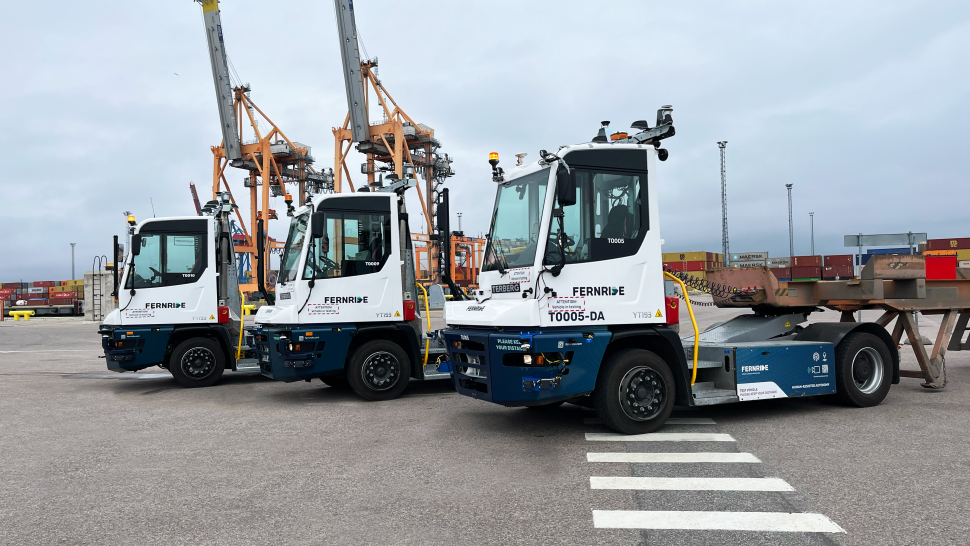
Fernride has become the first European company to operate terminal tractors without safety drivers while generating commercial revenue. The autonomous yard deployment is in the Estonian seaport of Muuga at HHLA TK Estonia terminal near Tallinn, Estonia’s capital.
The milestone came after the company received TÜV SÜD certification under the EU Machinery Directive and approval from the Estonian Transport Administration.
“This is a defining moment not only for Fernride but for the entire autonomous logistics industry in Europe,” said Hendrik Kramer, CEO and co-founder of Fernride, in a press release. “Meeting Europe’s most stringent regulatory standards took a remarkable effort, and I’m incredibly proud of our team’s dedication and precision throughout this journey.”
The TÜV SÜD certification confirms that Fernride’s autonomous vehicle platform meets EU standards for safety, cybersecurity and system reliability for the vehicle, sensors, computers and software. The certification also establishes a pathway for CE compliance and industrial deployment across Europe.
In an interview with FreightWaves, Kramer said the driverless deployment is six years in the making, a process that is part of its larger ambition to build a generational tech company in Europe focusing on the autonomous driving space.
Unlike U.S. autonomous trucking operations that still use safety drivers, Fernride’s system operates with no personnel in the vehicle cabin. Instead, the company employs a 1:4 ratio model where one remote operator monitors four autonomous trucks simultaneously, intervening only when necessary.
Kramer told FreightWaves, “In Europe it’s the other way around. Without that permission you are not allowed to operate without a driver in the cabin and therefore this audit and the certification have been very important to us, since now we have proven to the customers, ourselves, our investors and politicians that you can do this in Europe.”
“Entering the phase of driverless terminal transport marks a significant milestone—not just for our collaboration with Fernride, but for the future of terminal operations,” said Riia Sillave, CEO of HHLA TK Estonia, in the press release.
The system’s design includes continuous over-the-air updates, with AI learning from edge cases encountered during operations. Remote operators can issue simple commands or take full remote control during unusual situations, such as when a bird blocks the truck’s path. Kramer noted that the remote operators are driver managers, not safety drivers in the traditional sense, since there are no drivers in the cab.
Fernride’s technology is powertrain-agnostic, supporting both diesel and electric vehicles through retrofitting existing tractors. The Estonian terminal tractors are diesel but Kramer added, “We also have tractors with EV. Both options exist in the market. We can also retrofit the system into existing tractors. So we want to stay quite agnostic to the powertrain and what kind of tractor decisions are made by the customers.”
The company monetizes its technology through an annual software-as-a-service subscription model, with plans to improve operator-to-vehicle ratios to 1:6 next year and 1:8 by 2027. The company currently operates three trucks with one remote driver manager. Over the next year, the company is looking to expand to two driver managers for six vehicles and 24/7 operations.
“It’s like an enterprise software solution where we have an annual software as a service subscription so that [customers] can use the system.” Kramer added that there is a business case for one operator to four trucks. He added that the remote operator can also be the customer’s personnel. Currently at the terminal, they use truck drivers who are trained to also become remote operators.
Looking ahead, the goal is to help train customers adapt to the new operational realities that autonomous yard vehicles unlock.
“This is precisely what the coming year will focus on,” said Kramer. “Over the past three years, we’ve deployed our team to customer sites, where they’ve shared operational expertise. We’ve tested, iterated and operated our trucks there, with Fernride employees now handling those vehicles. Next year, we’ll train customer operators and service teams, allowing us to exit the terminals while offering remote technical support through a hotline for assistance as needed — without on-site personnel.”
At the end of the day, Kramer noted that autonomous development remains highly tied to customer willingness to test the new technologies, with gradual gains over radical transformations.
Kramer added, “Some of our engineers would have preferred a ‘big bang’ approach — deploying six autonomous tractors fully operational right away. But it’s much better for the customer to proceed in gradual steps: Prove it works, add a small increment, prove that works, and continue building to 100% without disrupting any operations.”
Brokerage Compliance Symposium
The day before F3. Every compliance issue you face - fraud exposure, carrier liability, FMCSA rules, cargo theft, insurance gaps - navigated by attorneys and operators defining best practices in a changing industry.
F3 Awards Dinner
The night before F3. FreightTech100 companies honored. FreightTech 25 and Shipper of Choice winners revealed live. Cocktail reception into dinner and live music - 300 industry leaders in one purpose-built room.
F3: Future of Freight Festival
Industry-defining keynotes, rapid-fire technology demos, and industry leaders networking in experiences across Chattanooga - plus the inaugural F3 Awards Dinner featuring the FreightTech and Shipper of Choice reveals.
The day before F3. Every compliance issue you face - fraud exposure, carrier liability, FMCSA rules, cargo theft, insurance gaps - navigated by attorneys and operators defining best practices in a changing industry.
The Signal at Chattanooga Choo Choo • Chattanooga, TN Register NowThe night before F3. FreightTech100 companies honored. FreightTech 25 and Shipper of Choice winners revealed live. Cocktail reception into dinner and live music - 300 industry leaders in one purpose-built room.
The Signal at Chattanooga Choo Choo • Chattanooga, TN Register NowIndustry-defining keynotes, rapid-fire technology demos, and industry leaders networking in experiences across Chattanooga - plus the inaugural F3 Awards Dinner featuring the FreightTech and Shipper of Choice reveals.
The Signal at Chattanooga Choo Choo • Chattanooga, TN Register Now