
It was in the December State of Freight, which took place not even four weeks ago, where Zach Strickland, the head of market analysis at SONAR, and his co-presenter at that time, FreightWaves editorial director J.P. Hampstead, could discuss a trucking market that was suddenly stronger.
That was the focus of most of the January webinar as the data that appeared shocking in December now has a few more weeks’ of life under its belt, leading to a growing belief that what has occurred recently is not short-term.
In the January State of Freight, Strickland was rejoined by his usual partner-in-analysis, FreightWaves and SONAR CEO Craig Fuller, to survey a landscape that for truckers is the best they’ve seen in a long time.
Here are five takeaways:
Tight inventories loom over the trucking market
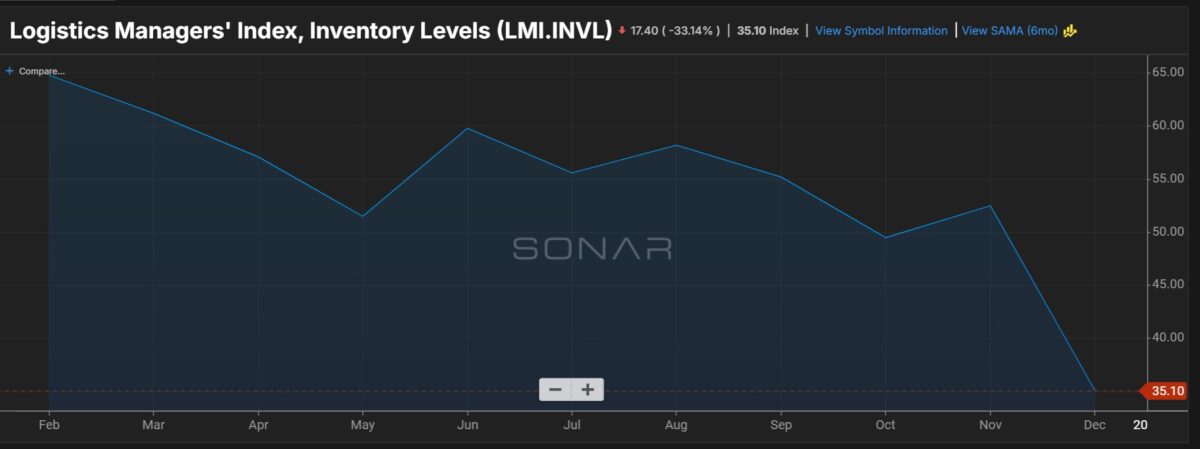
When the Logistics Managers’ Index came out last week, the headline on an analysis Strickland wrote about it declared “Warehouses empty in December.”
The LMI contains numerous indicators about the strength of the supply chain. One of them is data on inventory levels. And as Strickland wrote, “The latest December reading for inventory levels came in at 35.1, signaling the fastest drawdown of goods in the history of the index, which began in late 2016.”
A strong case can be made for a bounce in the economy, Fuller said, based on those inventory numbers in the LMI. “What’s really nice about the LMI is that it actually tells you what’s likely to happen over the next couple of months,” Fuller said. “And inventory levels are at the lowest levels they’ve measured.”
Fuller said the timing of those tight inventory levels could be particularly bullish for trucking if the U.S. Supreme Court hands down a ruling soon that would overturn many of the Trump tariffs. The uncertainty about tariffs, he said, “has caused a level of conservatism.” The Supreme Court ruling will bring clarity either way, he said, and that could lead to a restocking of inventories that would benefit carriers.
Will the capacity be there for an inventory restocking?
Fuller and Strickland both noted that the Outbound Tender Rejection Index (OTRI_ in SONAR remains above 10% even in January, despite it being a low volume month and the fact that demand in general has been soft. “That tells us that the market is certainly in much better shape,” Fuller said.
Why the market has strengthened was the subject of several points of discussion between Strickland and Fuller. Many of them came back to the crackdown on undocumented immigrants and non-domiciled CDL holders.
The market has been strengthened by “getting rid of the lower quality operators that were willing to take rates lower than everyone else’s operating costs,” Fuller said. He said that also involved “taking wages that were far what competing American labor forces would take.”
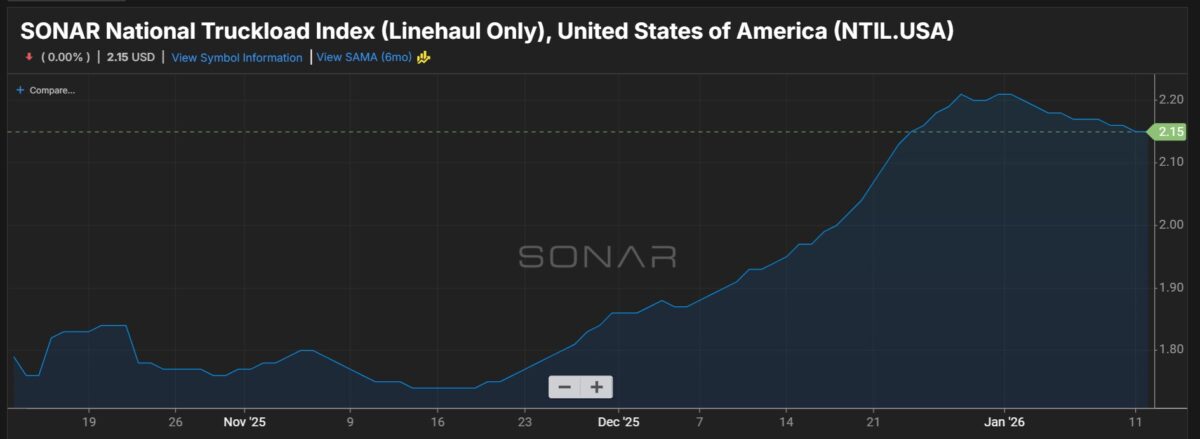
With crackdowns making that more difficult, he said, “the bottom is going to come up.” The result is visible in SONAR’s National Truckload Index Linehaul only (NTIL), which has increased sharply in recent weeks.
How bad has it been for operators?
Building on that theme that various developments have led to drivers disappearing, Strickland said a “supply-side type market flip, which would be a contraction of capacity, isn’t super satisfying.” But what’s going on now, he said, “is not coming from demand side dynamics.”
A rebalancing led by a capacity shrinkage, Fuller said, comes with it a reality that “capacity does come back.”
Strickland said data from the Truckload Carriers Association is showing that the “best operators” had been operating at an Operating Ratio (OR) of more than 100% in recent months. “So they were losing two to three cents per mile on every dollar that they were spending in the operation,” he said.
Fuller said that’s just a base number. “It does not include the working capital they need, and the financing,” he said. “It only tells you the operating profitability of the business. It doesn’t include all the other factors that are needed “in order to operate a successful company.”
Fuller noted that the most recent data on Class 8 new truck orders showed a sudden surge. But that may not last “until conditions are ripe enough that where motor carriers believe that these conditions are sustainable over the long term,” he said.
More opportunity for intermodal
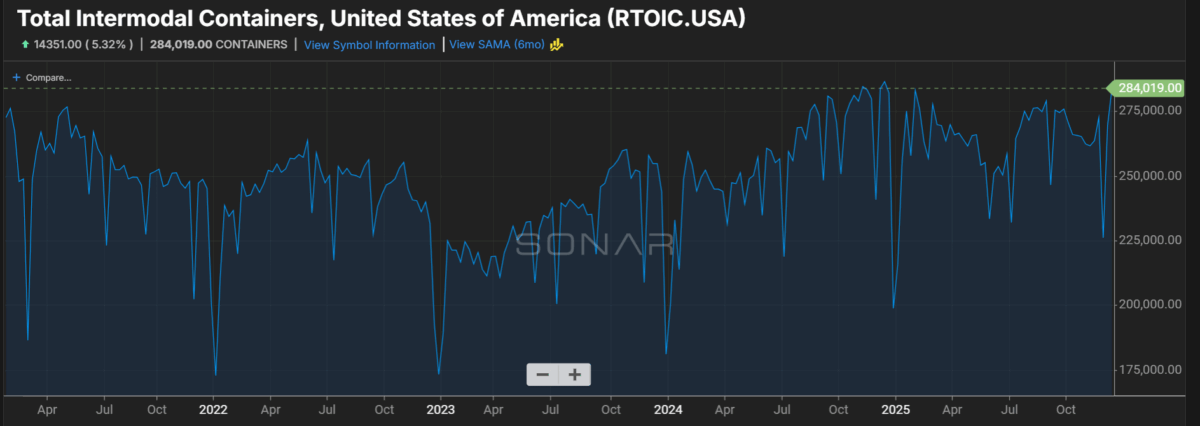
A ruling that would knock out some of the Trump tariffs could boost intermodal traffic, the speakers said, even after what has mostly been a good year.
“I think domestic intermodal is going to benefit as long as there are these long-haul corridors,” Fuller said. But even beyond that, other railroads, not just the long-haul lines coming out of the West Coast ports, “have started to improve their schedules and their routes,” Fuller said. “I think the intermodal business is going to continue to improve its conditions and become a much more attractive product in the future.”
Intermodal’s recent successes, he said, “has taken a lot of capacity out of the market.”
Strickland said the continued growth of domestic intermodal, even as international has softened, is a trend that “has really pulled demand out of the truckload market recently.”
Is there any optimism for a return of demand?
Fuller said “demand sucks.”
“We are not having a manufacturing recovery,” he said. “We’re not having housing participate in the recovery.”
But Fuller said there were reasons for optimism. Housing could come back, “albeit slowly,” he said. Ditto manufacturing. “And if those things happen, that’s just going to create additional demand,” he said.
But circling back to earlier comments about capacity, if housing and manufacturing were to rebound, they would be doing so in a freight market that has already seen trucking capacity removed “to a level that is currently supporting market conditions.” And that would be another bullish factor.
More articles by John Kingston
How is C.H. Robinson using AI? Its CFO has a story
Benesch panelists: Why 2026 could be a strong year for logistics
M&A3-way combo emerges for digital load matching: DAT, AscendTMS and Convoy
Brokerage Compliance Symposium
The day before F3. Every compliance issue you face - fraud exposure, carrier liability, FMCSA rules, cargo theft, insurance gaps - navigated by attorneys and operators defining best practices in a changing industry.
F3 Awards Dinner
The night before F3. FreightTech100 companies honored. FreightTech 25 and Shipper of Choice winners revealed live. Cocktail reception into dinner and live music - 300 industry leaders in one purpose-built room.
F3: Future of Freight Festival
Industry-defining keynotes, rapid-fire technology demos, and industry leaders networking in experiences across Chattanooga - plus the inaugural F3 Awards Dinner featuring the FreightTech and Shipper of Choice reveals.
The day before F3. Every compliance issue you face - fraud exposure, carrier liability, FMCSA rules, cargo theft, insurance gaps - navigated by attorneys and operators defining best practices in a changing industry.
The Signal at Chattanooga Choo Choo • Chattanooga, TN Register NowThe night before F3. FreightTech100 companies honored. FreightTech 25 and Shipper of Choice winners revealed live. Cocktail reception into dinner and live music - 300 industry leaders in one purpose-built room.
The Signal at Chattanooga Choo Choo • Chattanooga, TN Register NowIndustry-defining keynotes, rapid-fire technology demos, and industry leaders networking in experiences across Chattanooga - plus the inaugural F3 Awards Dinner featuring the FreightTech and Shipper of Choice reveals.
The Signal at Chattanooga Choo Choo • Chattanooga, TN Register Now