




The first week of October brought a mixed bag for small carriers. On one hand, volumes rebounded slightly, fuel prices climbed again, and reefer freight kept showing strength. On the other, dry van rates stayed flat, tender rejections remained weak, and ports still aren’t signaling a major inbound push ahead of the holidays.
That combination says a lot about where we are in this freight cycle — caught somewhere between survival mode and slow recovery. Let’s walk through what the data is really saying, and what you should be doing about it as we roll deeper into Q4.
Let’s be real—this market’s got us all constantly watching our phones.
Volumes just slid again. OTVI (Outbound Tender Volume Index) dropped to 9,775, down from the 10,000+ range we were flirting with just last week. That’s a big shift—and not in our favor. Tender rejections are still hugging 5%, which tells you brokers and shippers have plenty of options, and contract carriers are snatching up nearly 94% of what is tendered to them.
Now, while rates haven’t fallen, they’re not sprinting upward either. The National Truckload Index (NTI) ticked up slightly to $2.36, up a few cents from the mid-$2.30s we’ve been stuck in. Not bad. But when diesel’s sitting above $3.71, that tiny rate bump barely registers on your bottom line.
The real story this week? The sudden uptick in spot rates after various ICE enforcement across the US, specifically in the Chicago area. The twist is that we’ve got declining volume, spot rates suddenly fluctuating north, and fuel hovering around the $3.80 mark by the week.
(Photo: SONAR. National Truckload Index (NTI.USA). National truckload rates ticked up to $2.36—but fuel costs continue to eat into gains.)
Tender Rejections Still Below Six Percent
The Outbound Tender Rejection Index (OTRI) crept up just a bit, sitting around 5.6%, but that’s still soft. For context, rejection rates below 6% signal that most contract carriers are accepting their loads instead of turning them back for better-paying spot freight. That means there’s plenty of truck capacity on the road and not much negotiating leverage for small carriers on the load board.
If you’ve been in this long enough, you know that when rejection rates stay this low for this long, brokers and shippers hold most of the cards. It’s exactly what we’ve seen since midsummer. The market hasn’t tightened meaningfully since July, and that’s why you’re not seeing rate spikes even when volume temporarily bumps up.
The key takeaway here: don’t expect a sudden sustained surge in spot market rates until rejection rates start moving north of 8%. That’s the trigger point where supply gets tight enough for rates to climb. However if recent activities give a glimpse on what the future holds, things could get interesting.
Volumes Bounce Back — But Barely
Last week, we saw volumes climb back above the 10,000 mark after a previous drop of over 1,600 points. It gave us hope that maybe the back-to-school surge or early holiday positioning was kicking in. But with this week’s drop, that optimism’s gotta be checked.
We’re still in a soft freight environment. And when OTVI slips under 10K, it means less freight is moving through the system—and less opportunity for small carriers to find good-paying loads on load boards.
But before we get too excited, it’s important to note that this 10,000-range is where volumes have hovered for most of the year. We haven’t seen a sustained breakout since early 2023. The uptick could be tied to late back-to-school replenishment or early pre-holiday freight, but we’re still far from the true peak levels seen back in June and July. If you have been following the Small Carrier Market Update on here, you will know what we are referring to.
Consistency, not spikes, will be the real indicator that freight demand is turning the corner.
Spot Rates Still Stuck in Neutral
The National Truckload Index (NTI) is holding steady around $2.33 to $2.34 per mile — barely changed from August and September. It’s slightly higher than mid-summer lows but well below the $2.50 range we saw back in February.
That 20-cent difference doesn’t sound like much, but it’s the line between profit and break-even when diesel is flirting with $3.80 a gallon. In short, spot rates aren’t keeping up with operating costs.
Right now, we’re sitting in what’s known as a “neutral” pricing environment — rates aren’t crashing, but they’re not climbing either. The positive here is that stability gives small carriers a predictable floor. The negative is that floor doesn’t leave much room for error.
In other words, you’ve got to know your cost per mile to the penny right now. Those running lean with efficient routes and tight fuel control will survive this stretch. Those hauling freight below cost will feel it quickly.
Fuel Prices Continue Their Climb
And that brings us to fuel — the elephant in the room.
The DOE Diesel Price Per Gallon chart shows the national average sitting at $3.71, up roughly 30 cents from June. That might not seem catastrophic, but that 30-cent swing can eat hundreds of dollars a week off your bottom line, especially for smaller operations without bulk discounts.
We’re now just a few cents shy of the 12-month high of $3.80, and there’s no sign of relief. California and the Northeast remain the most expensive regions to fuel up, while the South and Midwest offer slightly better pricing.
If you haven’t adjusted your fuel strategy yet, now’s the time. Two areas you can control:
- Station Selection: Use your fuel card networks to find discounts — and don’t overlook smaller mom-and-pop stops that may offer better deals than the majors.
- Fuel Consumption: Reduce idle time, avoid overloading when possible, and cut unnecessary speed. A few tenths of a mile per gallon can make or break your profit margin in this environment.
For carriers under contract, maybe time to recalulate your fuel surcharge math.
Reefers Continue to Outperform Dry Van
Here’s where things look brighter: reefer freight is still leading the way.
The Reefer Tender Rejection Index (ROTRI) remains strong, hovering around 16%, nearly three times higher than dry van rejections. That means reefer carriers are seeing tighter capacity and better leverage when negotiating loads.
Seasonal demand from harvest season and early holiday food distribution is keeping the reefer market healthier than the van side. In fact, reefer rejection rates have held above 12% since early September — the most consistent strength we’ve seen all year.
Meanwhile, the Reefer Truckload Index (RTI) shows rates sitting at $2.58 per mile, a sharp drop this week but well above the spring lows near $2.45. If you’re pulling a reefer, you’re in a stronger position than most. Expect moderate gains as we move toward late-October.
Inbound Ocean Freight Suggests a Soft Q4
Let’s talk ports — because this is a leading indicator of what’s coming three to four weeks down the road.
The Inbound Ocean TEUs Volume Index (IOTI) rose slightly last week but remains around 1,834, nearly 400 points below July’s high. That means fewer containers are currently en route to U.S. ports.
Port of Los Angeles continues to dominate in volume, though it saw a 3.5% week-over-week increase, while Long Beach fell sharply by over 7%. Houston remains a quiet winner — up slightly week over week and 1% year over year — showing steady Gulf Coast momentum.
The takeaway here: retailers are still ordering cautiously. Nobody’s stocking heavy, and that means less inbound freight to feed the domestic truckload market later this month. If you were hoping for a big pre-holiday surge, this isn’t it.
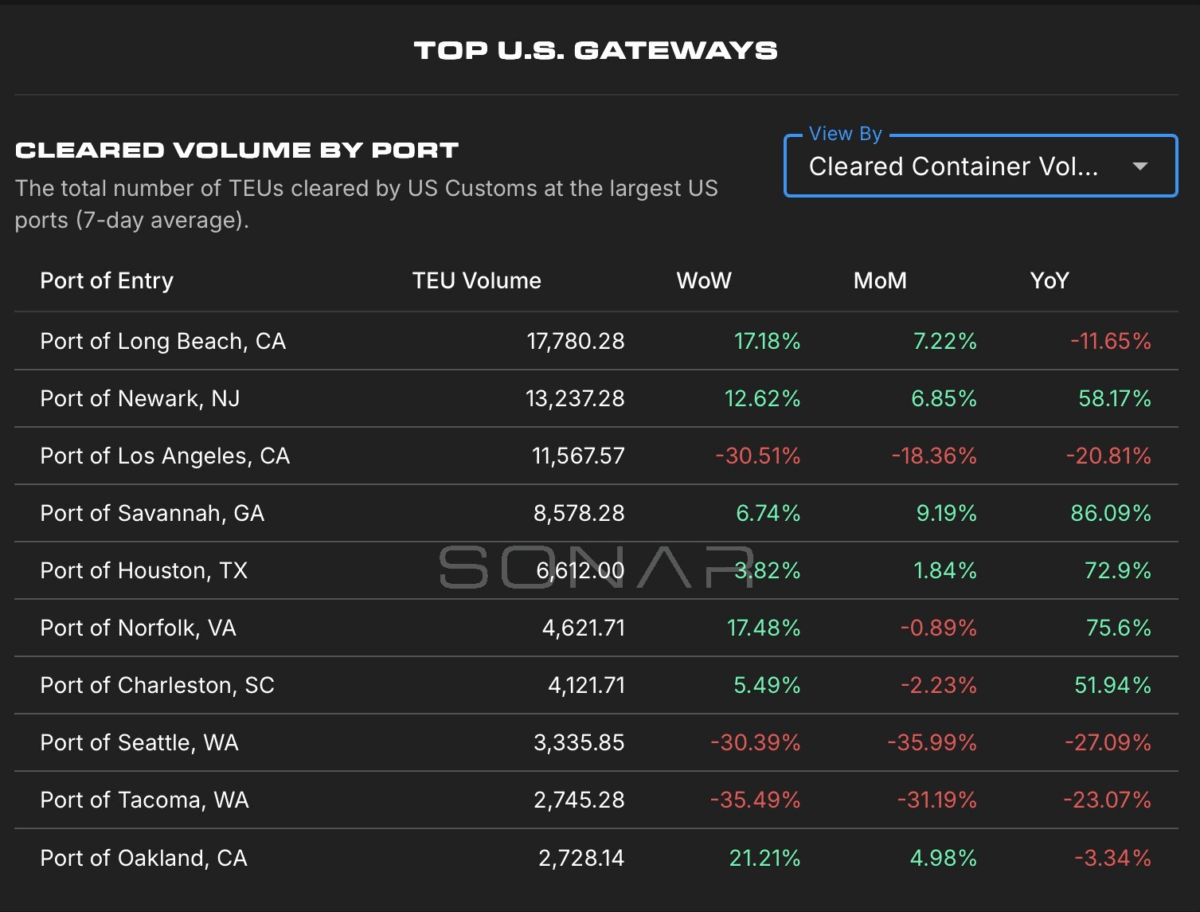
(Photo: SONAR. Top US Gateways, Cleared Container Volume. This provides you with insights on freight that has been cleared to hit the roads from customs)
Cleared Volumes Show Where the Freight Is Actually Moving
When we shift from inbound to cleared container volumes — meaning freight that’s already cleared customs and is hitting the street — we see a few bright spots.
Long Beach, California had a decent bounce this week, with cleared containers up over 17% compared to last week. But don’t let that fool you—they’re still down more than 11% from this time last year. That means they’re moving freight, but not like they used to.
Now if you’re running drayage or even just reloading near a port, pay attention to this: Newark, New Jersey and Savannah, Georgia are on fire. Newark is up over 12% this week and 58% higher than this time last year. Savannah is also rolling strong, with nearly 7% more freight this week and 86% higher than last year. That’s the kind of growth that tells you where to keep your eyes.
Houston’s holding steady, with a small bump this week and a massive 72% jump over last year. That’s important if you’re in Texas or run regional freight through the South—because more freight in means more chances to reload without deadheading too far.
Meanwhile, Los Angeles took a big hit—down over 30% this week alone, and it’s still dropping year over year. That’s a clear sign that some of these importers are shifting freight away from the old West Coast gateways and spreading it out across other ports.
Seattle and Tacoma? Tough week for them, too. Both are down over 30% this week and showing double-digit drops compared to 2024. If you’ve been banking on consistent freight coming through those areas, you might be feeling that slowdown already.
What It All Means for Small Carriers
This week’s update tells a simple story: a curious market.
Rates are holding, but fuel is hovering the $3.80 market. Volumes are steady, but not growing. Reefers are doing slightly better, but dry vans are stuck. Carriers are exiting, but not fast enough yet to rebalance supply and demand.
The message is clear — the market isn’t moving, but it’s not lifting you up either. The carriers who win in this environment are the ones running smart:
- Watching costs daily as they always fluctuate
- Planning fuel purchases before making the trek into your destination
- And protecting their operational integrity above all
Keep your eye on the reefer trend, the port activity, and those authority numbers. They’ll tell you when balance is starting to return. Until then, stay disciplined, stay educated, and control what you can control — because that’s what separates survivors from statistics.
Brokerage Compliance Symposium
The day before F3. Every compliance issue you face - fraud exposure, carrier liability, FMCSA rules, cargo theft, insurance gaps - navigated by attorneys and operators defining best practices in a changing industry.
F3 Awards Dinner
The night before F3. FreightTech100 companies honored. FreightTech 25 and Shipper of Choice winners revealed live. Cocktail reception into dinner and live music - 300 industry leaders in one purpose-built room.
F3: Future of Freight Festival
Industry-defining keynotes, rapid-fire technology demos, and industry leaders networking in experiences across Chattanooga - plus the inaugural F3 Awards Dinner featuring the FreightTech and Shipper of Choice reveals.
The day before F3. Every compliance issue you face - fraud exposure, carrier liability, FMCSA rules, cargo theft, insurance gaps - navigated by attorneys and operators defining best practices in a changing industry.
The Signal at Chattanooga Choo Choo • Chattanooga, TN Register NowThe night before F3. FreightTech100 companies honored. FreightTech 25 and Shipper of Choice winners revealed live. Cocktail reception into dinner and live music - 300 industry leaders in one purpose-built room.
The Signal at Chattanooga Choo Choo • Chattanooga, TN Register NowIndustry-defining keynotes, rapid-fire technology demos, and industry leaders networking in experiences across Chattanooga - plus the inaugural F3 Awards Dinner featuring the FreightTech and Shipper of Choice reveals.
The Signal at Chattanooga Choo Choo • Chattanooga, TN Register Now