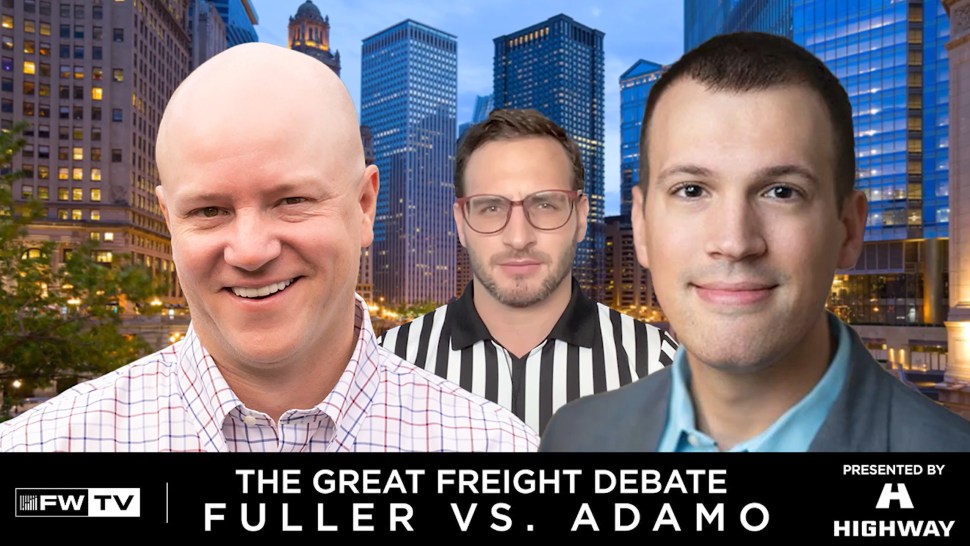
FreightWaves founder and CEO Craig Fuller and DAT Chief of Strategy Ken Adamo sparred over the state of the freight market, driver enforcement and the long-term future of trucking during a wide-ranging debate held on Thursday.
The discussion touched on the deep freight recession, the impact of immigration and safety enforcement, fraud, and how quickly automation will reshape the industry.
The debate was moderated by transportation attorney Matthew Leffler, known as The Armchair Attorney.
Adamo opened by rejecting the idea that recent federal and state enforcement actions against the issuance of commercial driver’s licenses (CDLs) — such as California’s cancellation of 17,000 CDLs following a federal audit — would meaningfully tighten capacity.
“We’re just still way too oversupplied,” he said. “If we were seeing capacity come out relative to demand, rates would go up — and they just frankly haven’t gone up.”
Adamo argues that the freight slump is fundamentally demand-driven.
“The economy stinks … especially the consumer economy. And what do we all ship? Things that fuel the consumer economy,” Adamo said.
Fuller countered that while demand is weak, capacity in the freight market is tightening.
“Spot rates are slowly melting up — very incrementally melting up,” Fuller said. “You’ll have a couple of days where spot rates shoot up, then reset, but we have a slowly melting-up freight market with anemic volumes at the same time.”
That combination, Fuller said, is “a pretty challenging market for freight brokers,” who face rising costs without an accompanying bump in freight.
Non-domiciled CDL crackdown
The debate intensified when the discussion turned to non-domiciled CDL enforcement and English-language proficiency (ELP) rules.
Fuller said the number of foreign-born or undertrained drivers is significantly larger than industry estimates.
“One of the largest insurance carriers told me they believe as many as 10% of the truck driver population are folks that do not speak English,” Fuller said, adding that some estimates run as high as 40%. “We’ve opened up this massive entry of foreign-born immigrants into our industry that oftentimes did not have to show qualifications that they could drive a truck.”
Fuller also said federal oversight over CDL enforcement has been weak over the last several years: “93% of carriers have no safety rating … because it requires an onsite audit. What are we doing if we’re not ensuring the safety of carriers?”
Adamo pushed back on the scale of the issue of non-domiciled CDL drivers.
“I don’t think there’s a million truck drivers out there that can’t speak English. I think it’s probably in the low one-and-a-half percent, Adamo said. “Some of the most English-proficient truck drivers are Mexican cross-border carriers, because they know that’s what Department of Transportation officers look for the most.”
Is there a driver shortage?
Adamo and Fuller sparred jokingly over whether a truck driver shortage exists.
“There is no truck driver shortage,” Fuller said. “The market has never had a problem finding qualified talent.”
Fuller added that any temporary shortages are simply price signals. “When you can’t find a commodity … wages go up. That’s what corrects the short-term labor problem,” he said.
Adamo mostly agreed with Fuller, but joked about a possible social media backlash.
“Just so I don’t get trash-talked on Twitter … I don’t actually think there’s not a truck driver shortage. It was an illustrative point.” He clarified: “If we raised all of the training and safety standards, we would absolutely have a shortage.”
Automation: ‘Not if, but when’
When the debate shifted to automation, both freight experts said that autonomous trucking is inevitable.
Fuller said automation will explode once reliability and regulation catch up. “This is not a matter of if — it’s a matter of when,” he said.
Fuller predicted a “J-curve of adoption” beginning in the next decade.
“By 2035 to 2040, it will be socially and legally acceptable to have driverless trucks doing point-to-point transport,” Fuller said.
Adamo said rapid improvements in AI operations is already having an effect on the freight industry. He noted companies like C.H. Robinson reports automation rates exceeding 70% on some workflows.
“AI dispatchers are talking to AI booking and negotiation agents … it’s really, really good,” Adamo said.
Brokerage Compliance Symposium
The day before F3. Every compliance issue you face - fraud exposure, carrier liability, FMCSA rules, cargo theft, insurance gaps - navigated by attorneys and operators defining best practices in a changing industry.
F3 Awards Dinner
The night before F3. FreightTech100 companies honored. FreightTech 25 and Shipper of Choice winners revealed live. Cocktail reception into dinner and live music - 300 industry leaders in one purpose-built room.
F3: Future of Freight Festival
Industry-defining keynotes, rapid-fire technology demos, and industry leaders networking in experiences across Chattanooga - plus the inaugural F3 Awards Dinner featuring the FreightTech and Shipper of Choice reveals.
The day before F3. Every compliance issue you face - fraud exposure, carrier liability, FMCSA rules, cargo theft, insurance gaps - navigated by attorneys and operators defining best practices in a changing industry.
The Signal at Chattanooga Choo Choo • Chattanooga, TN Register NowThe night before F3. FreightTech100 companies honored. FreightTech 25 and Shipper of Choice winners revealed live. Cocktail reception into dinner and live music - 300 industry leaders in one purpose-built room.
The Signal at Chattanooga Choo Choo • Chattanooga, TN Register NowIndustry-defining keynotes, rapid-fire technology demos, and industry leaders networking in experiences across Chattanooga - plus the inaugural F3 Awards Dinner featuring the FreightTech and Shipper of Choice reveals.
The Signal at Chattanooga Choo Choo • Chattanooga, TN Register Now