Every year in the United States, more than 130 billion pounds of food are wasted, much of it spoiled before it ever reaches consumers. A major culprit is the lack of visibility in the cold chain, where perishable goods are often left vulnerable during storage and transport. The vulnerability could be solved through the use of real-time data insights, essentially knowing what’s going on behind the closed doors of a trailer. A Norwegian technology company, Surfact, believes it has a solution, one born out of military experience and designed for some of the toughest supply chain environments.
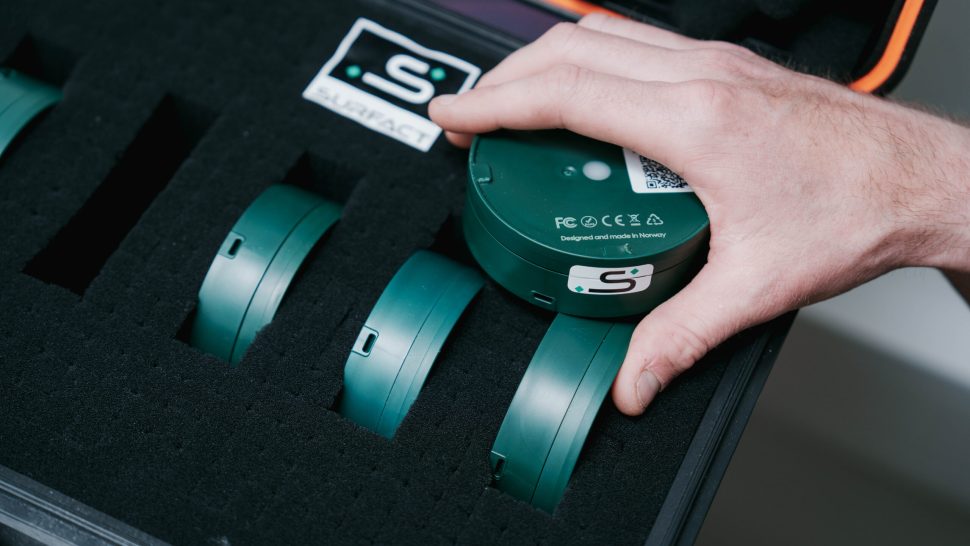
The company’s CEO and founder, Per Magne Helseth, first saw the problem during his service with the Norwegian forces in Afghanistan. Shipments of food and medicine deteriorated under extreme conditions, often before they could reach those who needed them most. The frustration of watching vital supplies go to waste sparked an idea: build a tool that could reveal what was really happening inside the supply line. Years later, that idea became Surfact and its flagship product, Emma, a hockey-puck-shaped smart cargo tracker that is now making its debut in U.S. foodservice distribution.
Showcased this week at the International Foodservice Distributors Association Solutions Conference in Columbus, Ohio, Emma promises to “make the invisible visible.” The device rides directly with the cargo, capturing real-time data on temperature, position, movement, shock, and light.
Unlike traditional reefer unit readings or passive loggers, Emma replicates the conditions that the products themselves experience. And with no need for infrastructure or gateways, the tracker turns any trailer into a “smart” trailer within seconds.
“In foodservice, too much product is lost before it ever reaches the plate,” said Helseth. “The problem isn’t just waste — it’s the fact that operators don’t see what’s really happening inside their cold chain. With Emma, you finally make the invisible visible. Or as we like to put it: we make your cargo talk.”
The tracker itself is built for durability. Tested in everything from frozen salmon exports to frontline logistics, Emma is designed to withstand harsh realities. Its casing, made from recycled ocean plastics, highlights Surfact’s sustainability focus, while its two-year battery life is among the longest in the industry.
Surfact is not entering the U.S. market alone. Partnerships with CSCS and Catena are fueling its push into foodservice distribution. Together, the three companies are integrating cargo-level intelligence, fleet data, and warehouse orchestration into one platform. The combined system, being demonstrated at IFDA, offers operators an end-to-end view of their supply chain, from the moment goods are loaded onto trailers to warehouse handling.
The promise goes beyond data integration. Surfact claims that with the system, operators can see measurable business impacts, including reduced freight costs, lower warehouse labor requirements, and improved visibility across the chain. Some customers, according to the company, are seeing returns on investment in as little as six months.
For Helseth, the U.S. debut represents both a milestone and a return to his original vision. “This isn’t our first time in the U.S., but it’s our first focused step into foodservice distribution here,” he said. “With Emma, operators finally get the kind of control and clarity that changes outcomes — and with CSCS and Catena, it becomes a fully connected, truly predictive cold chain system.”
What began as a frustration in a military supply line is now poised to reshape commercial food logistics. If Surfact succeeds, it could mean fewer blind spots in the cold chain and fewer pallets of food wasted before they ever reach the plate.
Brokerage Compliance Symposium
The day before F3. Every compliance issue you face - fraud exposure, carrier liability, FMCSA rules, cargo theft, insurance gaps - navigated by attorneys and operators defining best practices in a changing industry.
F3 Awards Dinner
The night before F3. FreightTech100 companies honored. FreightTech 25 and Shipper of Choice winners revealed live. Cocktail reception into dinner and live music - 300 industry leaders in one purpose-built room.
F3: Future of Freight Festival
Industry-defining keynotes, rapid-fire technology demos, and industry leaders networking in experiences across Chattanooga - plus the inaugural F3 Awards Dinner featuring the FreightTech and Shipper of Choice reveals.
The day before F3. Every compliance issue you face - fraud exposure, carrier liability, FMCSA rules, cargo theft, insurance gaps - navigated by attorneys and operators defining best practices in a changing industry.
The Signal at Chattanooga Choo Choo • Chattanooga, TN Register NowThe night before F3. FreightTech100 companies honored. FreightTech 25 and Shipper of Choice winners revealed live. Cocktail reception into dinner and live music - 300 industry leaders in one purpose-built room.
The Signal at Chattanooga Choo Choo • Chattanooga, TN Register NowIndustry-defining keynotes, rapid-fire technology demos, and industry leaders networking in experiences across Chattanooga - plus the inaugural F3 Awards Dinner featuring the FreightTech and Shipper of Choice reveals.
The Signal at Chattanooga Choo Choo • Chattanooga, TN Register Now