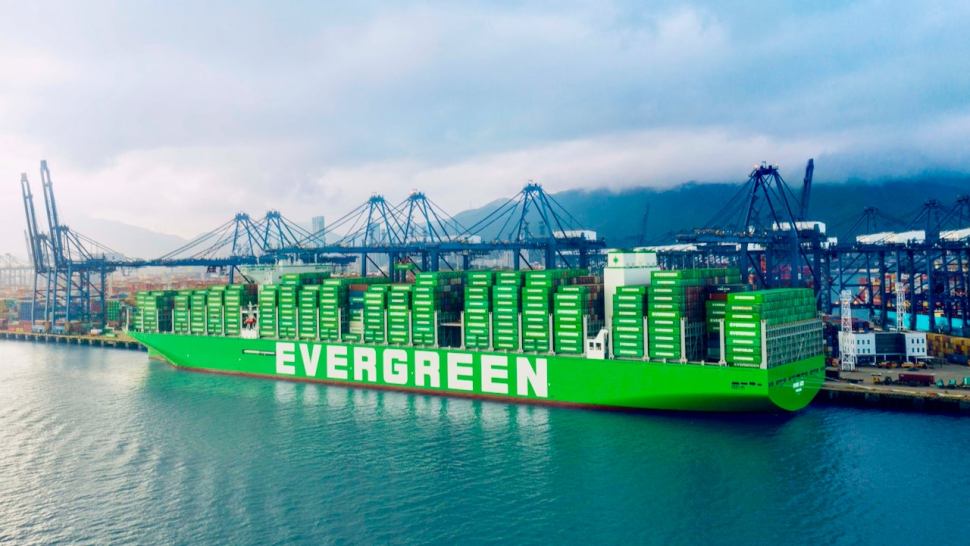
Taiwan-based Evergreen Marine in June launched the largest container ship ever built, the aptly named Ever Alot.
The massive ship has a capacity of 24,004 twenty-foot equivalent units, just a little more than its slightly older sibling, the Ever Ace, launched in July 2021 and the former world record holder at 23,992 TEUs.
The Ever Alot is more than 1,300 feet long and 203 feet wide. If you were to stack the Ever Alot vertically, it would be taller than the Empire State Building in New York City.
The Ever Alot made its maiden voyage leaving Shanghai, where it was constructed, to the Port of Rotterdam in August, becoming the first vessel to break the 24,000-TEU barrier.
The Ever Ace and the Ever Alot are part of a class of ships known as very large container ships (VLCs) or ultra large container vessels (ULCVs), ships so large they can barely pass through the locks of the Panama Canal.
The Ever Ace was built by South Korea-based Samsung Heavy Industries for about $150 million, according to Taiwan News. China-based Hudong-Zhonghua Shipbuilding manufactured the Ever Alot for a reported $145 million when it was ordered in 2019.
Both the Ever Alot and Ever Ace service routes between Europe and the Far East. The larger ships are aimed at gaining benefits of scale and lowering container slot costs, which could enable carriers to offer more competitive rates to shippers.
Since 2012, the average capacity of a container ship has grown from less than 3,000 TEUs to around 4,500 TEUs. In the last decade, more than 50 ships with a capacity of 21,000 TEUs or more have been built, according to a report from the BBC.
Some maritime experts have questioned the viability and financial sustainability of such large ships.
Matt Stoller, director of research at the American Economic Liberties Project, told FreightWaves these very large container ships need larger facilities and more equipment to handle them, requiring ports to pay for increased dredging, new warehouses, more cranes and personnel, as well as more road infrastructure.
Another reason most ultra large container ships service mainly Europe and Asia is because most U.S. ports are too small to accommodate them.
“We have a lot of ports in [the U.S.] but we don’t have enough ocean carrier firms,” Stoller said. “The ocean carrier firms’ boats are too big for most ports.”
But some large container ships have called on U.S. ports in recent years.
In 2015, the 18,000-TEU CMA CGM Benjamin Franklin called on the Port of Los Angeles, becoming the largest container ship to visit a North American port. That record was eclipsed in 2020, when the MSC Anna, a 19,200-TEU ship, called at the Port of Oakland in California.
The largest container ship to sail to the U.S. East Coast is the CMA CGM Marco Polo, a 16,022-TEU vessel that called on the ports of New York and New Jersey, Savannah and Charleston in 2021.

While the Ever Alot was the largest container ship in service when it launched in August, it may have already been eclipsed by larger vessels.
On Oct. 29, the Yangzijiang Shipbuilding Group in China floated two new ships, the MSC Loreto and MSC Irina, for the Mediterranean Shipping Company (MSC), the world’s largest shipping line.
Although MSC has not put these ships into service yet, Yangzijiang said each vessel will have a container capacity of 24,636 TEU, making them the largest container ships in the world.
MSC unseated Maersk as the world’s largest ocean carrier in January. Although ocean container traffic has slowed in general over the last year, MSC continues to aggressively expand its fleet.
MSC has a newbuild order book of 1,482,178 TEUs, according to Alphaliner (including chartered ships ordered by intermediaries) data reviewed by FreightWaves. MSC’s orderbook capacity is now 33.4% of its on-the-water fleet.
Watch: Contracted rates peak, reefer rates start to fall.
Click for more FreightWaves articles by Noi Mahoney.
More articles by Noi Mahoney
Tesla to invest $775 in Texas factory expansion
Mexico averaged 39 cargo thefts a day in November
Borderlands: Canada still top US trading partner ahead of Mexico
Brokerage Compliance Symposium
The day before F3. Every compliance issue you face - fraud exposure, carrier liability, FMCSA rules, cargo theft, insurance gaps - navigated by attorneys and operators defining best practices in a changing industry.
F3 Awards Dinner
The night before F3. FreightTech100 companies honored. FreightTech 25 and Shipper of Choice winners revealed live. Cocktail reception into dinner and live music - 300 industry leaders in one purpose-built room.
F3: Future of Freight Festival
Industry-defining keynotes, rapid-fire technology demos, and industry leaders networking in experiences across Chattanooga - plus the inaugural F3 Awards Dinner featuring the FreightTech and Shipper of Choice reveals.
The day before F3. Every compliance issue you face - fraud exposure, carrier liability, FMCSA rules, cargo theft, insurance gaps - navigated by attorneys and operators defining best practices in a changing industry.
The Signal at Chattanooga Choo Choo • Chattanooga, TN Register NowThe night before F3. FreightTech100 companies honored. FreightTech 25 and Shipper of Choice winners revealed live. Cocktail reception into dinner and live music - 300 industry leaders in one purpose-built room.
The Signal at Chattanooga Choo Choo • Chattanooga, TN Register NowIndustry-defining keynotes, rapid-fire technology demos, and industry leaders networking in experiences across Chattanooga - plus the inaugural F3 Awards Dinner featuring the FreightTech and Shipper of Choice reveals.
The Signal at Chattanooga Choo Choo • Chattanooga, TN Register Now