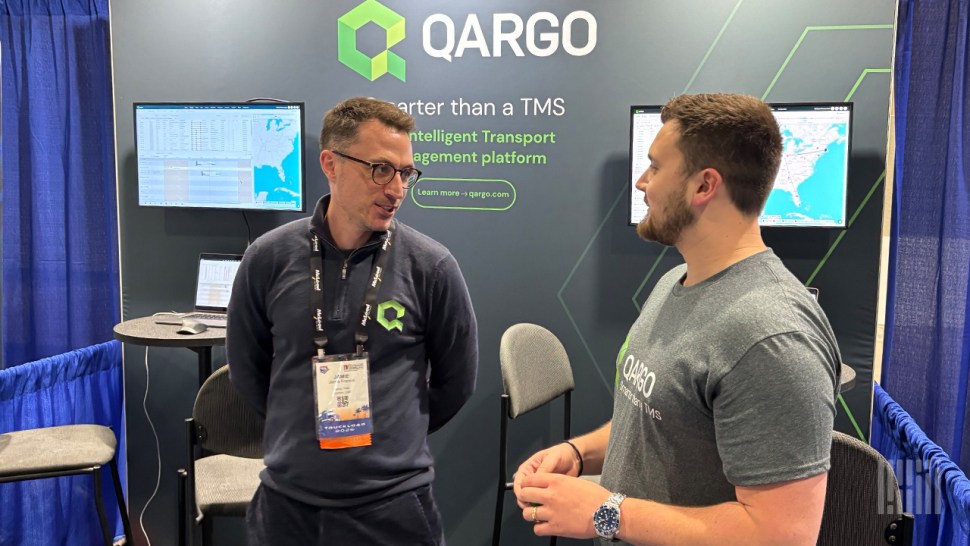
Kissimmee, Florida–At the recent annual meeting of the Truckload Carriers Association, the exhibition hall was dotted with major providers of transportation management systems (TMS): McLeod Software, Alvys and Trimble (NASDAQ: TRMB) were all there among the many tech-heavy exhibitors.
The small booth held down by Europe’s Qargo was like a beachhead for the company as it seeks to elbow its way into the competitive landscape of U.S. TMS providers.
Samuel Evans was manning the company’s spot on the floor, with Qargo having made the first sales of its TMS into the U.S. market. His battle plan and observations on how it will approach the U.S. market offer a perspective on the competitive landscape from someone attacking it from across the pond.
Qargo was founded in the U.K. about five years ago, Evans said in an interview with FreightWaves at the TCA meeting. It recently raised $33 million in venture capital through a series B offering, “which is going to help the continued growth and expansion of the business,” Evans said.
Evans said before the move into the U.S., Qargo had recorded “astronomical lift in the business.” It has grown its staff from about 25 to 30 people to about 170 now, he said. The customer base in Europe is now at 600 fleets and brokers.
“We have the absolute top end of the transport business in Europe,” Evans boasted. But he added that Qargo’s plan was always to take aim at the U.S. “It’s a very enticing market for everybody,” he said.
Five-year runway to the U.S. entrance
“It’s taken five years to get the product fit, to get all the right features in the right place to make sure we’ve actually got the kinks worked out,” Evans said of why the company would choose now to make its entrance. Qargo’s first efforts in the U.S. market occurred before the current upturn in freight rates, during a time when it was still accurate to describe ongoing conditions as a freight recession.
With the company comfortable with the level of penetration and activity in its home market, Evans said “it makes sense from an expansion point to grow now, where we can actually afford to put additional resources to focus on the market over here without detracting from what we’ve done throughout Europe.”
How does a company stand out from the crowd?
No matter what segment of the freight tech market a company is in, the reality is that an enormous percentage of a product’s features are identical to those at its competitors. How does somebody stick out besides just slashing prices (a strategy that virtually all agree is never successful in the long run)?
How Qargo makes that distinction, Evans conceded, “is the hardest question I get everywhere.”
One buzzword Evans said he stays away from is AI. Not because it isn’t in the Qargo platform; “we have AI throughout the platform and it does humongously helpful things.”
But it’s clear from Evans’ comments that the main sales pitch is that by being a relatively new platform, and with AI and other features built in, Qargo’s system is not one that might be groaning under the bolt-on features he spoke about.
But new features are being added all the time; Evans said Qargo ships about four per week.
As far as specifics, Evans cited the Qargo user interface (UI), “which is really overlooked and very difficult to describe verbally to anyone how it is a benefit.”
AI can’t do everything
And he took an unusual swipe at AI. That Qargo user interface, he said, allows a clear display of data that permits a “fast, informed good decision. That’s the best an operator could hope for.”
“They still need to make the decision,” he said of the users of any TMS. “We still need them to decide what goes where, and how that goes. And until AI is in a position where it can handle more complex tasks, that will be the case.”
While Evans discussed some of the features he thinks can help Qargo make a splash in the U.S., he also spoke of what he sees are some structural flaws in the American TMS market.
Some of the legacy platforms in use, Evans said, “have been around 40-plus years,” he said. He described them as being like a “rubber dinghy” that over time has had “bolt on after bolt on” to add to TMS functionality.
“They all feature lots of things they do, lots of use cases and there are lots of massive businesses running on them,” Evans said. “But the model they were built on isn’t built for the modern era of technology, with AI and all these other things coming in. They need to rebuild.”
Those systems, he said, “can’t just flip the switch and now it happens.” A more thorough rebuild is necessary, Evans added.
That is where Qargo sees its opportunity. Rebuilding a legacy system and then working with existing customers to make the switch is such a daunting task that the normal barrier to switching a TMS–which is enormous–might not look all that intimidating for a broker or carrier facing an overhaul of its existing system.
“They have to then do that in tandem with keeping the support live for their legacy system,” Evans said. “It’s a lot for any business to be able to handle.”
No plans for acquisitons
With a recent step by AscendTMS to make its first acquisition of another TMS provider, Evans said that is not Qargo’s plan. “We will look to take market share,” he said. “I think acquisition is really difficult for any business in any industry, predominantly because you have to merge the culture of the businesses.”
One reason for that: the previously mentioned burden of switching out a system. In the same way that a major overhaul of a legacy carrier’s system may make a customer more readily consider a switch to a new TMS provider like Qargo, a TMS user faced with getting a new system from the company that acquired its existing TMS has the same issue. And that may mean that a TMS provider acquiring a similar company for its customers might see some of that base drift away. Since a headache-inducing switch would be on the agenda anyway, they may decide to look around at other suppliers.
As far as where the company is now in the U.S., Evans said it has signed up two customers. He identified one: Premier Refrigerated Transport, the dedicated transportation arm of Monterey Mushrooms.
Staffing so far is just a handful of people with a Chicago base. Other executive staff is working on the move to the U.S., Evans said. Besides the booth at the TCA conference, Evans said Qargo had space on the floor of Manifest, and will be at the FreightWaves Festival of Freight conference in October.
More articles by John Kingston
Panel’s message: In order to survive tough trucking market, don’t overlook data
Next step in a peaceful 10-hour truck driver rest period: lithium batteries
FreightTech innovations unveiled at TCA: tail lights to TMS extensions
Brokerage Compliance Symposium
The day before F3. Every compliance issue you face - fraud exposure, carrier liability, FMCSA rules, cargo theft, insurance gaps - navigated by attorneys and operators defining best practices in a changing industry.
F3 Awards Dinner
The night before F3. FreightTech100 companies honored. FreightTech 25 and Shipper of Choice winners revealed live. Cocktail reception into dinner and live music - 300 industry leaders in one purpose-built room.
F3: Future of Freight Festival
Industry-defining keynotes, rapid-fire technology demos, and industry leaders networking in experiences across Chattanooga - plus the inaugural F3 Awards Dinner featuring the FreightTech and Shipper of Choice reveals.
The day before F3. Every compliance issue you face - fraud exposure, carrier liability, FMCSA rules, cargo theft, insurance gaps - navigated by attorneys and operators defining best practices in a changing industry.
The Signal at Chattanooga Choo Choo • Chattanooga, TN Register NowThe night before F3. FreightTech100 companies honored. FreightTech 25 and Shipper of Choice winners revealed live. Cocktail reception into dinner and live music - 300 industry leaders in one purpose-built room.
The Signal at Chattanooga Choo Choo • Chattanooga, TN Register NowIndustry-defining keynotes, rapid-fire technology demos, and industry leaders networking in experiences across Chattanooga - plus the inaugural F3 Awards Dinner featuring the FreightTech and Shipper of Choice reveals.
The Signal at Chattanooga Choo Choo • Chattanooga, TN Register Now