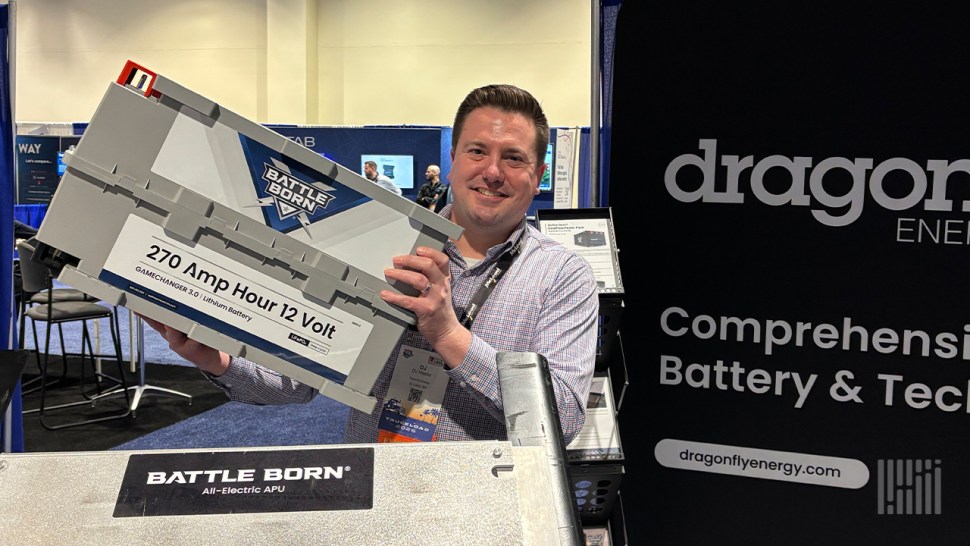
ORLANDO–While so much focus on battery technology in trucks has been on the prospect of possibly displacing what’s under the hood now, Dragonfly Energy took its wares to the Truckload Carriers Association annual meeting here to promote battery usage in another location in the vehicle.
The TCA meeting’s exhibition hall is marked by some companies that are there year in and year out, as well as a smattering of exhibitors who are making their first foray into the meeting. Dragonfly Energy fits that latter definition.
Dragonfly has been around for about a decade, according to DJ Hasler, an OEM Product Specialist who manned Dragonfly’s booth at TCA. But Dragonfly’s target market has mostly been lithium iron phosphate batteries for the marine and RV markets.
Among Dragonfly’s long-standing non-trucking customers are Airstream, the manufacturer of aluminum residential trailers.
Its product: a lithium iron phosphate battery, charged by a truck’s alternator, that drives a truck’s auxiliary power unit (APU) providing electricity, heating and cooling to a truck’s sleeper cab. One of its key selling points is that it can be charged to a level adequate to cover the full 10-hour rest period required by federal hours of service regulations.
The lithium battery product would be a substitute for diesel-powered APUs are smaller power units, which in turn were an improvement over running the truck engine, Hasler said. “Instead of wasting 0.8 to 1.2 gallons of diesel an hour using your main truck engine, they use a smaller two-cycliner engine to get through that rest period,” he said.
They’re also a substitute for lead acid battery-powered APUs, Hasler said. But he added that those batteries do not store as much electricity as lithium-based batteries and weigh about 160 to 200 pounds more.
The full 10 hours
The “value prop” for the battery-powered APUs, according to Hasler, starts with one key selling point: “We can get through the entire 10-hour rest period without the engine on,” he said in an interview with FreightWaves at the TCA exhibition hall.
About three years ago, Dragonfly made the decision to expand into the truck market and specifically to displace noisy diesel-driven APUs. Those created the issue of noise interrupting the driver’s desire to sleep. Whether the noise is coming from the engine idling, or a diesel-fueled APU, a unit driven by electricity means, as one driver told Hasler, “I can finally get through the 10-hour rest period without it sounding like I have a lawnmower underneath.”
“Diesel APUs made a ton of sense 10 years ago,” Hasler said. “Let’s use a smaller, more efficient engine instead of the big tractor engine.”
Power for a battery APU, fueled by electricity coming off the engine’s alternator, means that “we’re generating more than enough power with the truck,” Hasler said. “We just need to store that power in a proper way while you’re driving.”
Most of the installations of the APU for Dragonfly have been retrofits. But a modification by an OEM after the vehicle comes off the line also can be pursued, Hasler said.
Decade-long warranty
The power pack has a 10-year warranty, Hasler said. That can help the resale value of the truck, he added, or the power pack can be taken out of a truck and installed on a newer vehicle. “The customers are confident in the ROI of the APU because they’re going to get to use it for two trucks, but they have to pay for just one,” he said.
A truck’s true miles per gallon calculation includes the diesel consumption used to power an APU. Hasler said the sales pitch for Dragonfly’s product is that “their miles per gallon go up, their idling percentage goes down, and then they can do their own ROI calculation.”
But adoption of any new technology will always come up against a resistance point: cost.
“The resistance point is that it’s a higher initial investment, but it is a significantly lower total cost of ownership,” Hasler said. “We can tell them that until we’re blue in the face, right until they see it in their actual results.”
Wide range of price offerings
Hasler said Dragonfly has “multiple solutions,” with a price ranging from $4,000 to $10,000 per truck. The difference between the least expensive and the most expensive battery solution, he said, is runtime.
A truck company that runs heavily in warm weather areas, particularly in the summer, will need more power to cool a sleeper cab in the oppressive summer heat, according to Hasler. It would need more power to get through a 10-hour down cycle and give the driver a comfortable sleep.
Another operational selling point Dragofly makes is that if an engine doesn’t need to idle to keep the driver comfortable, it reduces wear on that equipment. “Every one hour of idling is the same as 25 miles of driving,” he said.
Penetration into the trucking sector is “definitely still pretty new,” Hasler said. “But we have a couple of very large national fleet households names that have adopted us and we are in a standard position for them moving forward.” He cited Stevens Transport as a leading customer.
Any time lithium is introduced into an activity, the risk of it catching fire is always present. Hasler said the lithium iron phosphate batteries produced by Dragonfly and then packed inside the APU are in stainless steel cells topped by bursting caps “to make it extremely safe. But it’s not 100% non-flammable.”
Despite various clean air and other environmental regulations in California, Hasler said the Golden State has not been a particularly strong market “because there aren’t as many of the typical big OTR sleeper cab fleets there as there are in the Midwest, so we’ve kind of just focused on where we’ve had early success.”
More articles by John Kingston
Derek Barrs defends FMCSA’s bold moves at TCA
How New York’s new driving penalties impact truckers
BMO’s quarterly earnings suggest truck credit might be improving
Brokerage Compliance Symposium
The day before F3. Every compliance issue you face - fraud exposure, carrier liability, FMCSA rules, cargo theft, insurance gaps - navigated by attorneys and operators defining best practices in a changing industry.
F3 Awards Dinner
The night before F3. FreightTech100 companies honored. FreightTech 25 and Shipper of Choice winners revealed live. Cocktail reception into dinner and live music - 300 industry leaders in one purpose-built room.
F3: Future of Freight Festival
Industry-defining keynotes, rapid-fire technology demos, and industry leaders networking in experiences across Chattanooga - plus the inaugural F3 Awards Dinner featuring the FreightTech and Shipper of Choice reveals.
The day before F3. Every compliance issue you face - fraud exposure, carrier liability, FMCSA rules, cargo theft, insurance gaps - navigated by attorneys and operators defining best practices in a changing industry.
The Signal at Chattanooga Choo Choo • Chattanooga, TN Register NowThe night before F3. FreightTech100 companies honored. FreightTech 25 and Shipper of Choice winners revealed live. Cocktail reception into dinner and live music - 300 industry leaders in one purpose-built room.
The Signal at Chattanooga Choo Choo • Chattanooga, TN Register NowIndustry-defining keynotes, rapid-fire technology demos, and industry leaders networking in experiences across Chattanooga - plus the inaugural F3 Awards Dinner featuring the FreightTech and Shipper of Choice reveals.
The Signal at Chattanooga Choo Choo • Chattanooga, TN Register Now