




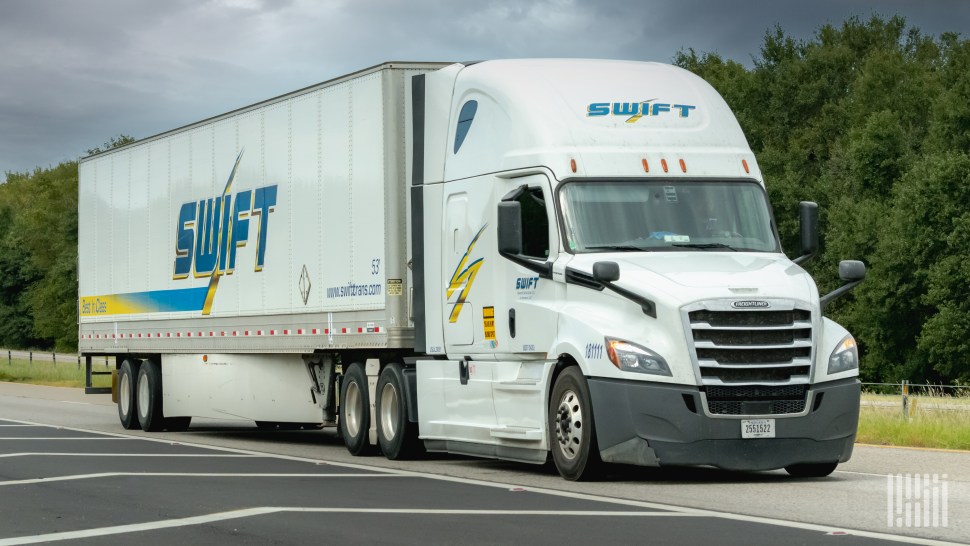
Knight-Swift Transportation missed fourth-quarter expectations but said it is continuing to attack costs and believes it can improve margins in the new year even without a lift in volume and rate. However, the multimodal transportation provider acknowledged it would likely take better demand and pricing to get back to longer-term margin ranges.
The Phoenix-based company reported a headline net loss of $6.8 million, or 4 cents per share, Wednesday after the market closed. However, the result included $53 million in noncash charges related to a decision to roll Abilene Motor Express under Swift Transportation.
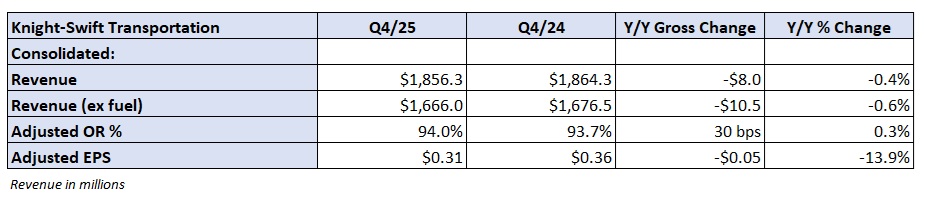
Excluding all one-time charges in the period, adjusted EPS of 31 cents, was 5 cents worse year over year and 4 cents below the consensus estimate. A reduction in interest expense and higher gains on sale combined for a 4-cent tailwind (at a normalized tax rate).
Consolidated revenue of $1.86 billion was down slightly y/y in the quarter and came in just shy of the $1.9 billion consensus estimate. Adjusted operating income was down 5% y/y to $101 million. Knight-Swift (NYSE: KNX) issued first-quarter EPS guidance of 28 to 32 cents, bracketing a consensus estimate of 31 cents.
TL belt tightened ahead of market turn
Truckload revenue fell 2% y/y to $1.08 billion as a 5% decline in average tractors in service was partially offset by a 2% increase in revenue per tractor. The carrier continues to trim its fleet count to improve asset utilization. Miles per tractor were up 1% y/y with revenue per loaded mile (excluding fuel surcharges) also up 1%.
On a Wednesday evening call with analysts, management indicated they are not yet prepared to declare a definitive market turn. It did note that a reduction in available capacity has tightened the market and that network balance so far in January is “modestly better than typical seasonality.”
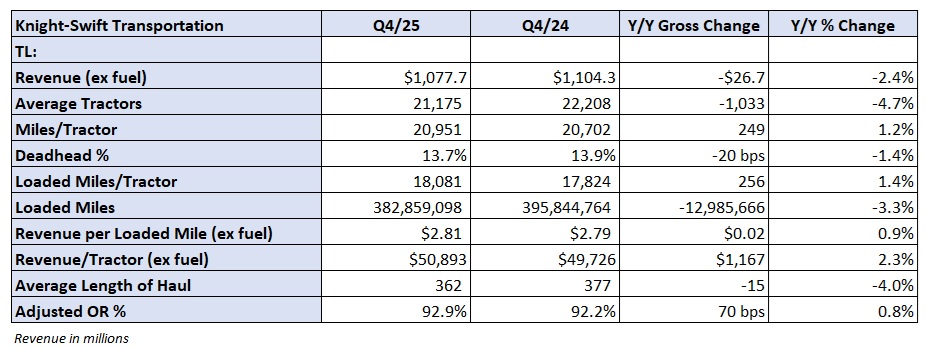
The TL unit booked a 92.9% adjusted operating ratio (inverse of operating margin), 70 basis points worse y/y but 330 bps better than the third quarter. Management said it could only raise rates by less than 1% last year, which came in well short of cost inflation. The company is targeting low- to mid-single-digit contractual rate increases during the 2026 bid season but said it’s still too soon to tell if that is the correct range.
The legacy Knight-Swift fleets operated at a 91.6% adjusted OR. U.S. Xpress saw 430 bps of y/y improvement, posting a mid-90% OR, largely due to better project freight opportunities in the quarter.
Approximately $150 million in expenses (80 bps of margin) have been removed from the unit. Roughly two-thirds of the reductions are tied to variable costs. Maintenance, fuel and insurance costs have moved lower as a percentage of revenue.
Fixed costs were reduced across several areas: equipment (improved asset utilization), real estate (selling excess capacity along with reducing facility maintenance costs) and overhead (non-driver headcount down about 5%).

LTL benefitting from unified brand
The less-than-truckload segment reported revenue of $299 million, a 7% y/y increase, as shipments per day increased 2% and revenue per shipment (excluding fuel) increased 5%. Yield (revenue per hundredweight) also increased 5%, but that was due to a 12% increase in length of haul. (Weight per shipment was flat in the period.)
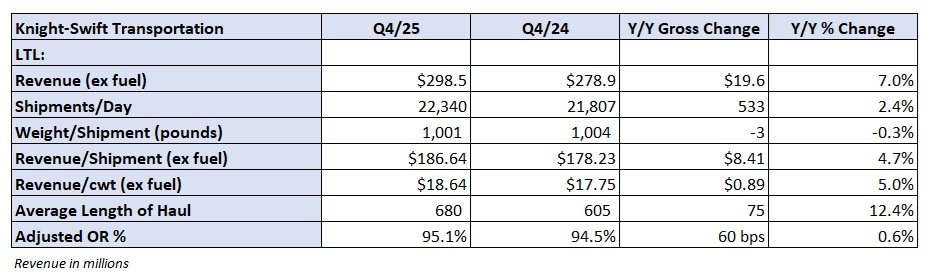
The unit reported a 95.1% adjusted OR, 60 bps worse y/y and 450 bps worse sequentially. Costs associated with onboarding new terminals have been a drag on margin. Door count was up 10% y/y in the quarter, but the carrier is expected to see only modest terminal growth moving forward.
The company currently has the capacity to generate $2 billion in revenue, a more than 50% increase from the $1.3 billion it generated over the past 12 months.
(Knight-Swift still needs to acquire a Northeast carrier to complete a national network.)
Knight-Swift’s three acquired LTL brands — AAA Cooper Transportation (ACT), Midwest Motor Express (MME) and Dependable Highway Express (DHE) — began operating under the ACT banner on Jan 1. Management touted recent successes marketing the unified brand, noting many large customers didn’t like the previous interline approach. It said that incorporating national accounts will produce an increase in the average length of haul, which stood at 680 miles in the fourth quarter. Currently, this haul length is more typical of a regional carrier network.

The logistics unit reported 210 bps of y/y margin degradation in the quarter (95.8% adjusted OR) as higher purchased transportation costs compressed gross margin by 180 bps to 15.5%.
The intermodal segment remained near breakeven, posting a 100.1% adjusted OR. A 99.8% OR in the third quarter was the first operating profit for the unit in 10 quarters.
All other segments, which include revenue from support services to third parties, will return to an operating profit in the first quarter. However, gains on equipment sales are expected to step meaningfully lower.
Brokerage Compliance Symposium
The day before F3. Every compliance issue you face - fraud exposure, carrier liability, FMCSA rules, cargo theft, insurance gaps - navigated by attorneys and operators defining best practices in a changing industry.
F3 Awards Dinner
The night before F3. FreightTech100 companies honored. FreightTech 25 and Shipper of Choice winners revealed live. Cocktail reception into dinner and live music - 300 industry leaders in one purpose-built room.
F3: Future of Freight Festival
Industry-defining keynotes, rapid-fire technology demos, and industry leaders networking in experiences across Chattanooga - plus the inaugural F3 Awards Dinner featuring the FreightTech and Shipper of Choice reveals.
The day before F3. Every compliance issue you face - fraud exposure, carrier liability, FMCSA rules, cargo theft, insurance gaps - navigated by attorneys and operators defining best practices in a changing industry.
The Signal at Chattanooga Choo Choo • Chattanooga, TN Register NowThe night before F3. FreightTech100 companies honored. FreightTech 25 and Shipper of Choice winners revealed live. Cocktail reception into dinner and live music - 300 industry leaders in one purpose-built room.
The Signal at Chattanooga Choo Choo • Chattanooga, TN Register NowIndustry-defining keynotes, rapid-fire technology demos, and industry leaders networking in experiences across Chattanooga - plus the inaugural F3 Awards Dinner featuring the FreightTech and Shipper of Choice reveals.
The Signal at Chattanooga Choo Choo • Chattanooga, TN Register Now