





December shipments fell to a cycle low while truckload rates again stepped higher, according to monthly data from Cass Information Systems.
Cass’ multimodal shipments index dropped 7.5% year over year in December. The decline was on top of a similar move in December 2024, producing a two-year-stacked decline of 13.5%. The shipments dataset was down 7.2% from November (3.2% lower seasonally adjusted).
| December 2025 | y/y | 2-year | m/m | m/m (SA) |
| Shipments | -7.5% | -13.5% | -7.2% | -3.2% |
| Expenditures | -0.6% | -4.0% | -1.9% | 0.2% |
| TL Linehaul Index | 2.1% | 1.6% | 1.0% | NM |
The Friday report blamed winter storms for the slowdown in volumes but noted that inventories have been drawn down.
“The three winter storms which hit the Midwest in the first two weeks of December slowed the highway network and created some pent-up demand that was still evident in the spot market in the first half of January,” the report said. “Holiday consumer spending data suggest retail inventories destocked in recent months as freight shipments across modes were below spending trends.”
Weather has been relatively mild so far in January. The report said volumes could come in above the normal seasonal trend for the month (down 5%) if the patterns hold.
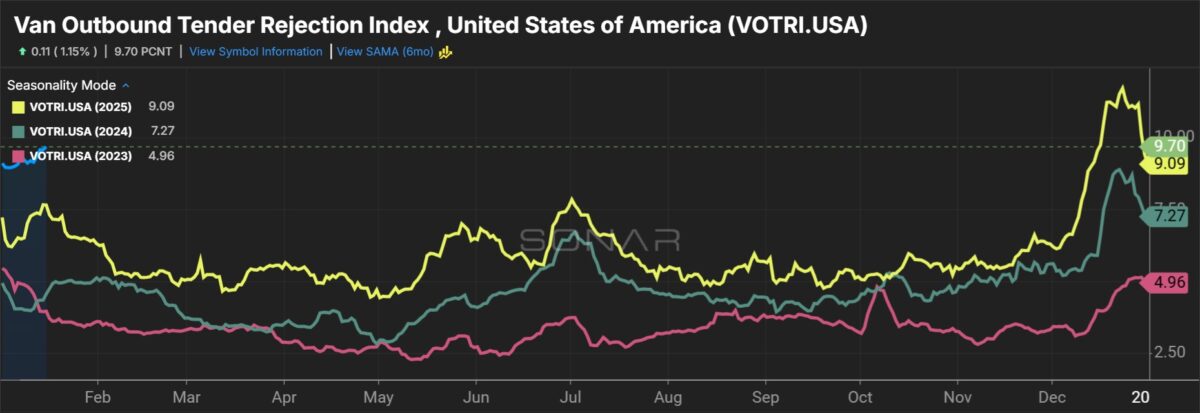
J.B. Hunt Transport Services (NASDAQ: JBHT) stated during a quarterly call with analysts on Thursday that the market began to tighten the week before Thanksgiving with improvement continuing through the end of the year. Management from the company didn’t provide a firm outlook for 2026 given the numerous head fakes already seen in this cycle. However, it was encouraged that seasonal strength to start the year has occurred without inclement weather as a catalyst. It also said that customer inventories are lean.

Cass’ expenditures index, which measures total freight spend including fuel, slid 0.6% y/y. Compared to two years ago, the dataset was off 4%, which was the smallest two-year-stacked decline since July 2023.
The expenditures subcomponent was off just 0.5% in 2025 while shipments were off 6% on average, implying freight rates were on the move higher throughout the year. Netting the change in volumes from the change in expenditures implies rates were likely up 7% y/y in December.
(However, Cass is assessing the impact of a changing freight mix from LTL to TL and has paused the release of its inferred rate data.)
The TL linehaul index, which tracks rates excluding fuel and accessorial surcharges, increased 1% from November, a fourth straight sequential increase. The rate index was up 2.1% y/y and stayed in positive territory in every month of 2025.
The report pointed to weather as the reason for the runup in rates during the month. It said mild weather to start the year has cleared the volume backlog and that the recent “rate momentum could be temporary” as the market has entered the seasonally slowest stretch of the year. However, it also reiterated that inventories will need to be replenished at some point and that “capacity continues to contract.”
Some public carriers and 3PLs have pointed to increased regulation of the driver pool (English-language proficiency requirements, non-domiciled CDL restrictions, and ELD and driver school crackdowns) as the reason for the recent spot market inflection.
“While the soft volume environment persists, after considerable destocking in Q4’25, we think the Supreme Court decision on IEEPA tariffs could provide a positive catalyst for freight demand,” the report said.
Data used in the indexes comes from freight bills paid by Cass (NASDAQ: CASS), a provider of payment management solutions. Cass processes $36 billion in freight payables annually on behalf of customers.
Brokerage Compliance Symposium
The day before F3. Every compliance issue you face - fraud exposure, carrier liability, FMCSA rules, cargo theft, insurance gaps - navigated by attorneys and operators defining best practices in a changing industry.
F3 Awards Dinner
The night before F3. FreightTech100 companies honored. FreightTech 25 and Shipper of Choice winners revealed live. Cocktail reception into dinner and live music - 300 industry leaders in one purpose-built room.
F3: Future of Freight Festival
Industry-defining keynotes, rapid-fire technology demos, and industry leaders networking in experiences across Chattanooga - plus the inaugural F3 Awards Dinner featuring the FreightTech and Shipper of Choice reveals.
The day before F3. Every compliance issue you face - fraud exposure, carrier liability, FMCSA rules, cargo theft, insurance gaps - navigated by attorneys and operators defining best practices in a changing industry.
The Signal at Chattanooga Choo Choo • Chattanooga, TN Register NowThe night before F3. FreightTech100 companies honored. FreightTech 25 and Shipper of Choice winners revealed live. Cocktail reception into dinner and live music - 300 industry leaders in one purpose-built room.
The Signal at Chattanooga Choo Choo • Chattanooga, TN Register NowIndustry-defining keynotes, rapid-fire technology demos, and industry leaders networking in experiences across Chattanooga - plus the inaugural F3 Awards Dinner featuring the FreightTech and Shipper of Choice reveals.
The Signal at Chattanooga Choo Choo • Chattanooga, TN Register Now