




Shares of Knight-Swift Transportation fell 3.5% in after-hours trading on Wednesday following a third-quarter earnings report that missed analysts’ expectations. The multimodal transportation provider also issued a fourth-quarter outlook that was light of consensus (at the midpoint of the range).
(Knight-Swift’s (NYSE: KNX) stock was up 20% in the month leading up to the report.)
Management stated on a Wednesday conference call with analysts that a seasonal lift in demand across the platform has not been observed heading into the holidays. However, it noted some constructive conversations with customers around project work for the fourth quarter.
It’s starting to see early impacts to the driver pool as non-domiciled CDL issuances cease and English language proficiency enforcement ramps. Early bid season activity is delivering low-single-digit rate increases accompanied by less customer churn as many shippers are reducing the number of carriers they work with.
Knight-Swift remains focused on cutting costs and attracting appropriately-priced freight to the network.

Noisy, cost-burdened Q3
The Phoenix-based company reported third-quarter adjusted earnings per share of 32 cents, which missed the consensus estimate of 37 cents and management’s guidance of 36 to 42 cents. (Headline EPS was just 5 cents in the quarter.) The company called out $58 million of “unusual items” in the period, some of which were included in the adjusted number.
Adjusted EPS excluded trade name impairments associated with the decision to combine its less-than-truckload brands ($28.8 million) and property lease and software impairments ($6 million), among other charges.
The adjusted number included 10 cents per share in charges from the 2024 wind down of its third-party insurance business ($11.2 million) and charges from prior auto liability claims at U.S. Xpress ($12 million). (Some carriers would have excluded these items from adjusted EPS.)
Knight-Swift issued fourth-quarter guidance of 34 to 40 cents compared to a 40-cent consensus estimate at the time of the print.
Truckload focused on utilization
Knight-Swift’s TL unit saw a 2% y/y decline in revenue as a 7% decline in average tractors in service was partially offset by a 5% increase in revenue per tractor. Loaded miles per tractor (up 5%) have improved y/y in eight of the past nine quarters. The company said it still has room to improve its utilization metrics.
Revenue per loaded mile (excluding fuel surcharges) was flat y/y at $2.77.

The unit reported a 96.2% adjusted operating ratio (inverse of operating margin), which was 60 basis points worse y/y and 160 bps worse sequentially. U.S. Xpress’ insurance costs were a 110-bp headwind in the quarter. Knight-Swift’s legacy fleets operated at a combined 93.7% adjusted OR.
The fourth-quarter outlook calls for 250 to 350 bps of sequential margin improvement in the TL unit (100 bps worse y/y at the midpoint of the range).

LTL unit consolidated under AAA Cooper banner
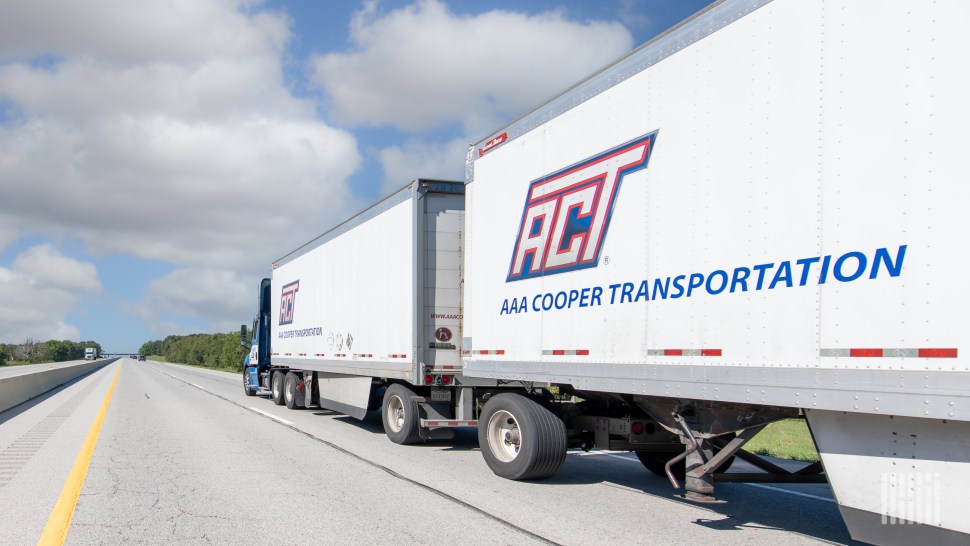
Knight-Swift’s three acquired LTL brands – AAA Cooper Transportation (ACT), Midwest Motor Express (MME) and Dependable Highway Express (DHE) – will all operate under the ACT banner starting Jan 1. The companies were integrated and placed on the same operating platform earlier this year.
Knight-Swift acquired Southeast and Midwest regional carrier ACT in 2021. It added MME’s Upper Midwest and Northwest footprint later in the same year. Western carrier DHE was acquired on July 30, 2024, leaving the Northeast as the last major region to add to complete a national network.
The combined platform has more than 170 terminals, including locations acquired from bankrupt Yellow Corp. as well as organic additions, covering approximately 70% of the U.S. The segment generated $1.26 billion in revenue over the past four quarters.

Less-than-truckload revenue increased 22% y/y during the third quarter as daily shipments increased 14% and revenue per shipment (excluding fuel) was up 7%. (The 2024 third quarter only included a two-month revenue contribution from DHE.)
Yield (revenue per hundredweight) was up 6% excluding fuel. A 14% increase in length of haul was a tailwind to the yield metric.
The unit booked a 90.6% adjusted OR, 100 bps worse y/y but 250 bps better than the second quarter.
Management said LTL demand was a little soft in the first two weeks of the fourth quarter, but it forecast a 10% to 15% y/y revenue increase for the period. The adjusted OR is expected to be similar to the 2024 fourth quarter (94.5%).
Logistics, intermodal bounce off bottom
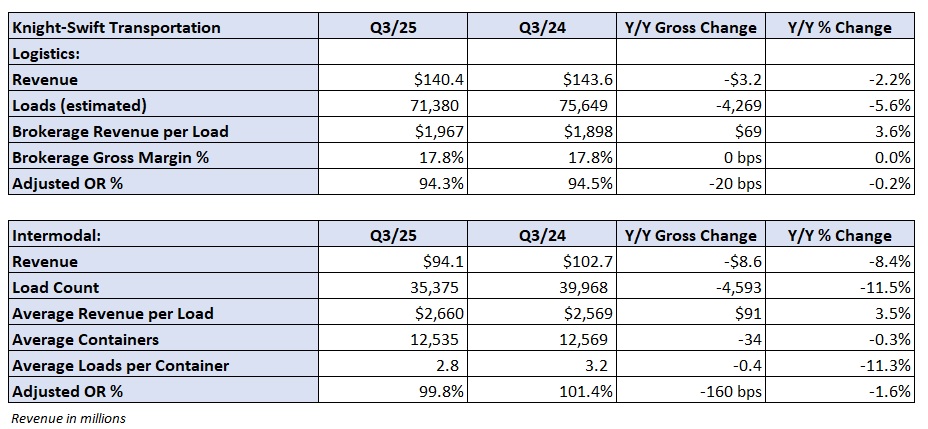
The logistics unit saw a modest y/y revenue decline but loads were up 13% from the second quarter, pushing revenue 9% higher sequentially. A 94.3% adjusted OR was 20 bps better y/y and 50 bps improved from the second quarter. Guidance calls for mid-teen sequential increases to revenue and operating income in the fourth quarter.
The intermodal segment reported its first adjusted operating profit in 10 quarters (a 99.8% adjusted OR). Revenue was down 8% y/y but improved 12% from the second quarter as loads increased 8% and revenue per load was up 3%.
Load count is expected to improve again sequentially in the fourth quarter, with little change likely to the near-breakeven margin.
Brokerage Compliance Symposium
The day before F3. Every compliance issue you face - fraud exposure, carrier liability, FMCSA rules, cargo theft, insurance gaps - navigated by attorneys and operators defining best practices in a changing industry.
F3 Awards Dinner
The night before F3. FreightTech100 companies honored. FreightTech 25 and Shipper of Choice winners revealed live. Cocktail reception into dinner and live music - 300 industry leaders in one purpose-built room.
F3: Future of Freight Festival
Industry-defining keynotes, rapid-fire technology demos, and industry leaders networking in experiences across Chattanooga - plus the inaugural F3 Awards Dinner featuring the FreightTech and Shipper of Choice reveals.
The day before F3. Every compliance issue you face - fraud exposure, carrier liability, FMCSA rules, cargo theft, insurance gaps - navigated by attorneys and operators defining best practices in a changing industry.
The Signal at Chattanooga Choo Choo • Chattanooga, TN Register NowThe night before F3. FreightTech100 companies honored. FreightTech 25 and Shipper of Choice winners revealed live. Cocktail reception into dinner and live music - 300 industry leaders in one purpose-built room.
The Signal at Chattanooga Choo Choo • Chattanooga, TN Register NowIndustry-defining keynotes, rapid-fire technology demos, and industry leaders networking in experiences across Chattanooga - plus the inaugural F3 Awards Dinner featuring the FreightTech and Shipper of Choice reveals.
The Signal at Chattanooga Choo Choo • Chattanooga, TN Register Now