




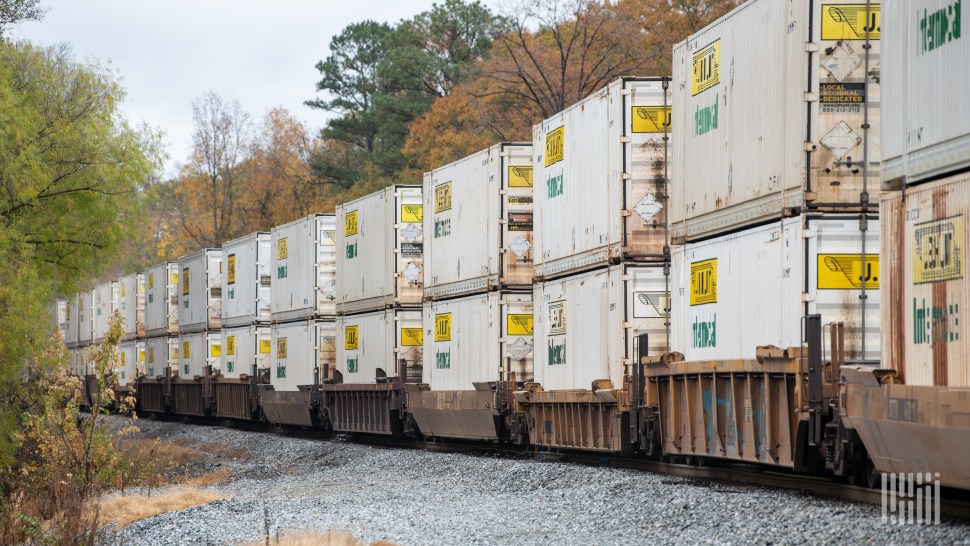
J.B. Hunt Transport Services reported a notable step up in earnings despite a slight falloff in revenue during the third quarter. The multimodal transportation provider previously outlined a $100-million cost reduction program, the fruits of which showed up in a big way in the recent period.
Join the leaders shaping freight’s future at
F3: Future of Freight Festival, Oct 21-22.
Network with the industry’s best and discover what’s next.
J.B. Hunt (NASDAQ: JBHT) saw consolidated revenue decline less than 1% year over year to $3.05 billion in the third quarter (the consensus estimate was $3.02 billion). However, operating income increased 8% y/y with earnings per share up 18% to $1.76 (30 cents ahead of analysts’ expectations).
(A lower tax rate compared to the 2024 third quarter was a 3-cent tailwind to EPS.)
Shares of J.B. Hunt jumped 12% in after-hours trading on Wednesday, following the better-than-expected report.
The company has scrutinized over 100 expense lines and found ways to improve efficiency and better utilize its assets. It removed $20 million in costs in the third quarter and said total annual savings could be “far greater than $100 million” over time.

Intermodal’s fate won’t be determined by rail merger
J.B. Hunt management said on a Wednesday evening call with analysts that it won’t be forced to move Eastern intermodal traffic to CSX (NASDAQ: CSX) if the Union Pacific (NYSE: UNP) – Norfolk Southern (NYSE: NSC) merger is approved. It said it could continue to use both Eastern railroads, contrary to current market speculation. It plans to have conversations with all rail providers to find the best lane solutions for its customers.

Intermodal revenue slid 2% y/y to $1.52 billion as both loads and revenue per load dipped approximately 1%. A 6% decline in transcontinental loads was largely offset by a 6% increase in Eastern loads. By month, loads were down 3% y/y in July, 2% lower in August and flat in September. The mix shift East weighed on intermodal yields in the period due to shorter lengths of haul.
(Both loads and revenue per load improved 3% sequentially from the second quarter.)
The ocean shipping peak season came early this year as shippers moved inventory ahead of tariff implementations. However, management said most of its customers are still expecting a ground transportation peak season as much of the merchandise that landed in the U.S. is still sitting near ports and at distribution centers.
The intermodal segment posted a 91.8% operating ratio (inverse of operating margin), which was 100 basis points better than the year-ago quarter, and 150 bps better than the second quarter. Drayage efficiencies, improved network balance and fewer empty moves drove the improvement.

Dedicated customer attrition ends
The company reiterated an expectation for full-year operating income in its dedicated unit to be flat y/y. It was calling for modest growth earlier in the year.
Dedicated revenue was up 2% y/y to $864 million in the quarter as average trucks in service dipped less than 1% and revenue per truck per week was up 3%. It sold service on 280 trucks in the quarter. Net customer attrition ceased in July and J.B. Hunt reiterated a long-term annual goal of net fleet growth between 800 and 1,000 trucks.
The segment recorded an 87.9% OR, which was 80 bps better y/y (100 bps better sequentially).

Brokerage losses narrow
The brokerage unit booked an operating loss of $752,000 in the third quarter, marking 11 consecutive losses. However, this was the smallest of the cycle.

Revenue was down less than 1% y/y as a 9% decline in loads was nearly offset by a 9% increase in revenue per load. The segment’s gross profit margin fell 290 bps to 15% but labor utilization improved (executed loads per employee were up 4%).
Shares of JBHT were up 12.4% in after-hours trading on Wednesday. The stock was off 5.2% in the 1-week lead up to the report as analysts cut estimates amid tepid demand heading into peak season.

Brokerage Compliance Symposium
The day before F3. Every compliance issue you face - fraud exposure, carrier liability, FMCSA rules, cargo theft, insurance gaps - navigated by attorneys and operators defining best practices in a changing industry.
F3 Awards Dinner
The night before F3. FreightTech100 companies honored. FreightTech 25 and Shipper of Choice winners revealed live. Cocktail reception into dinner and live music - 300 industry leaders in one purpose-built room.
F3: Future of Freight Festival
Industry-defining keynotes, rapid-fire technology demos, and industry leaders networking in experiences across Chattanooga - plus the inaugural F3 Awards Dinner featuring the FreightTech and Shipper of Choice reveals.
The day before F3. Every compliance issue you face - fraud exposure, carrier liability, FMCSA rules, cargo theft, insurance gaps - navigated by attorneys and operators defining best practices in a changing industry.
The Signal at Chattanooga Choo Choo • Chattanooga, TN Register NowThe night before F3. FreightTech100 companies honored. FreightTech 25 and Shipper of Choice winners revealed live. Cocktail reception into dinner and live music - 300 industry leaders in one purpose-built room.
The Signal at Chattanooga Choo Choo • Chattanooga, TN Register NowIndustry-defining keynotes, rapid-fire technology demos, and industry leaders networking in experiences across Chattanooga - plus the inaugural F3 Awards Dinner featuring the FreightTech and Shipper of Choice reveals.
The Signal at Chattanooga Choo Choo • Chattanooga, TN Register Now