





Less-than-truckload carriers “continue to flex pricing power,” according to a quarterly report from 3PL AFS Logistics and financial services firm TD Cowen. The group is forecasting LTL rates to again remain elevated during the fourth quarter.
Join the leaders shaping freight’s future at
F3: Future of Freight Festival, Oct 21-22.
Network with the industry’s best and discover what’s next.
The LTL rate-per-pound component of the TD Cowen/AFS Freight Index set a record in the third quarter, standing 65.1% above its January 2018 baseline. The dataset is expected to dip just 30 basis points sequentially in the fourth quarter to 64.8%. That would result in a 180-bp year-over-year increase and mark eight consecutive quarters of y/y growth.
While near record levels, the dataset has largely been range bound, maintaining a roughly 60% premium to the baseline, for the past three years.
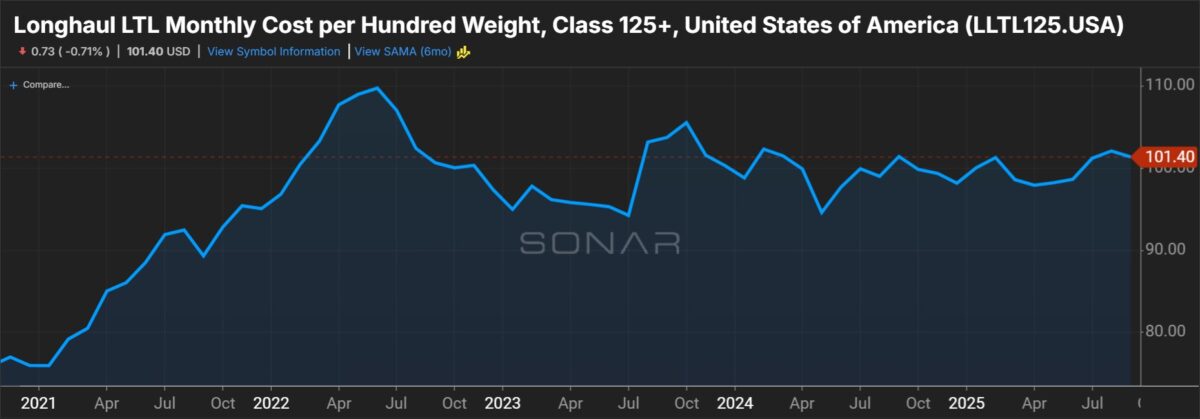
“Emphasizing yield rather than volume has proven to be a successful formula for carriers in previous down freight cycles and rates are again proving resilient, even in the face of negative indicators like the ISM Manufacturing PMI index showing contraction for 33 of the last 35 months,” said Mich Fabriga, vice president of LTL Pricing at AFS, in a news release.
Manufacturing data again disappointed in September, with the PMI registering a 49.1 reading (50 is neutral). The PMI new orders subindex – a signal for future activity – slid back into contraction at 48.9.
Weakness across the manufacturing complex drove shipment weights lower in the third quarter.
The spread between cost per LTL shipment (down 0.7% y/y) and weight per shipment (down 7.4% y/y) widened to 670 bps in the third quarter (from 220 bps in the second quarter), reflecting “strong pricing discipline by LTL carriers.”
Sequentially, cost per shipment was down 1.8% from the second quarter while weight per shipment was off 3%. Fuel surcharges were up 5.6% sequentially while length of haul was 1.3% higher.
“A longer-term indication of carriers’ successful yield management and margin protection efforts is that cost per shipment has held steady at elevated levels since Q2 2023 – a period of nine straight quarters,” the report said.
TL still displaying squishy trends
By comparison, truckload rate data from the index showed lackluster trends.
The TL rate-per-mile component of the index is expected to increase just 10 bps sequentially in the fourth quarter to just 6.1% above the 2018 baseline. That would mark three years of depressed results after peaking at 25.7% in the 2022 first quarter.
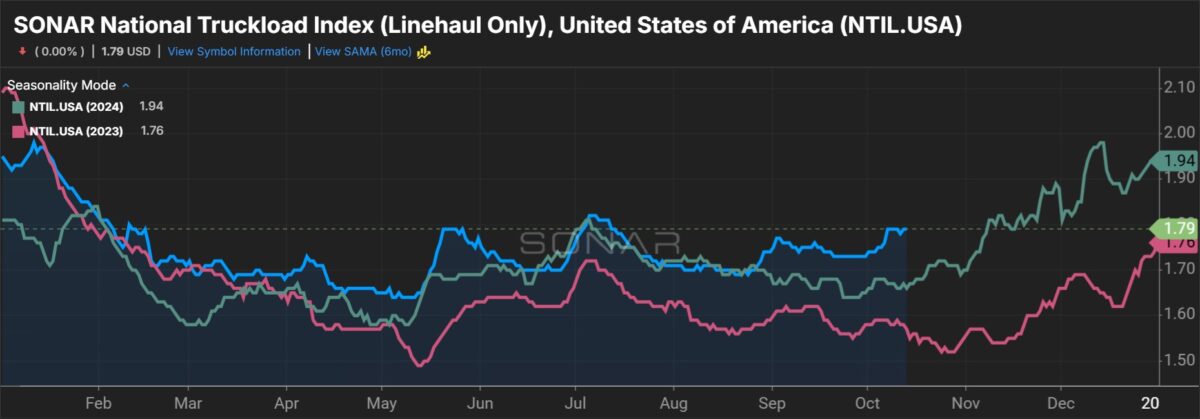
Truckload linehaul cost per shipment was up 0.2% sequentially in the third quarter, but the increase was driven by a 0.6% increase in miles per shipment. On a y/y comparison, cost per shipment turned positive, up 1.5%, reversing a sustained period of y/y declines, “but underlying conditions suggest the recovery remains tentative.”
“While the initial shock and awe of high-profile tariff announcements has subsided from earlier this year, businesses continue to grapple with the effects of shifting policies,” said AFS CEO Andy Dyer. “We’re also in year three of an unusually long downward freight cycle, and carriers are relying on hard-won lessons of the past to prioritize profitability and hang on in a soft environment.”
The LTL earnings season kicks off on Oct. 29 when Old Dominion Freight Line (NASDAQ: ODFL) reports third-quarter results. The TL earnings season starts on Wednesday when J.B. Hunt Transport Services (NASDAQ: JBHT) reports results after the market closes.
AFS Logistics is a non-asset-based 3PL providing audit and cost management services, managed transportation, and freight brokerage. It has visibility into more than $39 billion in annual freight spend.
Brokerage Compliance Symposium
The day before F3. Every compliance issue you face - fraud exposure, carrier liability, FMCSA rules, cargo theft, insurance gaps - navigated by attorneys and operators defining best practices in a changing industry.
F3 Awards Dinner
The night before F3. FreightTech100 companies honored. FreightTech 25 and Shipper of Choice winners revealed live. Cocktail reception into dinner and live music - 300 industry leaders in one purpose-built room.
F3: Future of Freight Festival
Industry-defining keynotes, rapid-fire technology demos, and industry leaders networking in experiences across Chattanooga - plus the inaugural F3 Awards Dinner featuring the FreightTech and Shipper of Choice reveals.
The day before F3. Every compliance issue you face - fraud exposure, carrier liability, FMCSA rules, cargo theft, insurance gaps - navigated by attorneys and operators defining best practices in a changing industry.
The Signal at Chattanooga Choo Choo • Chattanooga, TN Register NowThe night before F3. FreightTech100 companies honored. FreightTech 25 and Shipper of Choice winners revealed live. Cocktail reception into dinner and live music - 300 industry leaders in one purpose-built room.
The Signal at Chattanooga Choo Choo • Chattanooga, TN Register NowIndustry-defining keynotes, rapid-fire technology demos, and industry leaders networking in experiences across Chattanooga - plus the inaugural F3 Awards Dinner featuring the FreightTech and Shipper of Choice reveals.
The Signal at Chattanooga Choo Choo • Chattanooga, TN Register Now