





The freight market experienced a bounce in September, primarily driven by truckload volumes, though the outlook remains uncertain, according to a monthly report from Cass Information Systems.
Join the leaders shaping freight’s future at
F3: Future of Freight Festival, Oct 21-22.
Network with the industry’s best and discover what’s next.
Cass’ multimodal shipments index increased 2.5% sequentially in September (up 1.5% seasonally adjusted), reversing August’s dip. The volumes dataset was down 5.4% year over year, which was the smallest y/y decline in three months as delayed tariff implementations were supportive of volumes. For a second straight month, the TL market took share from the less-than-truckload market.
Shippers consolidating smaller loads into full truckloads to take advantage of still-depressed rates drove the mix shift in trucking. While the “TL bounce” led to higher rates in the month, tariffs are expected to negatively impact consumer spending, pushing out a meaningful recovery, the report said.
“We think the LTL declines reflect ongoing available TL capacity—where low rates lead shippers to consolidate LTL loads into truckloads—and private fleet insourcing,” the report said. “The positivity in TL volumes may be temporary, as pre-tariff shipping may lead to more air pockets in demand.”
Further, inbound container flows from China are forecast to be subdued in the back half of the year. Cass’ volumes dataset is expected to be off 6% y/y in October, assuming typical seasonality during the month.
| September 2025 | y/y | 2-year | m/m | m/m (SA) |
| Shipments | -5.4% | -10.4% | 2.5% | 1.5% |
| Expenditures | 2.2% | -4.5% | 5.1% | 2.5% |
| TL Linehaul Index | 2.6% | -1.0% | 1.7% | NM |
Cass’ freight expenditures index, which measures total freight spend including fuel, increased 5.1% sequentially (up 2.5% seasonally adjusted). The index was up 2.2% y/y, marking the fifth y/y increase in the past six months.
The dataset also saw its smallest two-year-stacked decline (down 4.5%) since July 2023.
Backing out the modest sequential volume increase, actual freight rates were likely 1% higher seasonally adjusted from August. However, Cass is still assessing the impact of a changing freight mix and has paused releasing its inferred rate data.
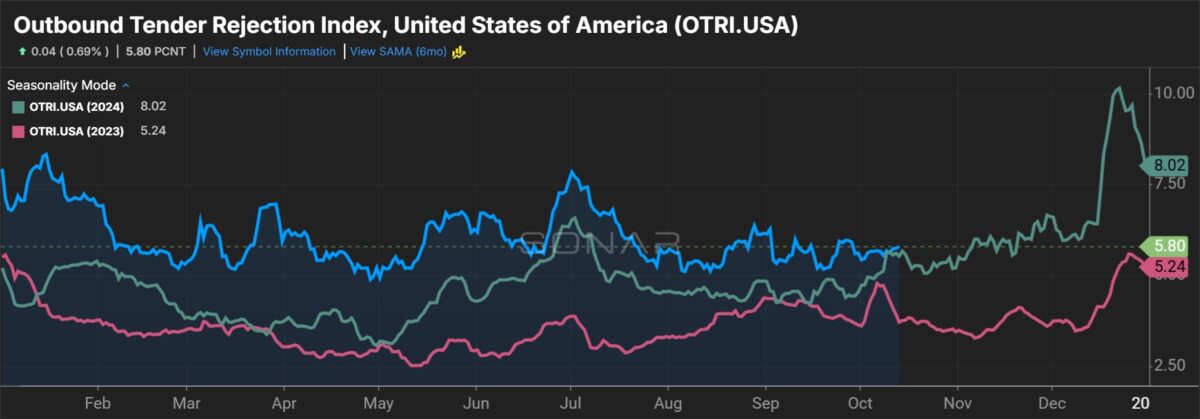
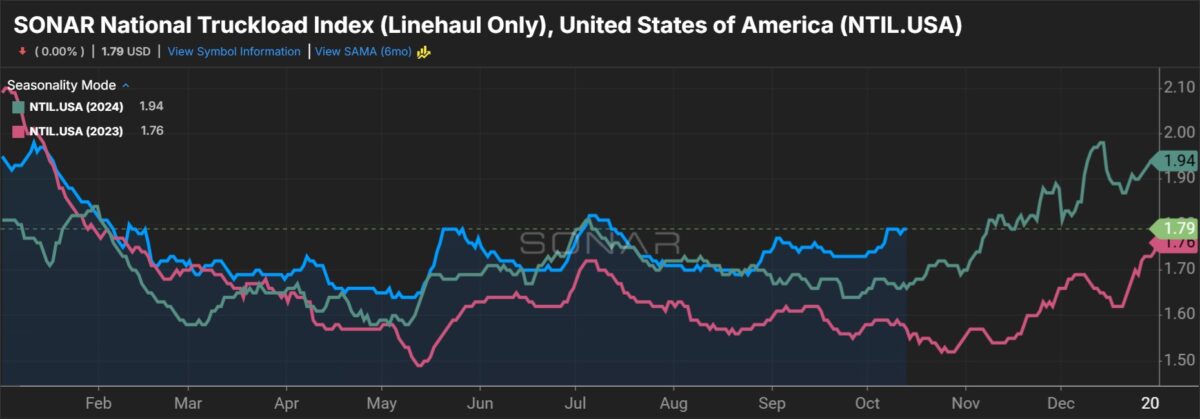
Cass’ TL linehaul index, which tracks rates excluding fuel and accessorial surcharges, was up 1.7% sequentially during September, reversing August’s decline. The index was up 2.6% y/y, a ninth straight y/y increase, and the largest in three years.
The report said “the net effects of the immigration crackdown,” including a stoppage in the issuance and renewal of non-domiciled commercial driver’s licenses, could materially tighten capacity in the next two years.
“While demand trends are mixed and the outlook remains cloudy, capacity continues to contract,” the report said, pointing to Class 8 tractor production, which is forecast to be “several thousand trucks per month below what is needed to maintain the fleet size,” in the back half of the year.
“In our view, lower capacity in an otherwise stable demand environment could move the cycle forward and actually create for-hire demand by reversing the insourcing of recent years. But this will take time.”
Equity analysts have been trimming carrier earnings estimates heading into the third-quarter earnings season, which begins Wednesday when J.B. Hunt Transport Services (NASDAQ: JBHT) reports. Generally soft demand and expectations for a muted peak season are expected to keep a lid on rates and carrier margins, analysts said. However, 2026 numbers could get more interesting as the driver pool becomes heavily regulated.
Data used in the indexes comes from freight bills paid by Cass (NASDAQ: CASS), a provider of payment management solutions. Cass processes $36 billion in freight payables annually on behalf of customers.
Brokerage Compliance Symposium
The day before F3. Every compliance issue you face - fraud exposure, carrier liability, FMCSA rules, cargo theft, insurance gaps - navigated by attorneys and operators defining best practices in a changing industry.
F3 Awards Dinner
The night before F3. FreightTech100 companies honored. FreightTech 25 and Shipper of Choice winners revealed live. Cocktail reception into dinner and live music - 300 industry leaders in one purpose-built room.
F3: Future of Freight Festival
Industry-defining keynotes, rapid-fire technology demos, and industry leaders networking in experiences across Chattanooga - plus the inaugural F3 Awards Dinner featuring the FreightTech and Shipper of Choice reveals.
The day before F3. Every compliance issue you face - fraud exposure, carrier liability, FMCSA rules, cargo theft, insurance gaps - navigated by attorneys and operators defining best practices in a changing industry.
The Signal at Chattanooga Choo Choo • Chattanooga, TN Register NowThe night before F3. FreightTech100 companies honored. FreightTech 25 and Shipper of Choice winners revealed live. Cocktail reception into dinner and live music - 300 industry leaders in one purpose-built room.
The Signal at Chattanooga Choo Choo • Chattanooga, TN Register NowIndustry-defining keynotes, rapid-fire technology demos, and industry leaders networking in experiences across Chattanooga - plus the inaugural F3 Awards Dinner featuring the FreightTech and Shipper of Choice reveals.
The Signal at Chattanooga Choo Choo • Chattanooga, TN Register Now