




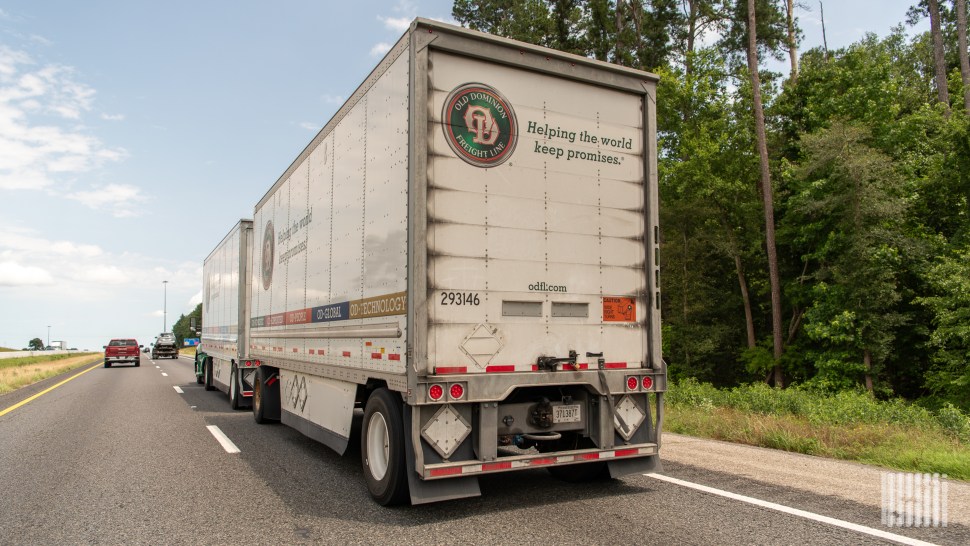
Less-than-truckload carrier Old Dominion Freight Line announced Monday a 4.9% general rate increase to various tariff codes effective Nov. 3. The rate bump is in line with the headline percentage increase taken last year but the implementation date is one month earlier.
Join the leaders shaping freight’s future at
F3: Future of Freight Festival, Oct 21-22.
Network with the industry’s best and discover what’s next.
Carriers usually put GRIs into effect for standard tariff codes each year. The announced percentage increase represents an expected average of adjustments to base rates across different lanes and weight categories. General rate increases are intended to counteract cost inflation throughout carrier networks and are used to fund capex projects.
“To satisfy our customers’ expectations and deliver on the promises we have made, we must continue to enhance our high-quality service network and systems,” said Todd Polen, head of pricing services at Old Dominion (NASDAQ: ODFL), in a news release. “This GRI will affect our class tariffs and is intended to partially offset the rising costs of real estate, new equipment, technology investments, and competitive employee wage and benefit packages.”
Other carriers recently announced similar rate actions a little ahead of schedule this year.
ABF Freight, a subsidiary of ArcBest (NASDAQ: ARCB), implemented a 5.9% GRI on Aug. 4, which was one month earlier than its 2024 GRI. Saia’s (NASDAQ: SAIA) 5.9% GRI went into effect on Oct.1, three weeks earlier this year but 200 basis points less than its 2024 increase.
FedEx Freight (NYSE: FDX) recently said a 5.9% GRI (6.9% in Mexico) will take effect on Jan. 5. This year’s timing and percentage increase were unchanged.
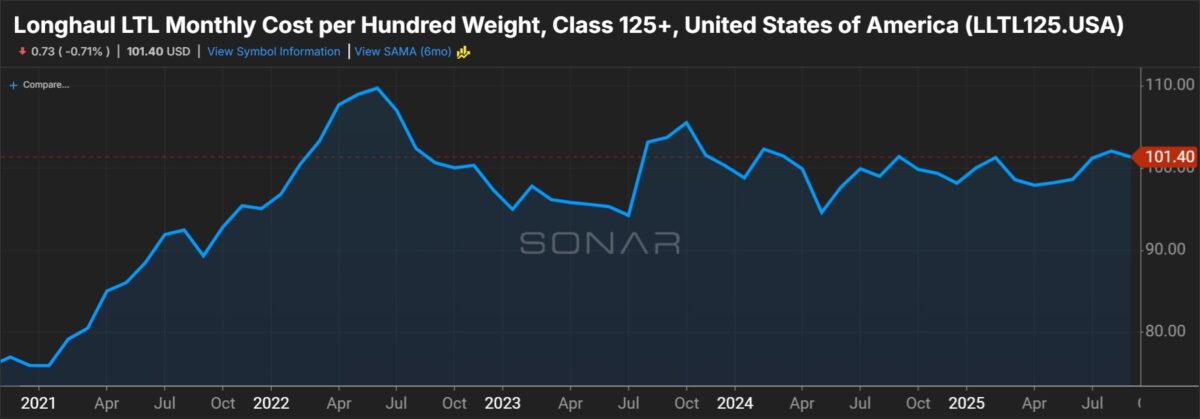
LTLs upping yields 3 years into downturn
The rate increases come amid a prolonged downturn, reflecting the industry’s largely consolidated makeup and high barriers to entry.
Weak demand across the industrial sector, which accounts for as much as two-thirds of revenue for some carriers, has lingered for three years. Manufacturing activity slumped again in September, with the Purchasing Managers’ Index (PMI) registering a 49.1 reading (50 is neutral). The dataset has been in negative territory for 33 of the past 35 months.
Concern exists among some analysts that the industry’s favorable pricing dynamics are being challenged by the introduction of new capacity following the redistribution of defunct Yellow Corp.’s 325-terminal portfolio. Persistently low truckload rates are also an overhang on the industry.
Less-than-truckload bulls, however, counter that Yellow’s terminals have simply changed hands and that there has not been any net increase in door capacity. Further, several of Yellow’s service centers have been repurposed outside of the industry and just a few remain for purchase as the liquidation nears conclusion.
A quarterly report released last week from 3PL AFS Logistics and financial services firm TD Cowen said LTL carriers “continue to flex pricing power.”
During the third quarter, the LTL rate-per-pound index stood 65.1% above its January 2018 baseline – an all-time high. The index is expected to dip just 30 bps in the fourth quarter to 64.8%, which would mark eight straight quarters of year-over-year growth. However, rate growth is cooling, as the dataset has held a roughly 60% premium to the baseline for the past three years.
Service metrics have a strong influence on carrier pricing. Old Dominion was recently named the top national LTL carrier for a 16th consecutive year by Mastio & Co. Old Dominion ranked No. 1 in 23 of the 28 national service categories evaluated.
Shares of LTL carriers were up between 2% and 4% at 1:02 p.m. EDT on Wednesday. ODFL was 2.7% higher at the time compared to the S&P 500, which was up 1.1%.
Brokerage Compliance Symposium
The day before F3. Every compliance issue you face - fraud exposure, carrier liability, FMCSA rules, cargo theft, insurance gaps - navigated by attorneys and operators defining best practices in a changing industry.
F3 Awards Dinner
The night before F3. FreightTech100 companies honored. FreightTech 25 and Shipper of Choice winners revealed live. Cocktail reception into dinner and live music - 300 industry leaders in one purpose-built room.
F3: Future of Freight Festival
Industry-defining keynotes, rapid-fire technology demos, and industry leaders networking in experiences across Chattanooga - plus the inaugural F3 Awards Dinner featuring the FreightTech and Shipper of Choice reveals.
The day before F3. Every compliance issue you face - fraud exposure, carrier liability, FMCSA rules, cargo theft, insurance gaps - navigated by attorneys and operators defining best practices in a changing industry.
The Signal at Chattanooga Choo Choo • Chattanooga, TN Register NowThe night before F3. FreightTech100 companies honored. FreightTech 25 and Shipper of Choice winners revealed live. Cocktail reception into dinner and live music - 300 industry leaders in one purpose-built room.
The Signal at Chattanooga Choo Choo • Chattanooga, TN Register NowIndustry-defining keynotes, rapid-fire technology demos, and industry leaders networking in experiences across Chattanooga - plus the inaugural F3 Awards Dinner featuring the FreightTech and Shipper of Choice reveals.
The Signal at Chattanooga Choo Choo • Chattanooga, TN Register Now