




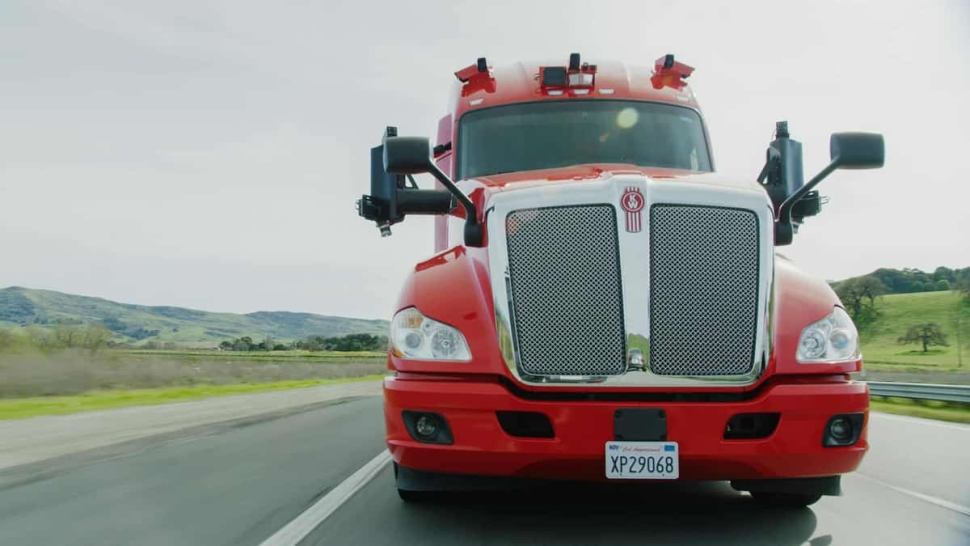
Self-driving truck company Kodiak Robotics has released a 49-page safety self-assessment report that aims both to demonstrate the startup’s commitment to public safety and provide a detailed portrait of how the company programs and operates its autonomous vehicles.
“We believe it’s critical that we begin the process of explaining to the general public not just how we are safely testing our vehicles, but how we’re going to prove, mathematically and in plain English, that our vehicles are comprehensively safe even without a person behind the wheel,” Kodiak co-founders Paz Eshel and Don Burnette said in a letter introducing the report.
A growing number of autonomous vehicle companies are testing their vehicles on public roads, and the federal government has asked established manufacturers and startups to voluntarily outline how they are developing and applying the technologies.
To date, 20 self-driving companies have submitted the safety reports, according to the National Highway Traffic Safety Administration (NHTSA). In addition to Ford, GM and other automakers, autonomous trucking outfits TuSimple and Ike have filed documents describing their systems and approaches.
Defensive driving
Founded in 2018, Kodiak is one of a handful of trucking startups seeking to automate long-haul trucking. In addition to developing the technology, the company also operates as a carrier and is currently hauling commercial cargo between Dallas and Houston.
In its safety assessment, released on June 11 along with a series of blog posts, the team explains why it focuses on “structured highway driving” — not city driving — and how its systems, designed specifically for heavy-duty trucks, ensure a safe driving environment for everyone.
“We optimize our driving for safety, not comfort: paper towels don’t care if they get jostled a bit, whereas a rideshare passenger expects a smooth ride,” the company stated.
Among the topics covered in the report is a discussion of how many of the technologies Kodiak has developed mimic the ways in which humans drive.
A case in point: Self-driving vehicles usually depend on highly detailed maps created over the course of dozens of mapping runs. But embedded in the “Kodiak Driver” is the ability to respond to visual cues such as lane markings — even when its map doesn’t reflect what it’s seeing on the road. Such a system allows the vehicle to respond to unexpected events in the road, such as construction projects.
The company calls this approach “perception over priors — i.e., that the Kodiak Driver trusts its eyes, not its memory, and we believe it represents a significant step forward for the AV industry.”
Easing minds
Emphasizing safety has become a top priority for autonomous vehicle companies as surveys continue to show many consumers continue to be skeptical of self-driving vehicles.
The latest critique of autonomous driving came in the form of a study released last week by the Insurance Institute for Highway Safety (IIHS) showing that autonomous vehicles might prevent only around a third of all crashes, undercutting some industry claims that autonomy will yield more dramatic safety benefits.
Asked about that study, Burnette, Kodiak’s CEO, told FreightWaves in an email that he had not evaluated it in detail. But he reaffirmed Kodiak’s commitment to safety, saying the company will not deploy its technology until it can “comprehensively demonstrate” that the Kodiak Driver is safer than an average human truck driver.
“We will continue to improve the safety of our trucks for decades to come,” Burnette added.
Among other topics covered by Kodiak’s report are cybersecurity, regulatory compliance and systems engineering.
Brokerage Compliance Symposium
The day before F3. Every compliance issue you face - fraud exposure, carrier liability, FMCSA rules, cargo theft, insurance gaps - navigated by attorneys and operators defining best practices in a changing industry.
F3 Awards Dinner
The night before F3. FreightTech100 companies honored. FreightTech 25 and Shipper of Choice winners revealed live. Cocktail reception into dinner and live music - 300 industry leaders in one purpose-built room.
F3: Future of Freight Festival
Industry-defining keynotes, rapid-fire technology demos, and industry leaders networking in experiences across Chattanooga - plus the inaugural F3 Awards Dinner featuring the FreightTech and Shipper of Choice reveals.
The day before F3. Every compliance issue you face - fraud exposure, carrier liability, FMCSA rules, cargo theft, insurance gaps - navigated by attorneys and operators defining best practices in a changing industry.
The Signal at Chattanooga Choo Choo • Chattanooga, TN Register NowThe night before F3. FreightTech100 companies honored. FreightTech 25 and Shipper of Choice winners revealed live. Cocktail reception into dinner and live music - 300 industry leaders in one purpose-built room.
The Signal at Chattanooga Choo Choo • Chattanooga, TN Register NowIndustry-defining keynotes, rapid-fire technology demos, and industry leaders networking in experiences across Chattanooga - plus the inaugural F3 Awards Dinner featuring the FreightTech and Shipper of Choice reveals.
The Signal at Chattanooga Choo Choo • Chattanooga, TN Register Now