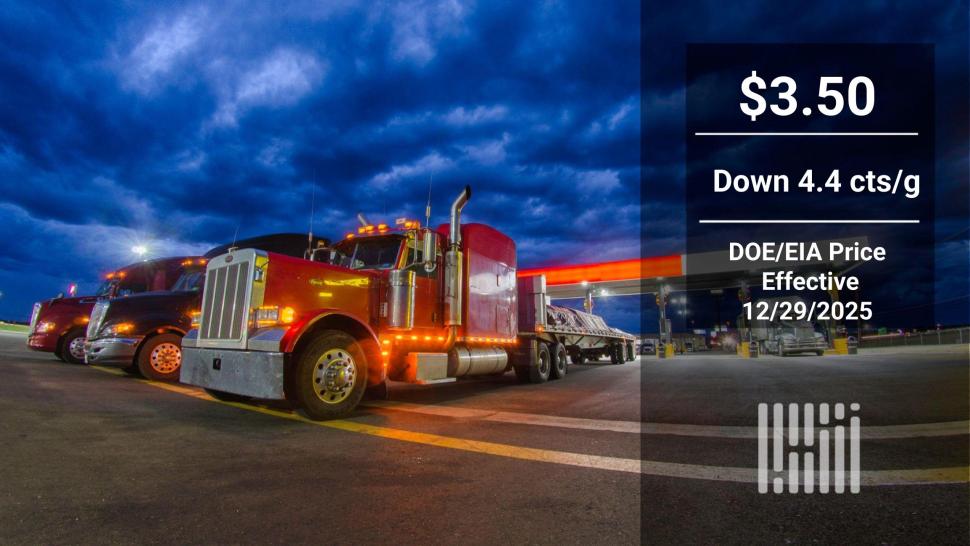
Diesel consumers continued to enjoy a decline in the fuel’s pump price during Christmas, as the benchmark used for most fuel surcharges declined for the sixth consecutive week.
The Department of Energy/Energy Information Administration average weekly retail diesel price declined 4.4 cents/gallon to an even $3.50/gallon. With the latest drop, the price is down 36.8 cts/g over those six weeks.
The recent lengthy slide in the price also has led to a mathematical oddity at the end of the year. The price of $3.50/g at the end of the year is only .03 cts/g less than where the benchmark price closed 2024. All those ups and downs led to the price finishing the year pretty much where it started.
As for the latest streak of declines, it’s the longest since a 10-week stretch of lower prices during summer 2024. But that 10-week run only resulted in a drop in the price of 27.6 cts/g, less than what the market did in the six weeks to close out 2025.
The sharp decline in ultra low sulfur diesel (ULSD) prices on the CME commodity exchange has slowed after weeks of declines that continue to show up at the pump.
Since the market settled at $2.1286/g on December 16, the ULSD settlement climbed to as much as $2.1906/g on December 12 before dropping back to a Friday settlement of $2.107/g. Prices popped higher on Monday to settle at $2.1275/g.
The ULSD price Tuesday was up about 1.5% at noon EST.
But diesel continues to show other signs of weakness that may suggest the declines have not run out of steam.
The spread between ULSD and global crude benchmark Brent closed Monday at about 65.2 cts/g. It’s the lowest for that indicator since a spread of about 64.5 cts/g in late August.
The other indicator pointing to weakness is the fact that ULSD settled Monday in a contango for the first time since late August. Those two days in August were the only other time ULSD settled the day in contango in 2025.
Contango is a market structure where the first month price in a commodity contract is lower than the second month. It is the structure a commodity market would be in if supply and demand were in perfect balance, with the higher prices into the future reflecting the cost of storage and the time value of money.
It also is a reflection of healthy inventories. When inventories are tight, the market will generally enter a structure known as backwardation, where the price declines as it goes out into the future.
The EIA’s latest inventory report on U.S. stocks of non-jet fuel distillate, which are about 90% diesel, show them to be at the highest level for this time of year in the last three years. While previous years, during the pandemic and before it, came in far higher than the most recent figure of 118.7 million barrels, that latest number is the highest since 2022 and is up 7.8 million barrels since early November.
The move into a ULSD contango is likely reflecting that gradual build.
More articles by John Kingston
Amazon backs Flowers Foods at SCOTUS on delivery driver legal status
Love’s factoring business gets bigger, buying trio of companies
New York City bill that targeted Amazon won’t get taken up in 2025
Brokerage Compliance Symposium
The day before F3. Every compliance issue you face - fraud exposure, carrier liability, FMCSA rules, cargo theft, insurance gaps - navigated by attorneys and operators defining best practices in a changing industry.
F3 Awards Dinner
The night before F3. FreightTech100 companies honored. FreightTech 25 and Shipper of Choice winners revealed live. Cocktail reception into dinner and live music - 300 industry leaders in one purpose-built room.
F3: Future of Freight Festival
Industry-defining keynotes, rapid-fire technology demos, and industry leaders networking in experiences across Chattanooga - plus the inaugural F3 Awards Dinner featuring the FreightTech and Shipper of Choice reveals.
The day before F3. Every compliance issue you face - fraud exposure, carrier liability, FMCSA rules, cargo theft, insurance gaps - navigated by attorneys and operators defining best practices in a changing industry.
The Signal at Chattanooga Choo Choo • Chattanooga, TN Register NowThe night before F3. FreightTech100 companies honored. FreightTech 25 and Shipper of Choice winners revealed live. Cocktail reception into dinner and live music - 300 industry leaders in one purpose-built room.
The Signal at Chattanooga Choo Choo • Chattanooga, TN Register NowIndustry-defining keynotes, rapid-fire technology demos, and industry leaders networking in experiences across Chattanooga - plus the inaugural F3 Awards Dinner featuring the FreightTech and Shipper of Choice reveals.
The Signal at Chattanooga Choo Choo • Chattanooga, TN Register Now